
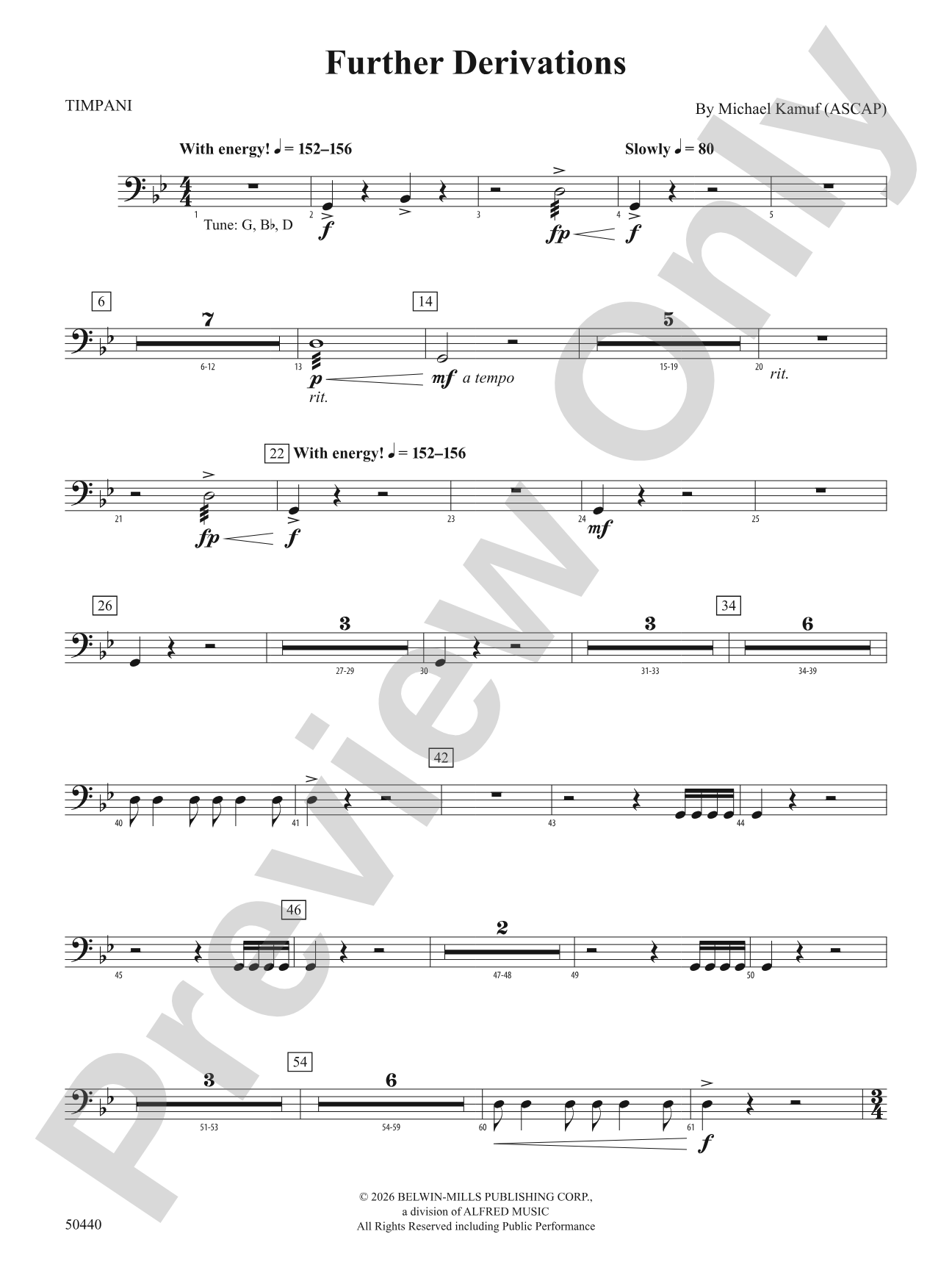

Further Derivations: Timpani
By Michael Kamuf
Grade: 2
Item: 00-PC-0019683_TMP
$3.00
Pickup currently not available
Description
Mystery and intrigue abound in Further Derivations, by Michael Kamuf. It incorporates different moods, themes, styles, and meters to create a fun and rewarding performance piece. The opening lyrical section provides an opportunity for expressive playing, while the faster passages create varying textures that your students will love playing!


Don't just read it, hear it, play along with it, and watch your students grow with it. In MakeMusic Cloud, Further Derivations: Timpani comes alive with professional accompaniment, adjustable tempo, and built-in practice tools that turn solo practice into real progress.
Open in the Player
Jump straight in and assign it today.
Start Your Free Trial
Open this title and explore the full library in minutes.
Sample Audio
1
Audio File
--:--
0:00
0:00
Sample Video
Additional Details
Series:
Belwin Young Band
Publisher:
Alfred Music
SKU:
00-PC-0019683_TMP
More about this title
About the Composer: Michael Kamuf

Michael Kamuf earned Bachelor of Music degrees in Jazz Performance and Music Education from the Dana School of Music at Youngstown State University and a Master of Arts degree in Instrumental Conducting from George Mason University. His compositions and arrangements have been performed by ensembles including the Woody Herman and Glenn Miller Orchestras, the USAF Airmen of Note, the US Navy Commodores, and soloists such as James Moody, Eddie Daniels, Sean Jones, and Bill Watrous. Kamuf serves as an exclusive writer for the Belwin Division of Alfred Music Publishing, with over 100 published works across jazz, orchestra, and concert band catalogs.
Kamuf taught instrumental music for Montgomery County Public Schools in Maryland for thirty years, including twenty-seven years as Director of Bands and Orchestras and Music Department Chairperson at John T. Baker Middle School in Damascus, Maryland. Under his leadership, the Baker ensembles earned consistent high ratings at festivals and commissioned works for young concert bands. He currently leads the Mike Kamuf Little Big Band, a jazz octet based in the Baltimore and Washington, DC area.
Why we love this
Kamuf understands exactly what a Grade 2 band needs: a piece that sounds substantial without overwhelming young players. The contrast between the opening lyrical writing and the faster passages keeps both the ensemble and the audience engaged, while the carefully layered textures give every section something meaningful to play. This is the kind of piece that feels rewarding to conduct because your students will actually want to nail it.
What to expect
Further Derivations draws you in with a reflective, singing quality before shifting into more energetic territory. The shifting moods and textures create a sense of exploration and discovery, keeping the listening experience dynamic without ever feeling fragmented or chaotic.
Who it's for
This piece works well for Grade 2 concert bands preparing for festival or contest performance, as well as for programs that want strong ensemble pieces without the complexity of advanced rhythmic or harmonic demands. It suits directors looking for repertoire that builds musicianship while remaining accessible to developing musicians.
How to get the most out of it
- Shape the opening lyrical section with clear phrase breathing; let the expressive quality emerge from disciplined long tones rather than pushing for volume.
- In the faster passages, maintain clarity of line by having students focus on articulation precision within the ensemble texture rather than individual balance.
- Pay attention to the meter and style shifts; marking these clearly in rehearsal prevents the transitions from feeling rushed or disjointed.
- Use sectional rehearsals to isolate the busier parts, then combine progressively so students understand how their lines fit within the fuller texture.
How to use it
Program this as a mid-concert or closing selection on a festival program to showcase the band's range in both expressive and articulate playing. It also pairs well alongside other Grade 2 pieces in a concert that alternates between lyrical and rhythmically driven works, demonstrating growth in student musicianship across contrasting styles.
Skills your students will build
- Sustaining long phrases with consistent tone and breath management
- Executing meter and style changes with confidence and precision
- Listening for and maintaining balance within multi-layered textures
- Coordinating articulation and attack across the ensemble in varied tempos