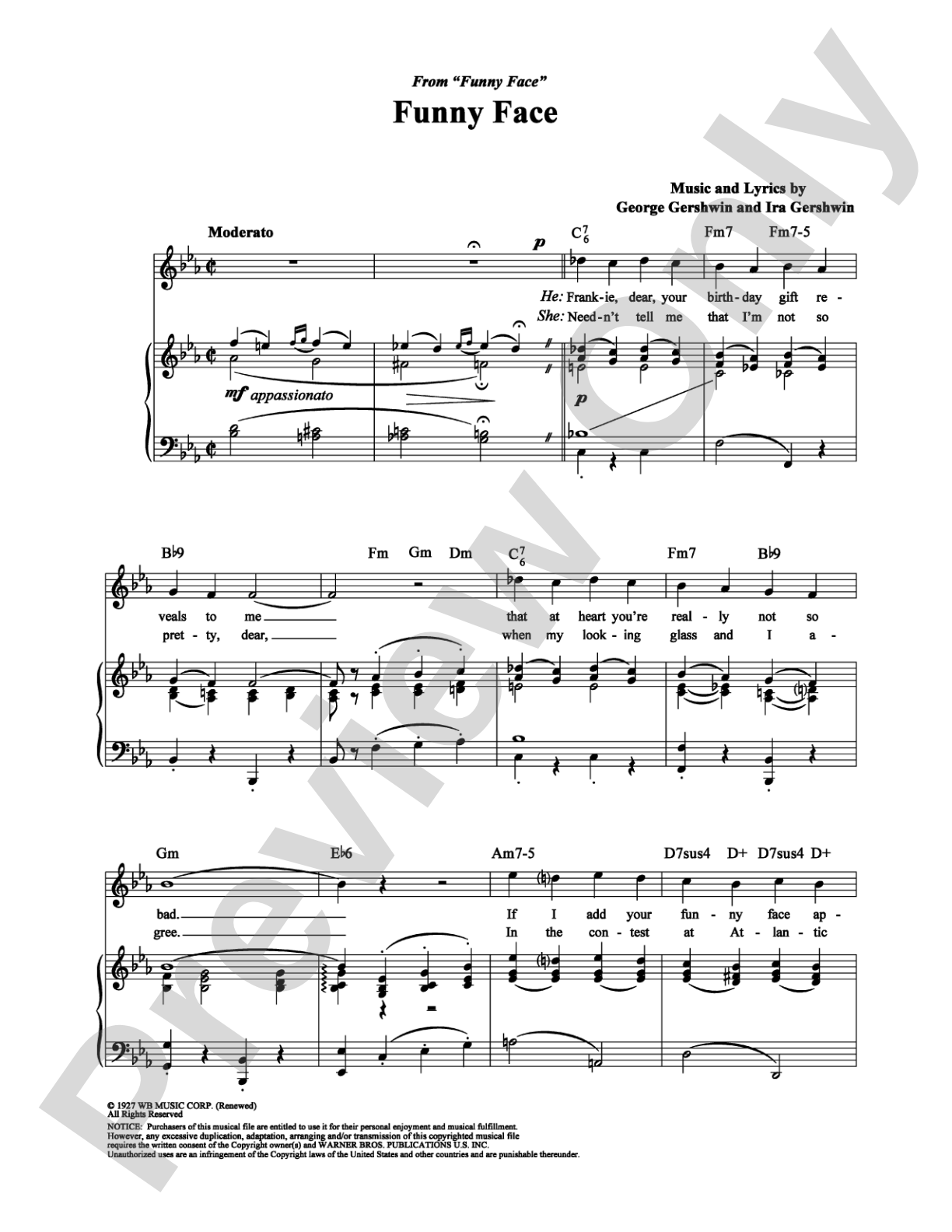
Funny Face: Piano/Vocal/Chords Digital Sheet Music

Funny Face: Piano/Vocal/Chords Digital Sheet Music

George Gershwin, Fred Astaire

Item: 00-PS-0005376

Digital Download
$3.99
Description

Funny Face: Piano/Vocal/Chords Digital Sheet Music isn't in MakeMusic Cloud just yet...but it could be. Let us know you'd like to see it, and you'll help shape what comes next. In the meantime, start a free trial and dive into thousands of interactive titles your students can play along with today.

Sample Audio
No sample audio found.
Sample Video
Additional Details
SKU: 00-PS-0005376

More about this title

About the Artist: Fred Astaire

Fred Astaire (1899-1987) revolutionized American dance and musical theater through his innovative choreography, rhythmic precision, and seamless integration of movement with song. His film and stage performances set the standard for how singers and dancers approach rhythm, phrasing, and the physical expression of melody, making his interpretations essential study for musicians seeking to understand the connection between vocal line and accompaniment.

Why we love this

Astaire's approach to a standard like this one demands rhythmic clarity and conversational phrasing from both singer and pianist. The piano/vocal/chords format lets you study how a master interpreter shapes a melody, making this a valuable reference for students learning to balance technical accuracy with interpretive freedom.

What to expect

Bright, witty, and rhythmically infectious. The number has the buoyancy of classic musical theater—clever lyrics meet an uncomplicated melody that rewards precise ensemble timing and a conversational approach to phrasing. There's elegance here without stiffness; playfulness without lack of control.

Who it's for

Vocalists preparing jazz standards or musical theater repertoire will benefit from studying Astaire's rhythmic sophistication and phrasing choices. Pianists accompanying singers will find this format valuable for understanding voicings and comping styles suited to classic American song.

How to get the most out of it

  • Treat the piano line as a conversation partner, not accompaniment. Astaire's phrasing often plays against the beat, so lock in your rhythmic foundation and allow space for the vocalist to sit slightly behind or ahead of the measure.
  • Pay attention to articulation and snap in the piano part. The clarity of Astaire's era demands crisp rhythmic definition; use light staccato and precise note release to match the character of the vocal line.
  • Shape phrases across bar lines rather than within them. Study where Astaire breathes and emphasizes, then support those moments with dynamic contouring in the accompaniment.
  • Bring flexibility to the chords. These changes are labeled for jazz interpretation, so feel free to voice them freshly while maintaining harmonic clarity for the singer.

How to use it

Include this in a jazz standards concert or a program celebrating American musical theater songwriting. It works well alongside other Gershwin material or as a contrasting lighter piece in a recital focused on vocal repertoire from the 1920s-1940s.

Skills your students will build

  • Understanding rhythmic placement and phrasing in jazz-influenced standards
  • Accompanying singers while maintaining rhythmic independence and clarity
  • Voicing chords idiomatically for the jazz/musical theater style
  • Interpreting written rhythm in relation to natural speech patterns and melodic contour

You May Also Like