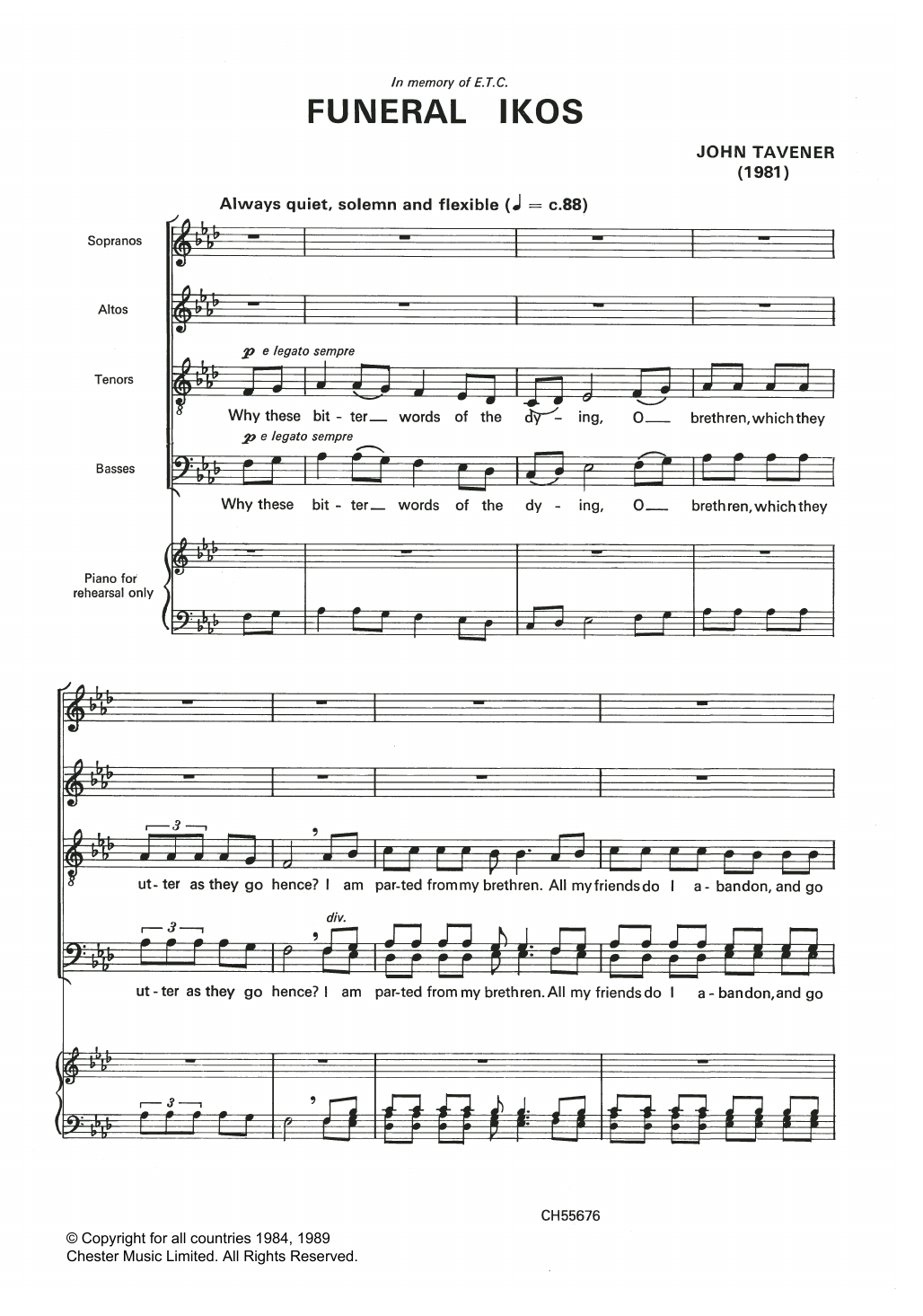
Funeral Ikos Sheet Music Preview

Funeral Ikos: SATB Choral Octavo

As performed by John Tavener

Item: 35-DS00345663

Digital Download
$2.99
Description

Funeral Ikos: SATB Choral Octavo isn't in MakeMusic Cloud just yet...but it could be. Let us know you'd like to see it, and you'll help shape what comes next. In the meantime, start a free trial and dive into thousands of interactive titles your students can play along with today.

Sample Audio
No sample audio found.
Sample Video
Additional Details
Publisher: Hal Leonard
Page Count: 14
SKU: 35-DS00345663

More about this title

About the Artist: John Tavener

John Tavener (1944-2013) was a British composer whose spiritual depth and harmonic language fundamentally shaped contemporary choral music. His Orthodox Christian faith infused his compositions with a contemplative quality that resonates across denominations, making his work invaluable for choirs seeking repertoire with genuine philosophical weight.

Why we love this

Tavener's Funeral Ikos cuts through the noise with unadorned vocal writing that demands nothing but presence from your singers. The piece's emotional architecture unfolds without sentimentality; it trusts the text and the voices to carry profound grief and acceptance, making it a standout choice for memorial services or concert programming that honors loss without wallowing.

What to expect

An ikos is a liturgical hymn of lamentation, and Tavener's setting moves with the quiet inevitability of ritual. The piece inhabits a soundworld of modal harmony and open sonorities that feels both ancient and immediate, creating space for introspection without demanding dramatic gestures.

Who it's for

Accomplished SATB choirs comfortable with sustained harmonic writing and unaccompanied singing. This works for both secular choirs drawn to spiritually resonant repertoire and church choirs seeking contemporary approaches to funeral or memorial music.

How to get the most out of it

  • Prioritize vowel unity across all four parts, especially on sustained tones where slight differences in color become audible. Record a sectional warmup and listen back critically.
  • Treat silence as compositional material. The rests between phrases are not accidents; they allow the text to breathe and give listeners space to absorb what they've heard.
  • Balance dynamic restraint with clarity. Tavener's writing often sits in moderate dynamics, but each voice line must remain audible within the ensemble texture.
  • Establish a consistent tempo that allows the harmonic movement to unfold naturally without feeling rushed or dragging. Work this out early in rehearsal rather than adjusting it week to week.

How to use it

Reserve this for concerts or services centered on contemplation, remembrance, or spiritual searching. It pairs powerfully with instrumental works of similar sensibility, or stands alone as a complete artistic statement in a shorter program.

Skills your students will build

  • Singing sustained harmonic textures without pitch drift
  • Balance and blend in a cappella four-part writing
  • Interpretation of liturgical or ritual texts with restraint
  • Attention to silence as a compositional and expressive tool
  • Intonation within modal harmonic language

You May Also Like