
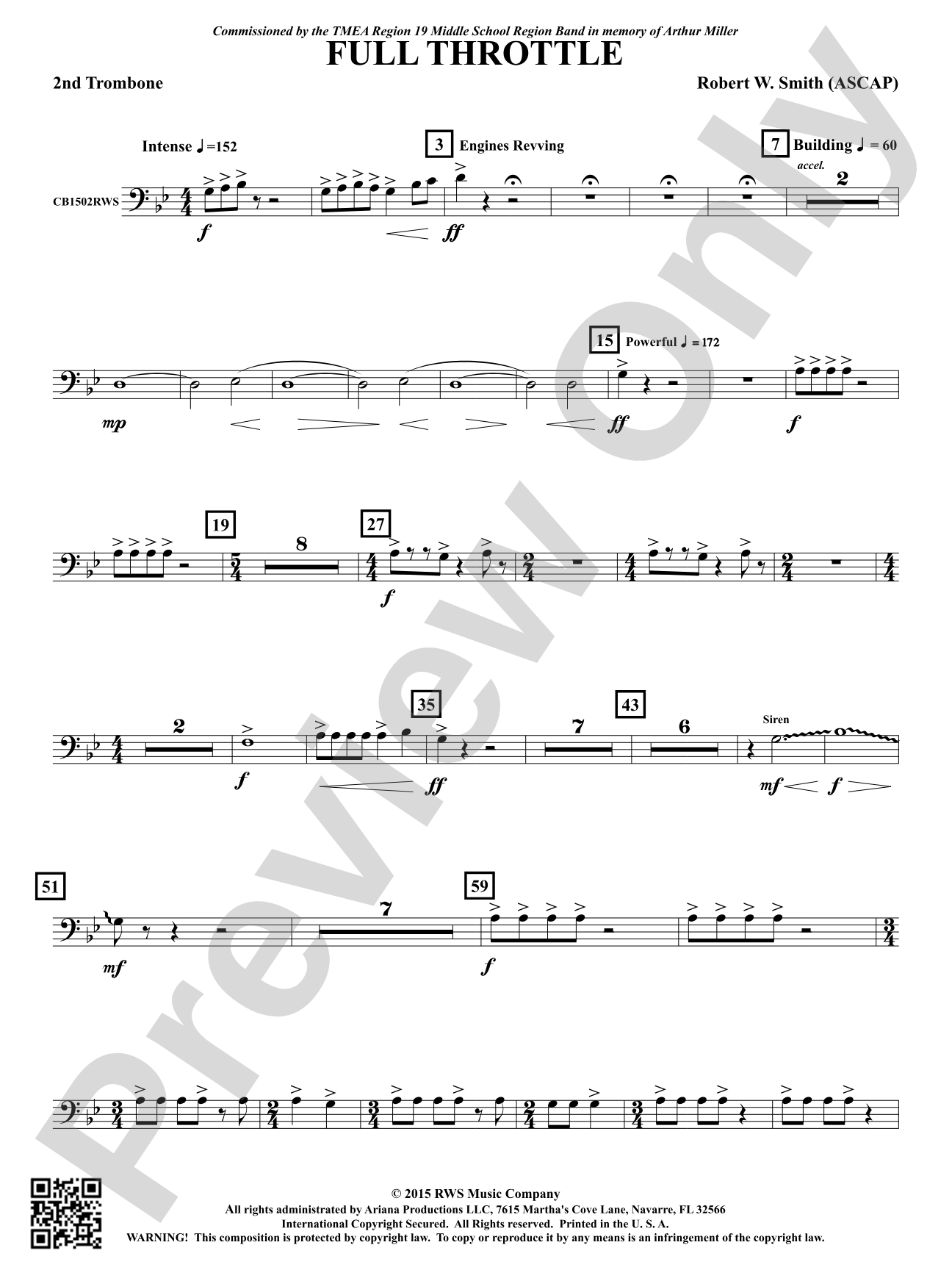

Full Throttle: 2nd Trombone
By Robert W. Smith
Grade: 3.5
Item: 98-PC-RWS1502_TN2
$3.99
Pickup currently not available
Description
With engines revving and starting lights descending, our car race begins with all of the energy your musicians can deliver. Powerful and biting harmonies combined with mixed meters and flowing melody make "Full Throttle" a musical experience that will captivate your concert band. Teaching opportunities abound in a programmatic setting that will engage concert bands of all ages.
Original Item#: RWS-1502-00


Original Item#: RWS-1502-00
Discover MakeMusic Cloud: thousands of interactive titles your students can play along with today.
Sample Audio
1
Audio File
--:--
0:00
0:00
Sample Video
No sample videos found.
Additional Details
Series:
RWS - Concert Band
Publisher:
RWS Music Company
SKU:
98-PC-RWS1502_TN2
More about this title
About the Composer: Robert W. Smith
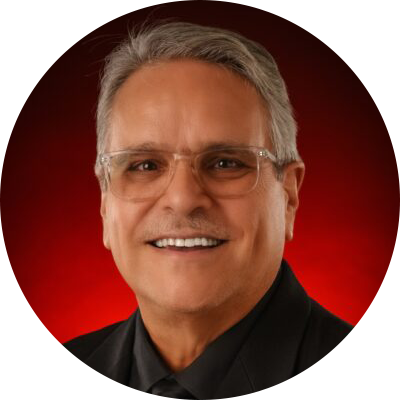
Robert W. Smith stands among America's most frequently performed composers for concert band and orchestra, with over 400 published works to his credit. He earned his Bachelor of Music Education from Troy State University and a Master of Music from the University of Miami, and has built a career defined by both compositional output and international conducting work. His symphonies, including The Divine Comedy and The Odyssey, have reached audiences across North America, Europe, Australia, and Asia, while pieces like The Tempest have become standard repertoire for developing ensembles.
Beyond the concert hall, Smith's music has soundtracked major cultural moments: presidential ceremonies in Japan, the Olympic Games, broadcasts of the Macy's Thanksgiving Day Parade, and Opening Day at Dodger Stadium. As a clinician and guest conductor, he has worked with ensembles across the United States, Canada, Japan, Australia, and Europe, bringing his direct experience with student musicians into every score he writes.
Why we love this
Smith crafts a piece that delivers visceral excitement without sacrificing musical substance. The mixed meters and flowing melodic lines demand real musicianship from your band while the programmatic car-race narrative keeps everyone engaged—a rare combination at this level. The energy is genuine and earned, not manufactured through orchestration tricks alone.
What to expect
Full Throttle plunges you into the roar of an engine and the tension of a starting line. The biting harmonies and powerful textures create a muscular sound that feels urgent and alive, while the flowing melodic lines prevent the piece from becoming purely percussive. You're not just playing notes; you're narrating a race.
Who it's for
This work sits perfectly for Grade 3.5 concert bands ready to tackle mixed meters and programmatic storytelling. It appeals to musicians of all ages who respond to vivid imagery and concrete musical situations, and directors seeking a piece that teaches genuine compositional technique within a high-energy package.
How to get the most out of it
- Clarify the meter shifts with your section leaders before rehearsal. Mark the transitions clearly in your parts so players anticipate the change rather than react to it.
- Balance the biting harmonies by checking voicing across all sections during sectionals; these colors only cut through when tuned deliberately.
- Shape the flowing melody as a connected arc, not a series of individual phrases. Even in the faster passages, singers and players should hear where the line wants to breathe.
- Use tempo and dynamics to paint the race narrative: let the energy build naturally rather than forcing excitement into every measure.
How to use it
Program this as your opening number or emotional centerpiece on a concert featuring a mix of styles. It pairs well alongside lyrical pieces that show contrast, and its programmatic clarity makes it effective on festival competitions where adjudicators appreciate both musicality and descriptive writing. The piece works equally well as a season opener that energizes your band and establishes technical expectations.
Skills your students will build
- Reading and executing mixed meters (flowing between time signatures)
- Balancing harmonic color through deliberate tuning and voicing
- Connecting melodic lines across phrasing rather than treating them as isolated gestures
- Understanding programmatic composition and how narrative informs musical choices
- Coordinating ensemble articulation and dynamics to support rhythmic drive