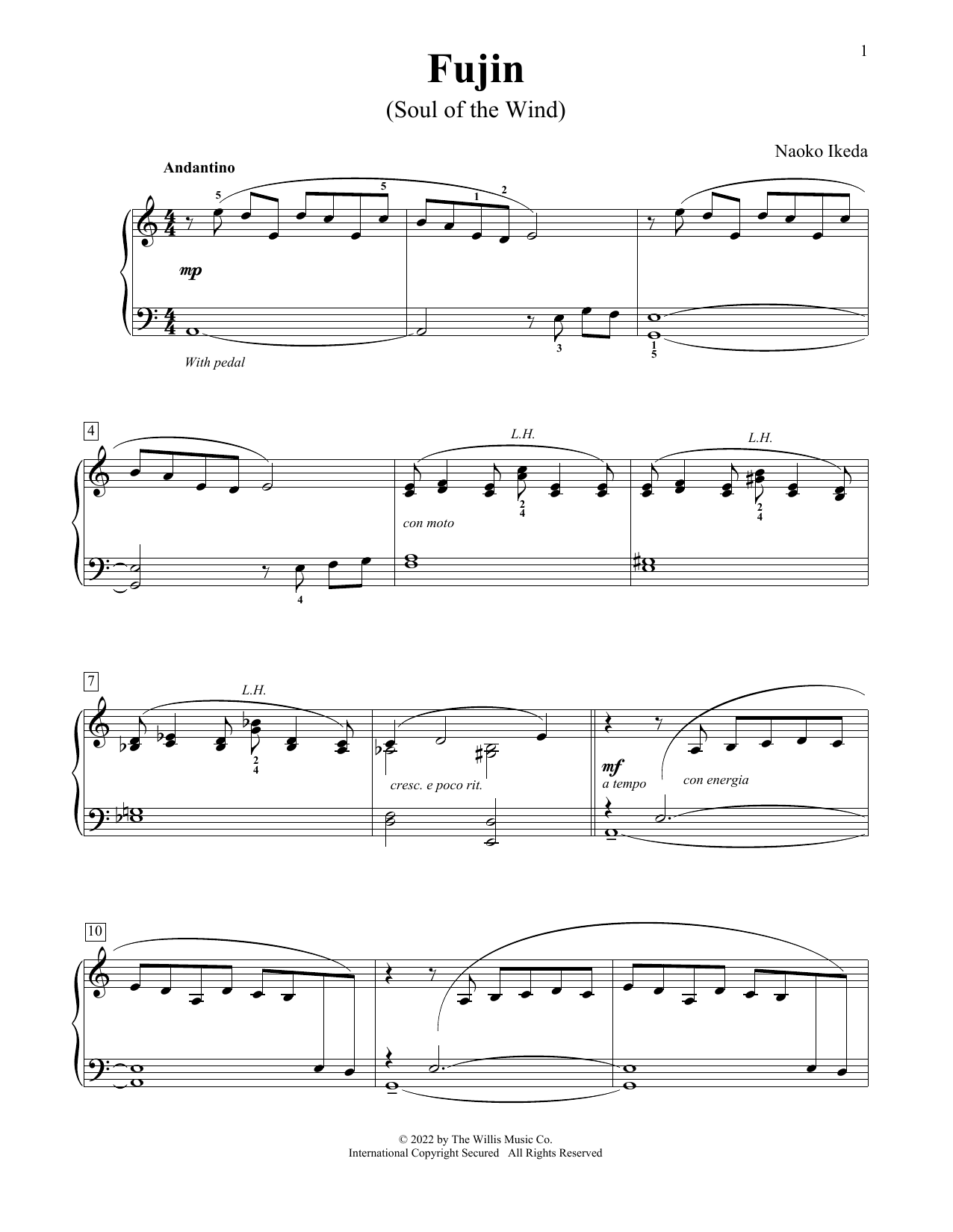
Fujin (Soul Of The Wind) Sheet Music Preview

Fujin (Soul Of The Wind): Educational Piano

By Naoko Ikeda

Item: 35-DS00694014

Digital Download
$4.99
One moment…
Description

Discover MakeMusic Cloud: thousands of interactive titles your students can play along with today.

Sample Audio
No sample audio found.
Sample Video
Additional Details
Publisher: Hal Leonard
Page Count: 3
SKU: 35-DS00694014

More about this title

About the Composer: Naoko Ikeda

Naoko Ikeda is a Japanese composer known for writing accessible yet artistically substantive works for piano students and chamber ensembles. Her compositions bridge contemporary classical language with pedagogical clarity, making her a valued voice in educational music publishing.

Ikeda's writing demonstrates a keen understanding of what makes pieces engaging for intermediate pianists: musical ideas that feel fresh and intentional, technical challenges that serve the music rather than exist for their own sake, and emotional depth that rewards serious preparation.

Why we love this

Fujin captures something genuinely poetic in just three pages. The piece doesn't waste a note, and its modern sensibility feels neither pretentious nor overly simplified. Your students will sense they're playing something with artistic substance, not just a technical exercise dressed up as music.

What to expect

Contemplative and lean. The music evokes gentle motion and invisible forces, with moments of clarity emerging from harmonic ambiguity. It feels like witnessing something fleeting, observed closely but never grasped entirely.

Who it's for

Intermediate to advanced pianists who are ready to engage with contemporary classical idioms. This piece works well for students developing their ability to communicate in a modern voice while maintaining lyrical integrity.

How to get the most out of it

  • Listen closely to the harmonic movement beneath the melody. Many passages use unconventional chord progressions that reveal themselves best when played with dynamic clarity around the implied voice leading.
  • The piece's title references wind and air; shape phrases with that imagery in mind. Resist the urge to fill every space with sound. Let silence and breath become part of the musical argument.
  • Mark your dynamics with precision and follow them consistently. In contemporary pieces like this, the written p and f markings are compositional choices, not suggestions.

How to use it

Pair this with other 21st century solo piano works to build a recital segment that feels cohesive in aesthetic without becoming predictable. It also works beautifully as a palette cleanser between Romantic and Classical era selections, offering listeners a modern perspective on lyrical expression.

Skills your students will build

  • Navigating contemporary harmonic language and non-functional chord progressions
  • Balancing minimalist texture with expressive phrasing
  • Interpreting sparse notation and implied musical architecture
  • Sustaining musical line through passages with limited melodic movement
  • Executing precise dynamics as a compositional rather than emotional tool

You May Also Like