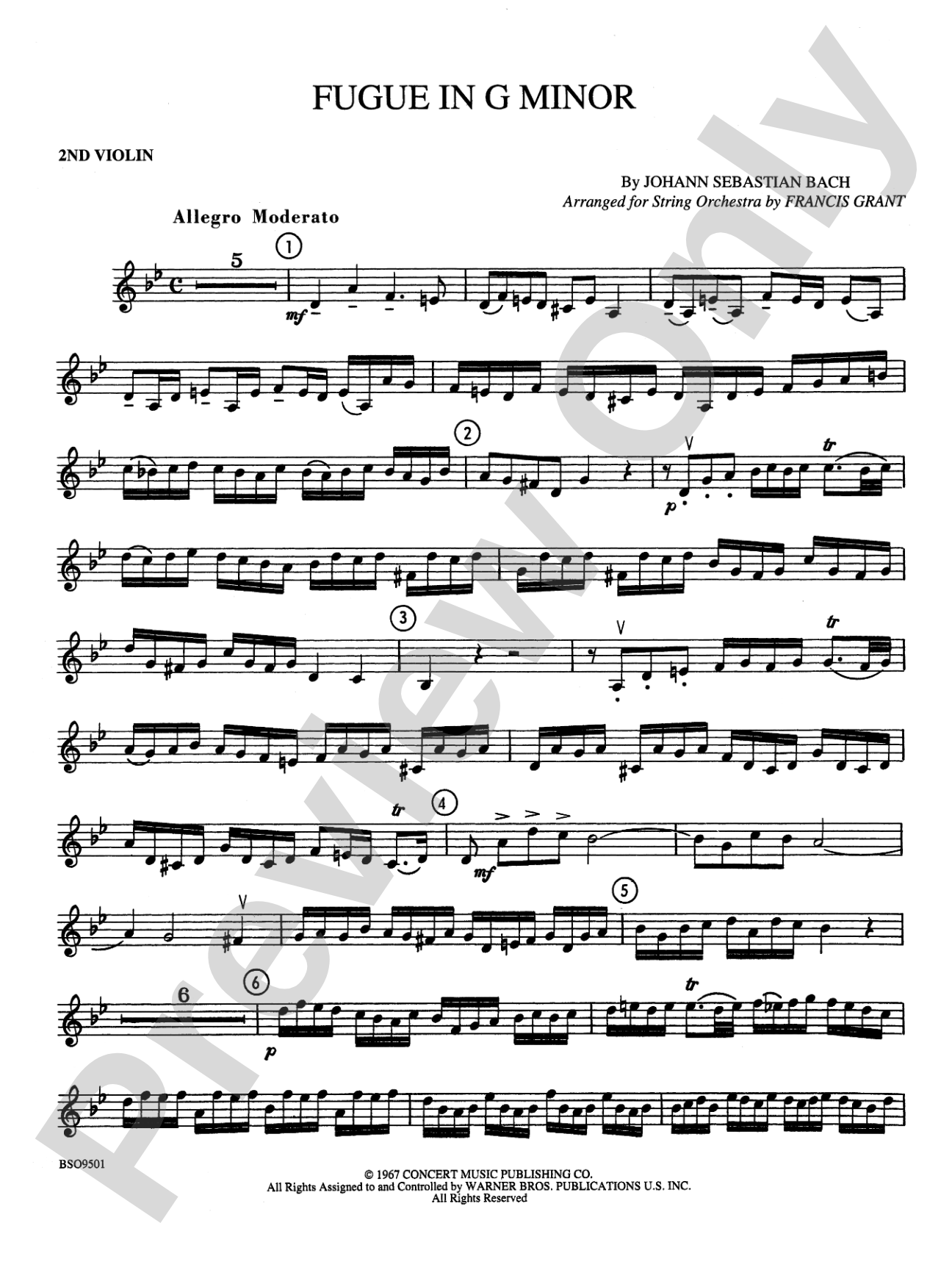
Fugue in G Minor (The "Little"): 2nd Violin Sheet Music Preview

Fugue in G Minor (The "Little"): 2nd Violin

By Johann Sebastian Bach / arr. Francis Grant

Grade: 3.5

Item: 00-PC-0002250_VN2

Digital Download
$5.99
Description
The famous 'little' fugue is transcribed superbly for string orchestra. Nothing is lost in this arrangement -- Francis Grant shows his expertise in this piece. Wonderful training, concert and contest music. (3:15)

Don't just read it, hear it, play along with it, and watch your students grow with it. In MakeMusic Cloud, Fugue in G Minor (The "Little"): 2nd Violin comes alive with professional accompaniment, adjustable tempo, and built-in practice tools that turn solo practice into real progress.

Sample Audio
No sample audio found.
Sample Video
Additional Details
Series: Belwin Concert String Orchestra
Publisher: Alfred Music
Page Count: 116
SKU: 00-PC-0002250_VN2

More about this title

About the Composer: Johann Sebastian Bach

Johann Sebastian Bach (1685, 1750) was a German composer and organist whose mastery of counterpoint and harmonic architecture shaped the foundation of Western music. His works span nearly every genre of his era, from orchestral suites and concertos to sacred cantatas and keyboard music, each demonstrating inexhaustible melodic invention and structural clarity. For music educators, Bach remains essential: his compositions teach voice leading, harmonic progression, and structural thinking at every level.

Why we love this

Francis Grant's transcription honors the original without sentimentality, giving string orchestras access to one of the Baroque's most architecturally perfect pieces. At Grade 3.5, it sits in a sweet spot where students face genuine contrapuntal challenge without drowning in it, and the familiar subject means they can focus on clarity of line rather than learning from scratch. The piece works equally well in a concert setting or festival round, so you get real versatility from one rehearsal investment.

What to expect

Intellectual rigor wrapped in elegance. The piece marches forward with mathematical inevitability, yet each voice sings with purpose; there's nothing dry about it. The familiar subject anchors listeners while the contrapuntal weaving creates momentum and a quiet sense of discovery.

Who it's for

String orchestras working at the Grade 3 to 4 level who are ready for genuine Baroque counterpoint but need something shorter and more approachable than a full orchestral suite. This works well for groups building toward festival competition or seeking concert repertoire that teaches something real.

How to get the most out of it

  • Bring out the subject immediately in your first violin section with a warm, singing tone; it needs to cut through without hardness, which will establish the entire character from measure one.
  • Resist the urge to slow down during the fugal exposition. The piece breathes naturally at a steady tempo, and younger players often tighten up when they feel the complexity.
  • Balance the inner voices (violas and second violins) carefully during entries; if the harmony disappears, the counterpoint loses its power.
  • Use the full three minutes fifteen seconds; rushing cheapens the architecture. Let the development unfold with purpose.

How to use it

Pair this with lighter contemporaneous works or earlier Baroque pieces to showcase stylistic progression, or program it as a standalone opener that sets a serious, thoughtful tone for the rest of your concert. It also serves as excellent festival material because judges immediately recognize both the source and the quality of the transcription.

Skills your students will build

  • Tracking independent melodic lines while maintaining ensemble cohesion
  • Sustaining tone quality and intonation during imitative entries
  • Reading baroque articulation and phrasing conventions
  • Understanding fugal form and motivic development
  • Balancing contrapuntal texture across multiple string sections

You May Also Like