
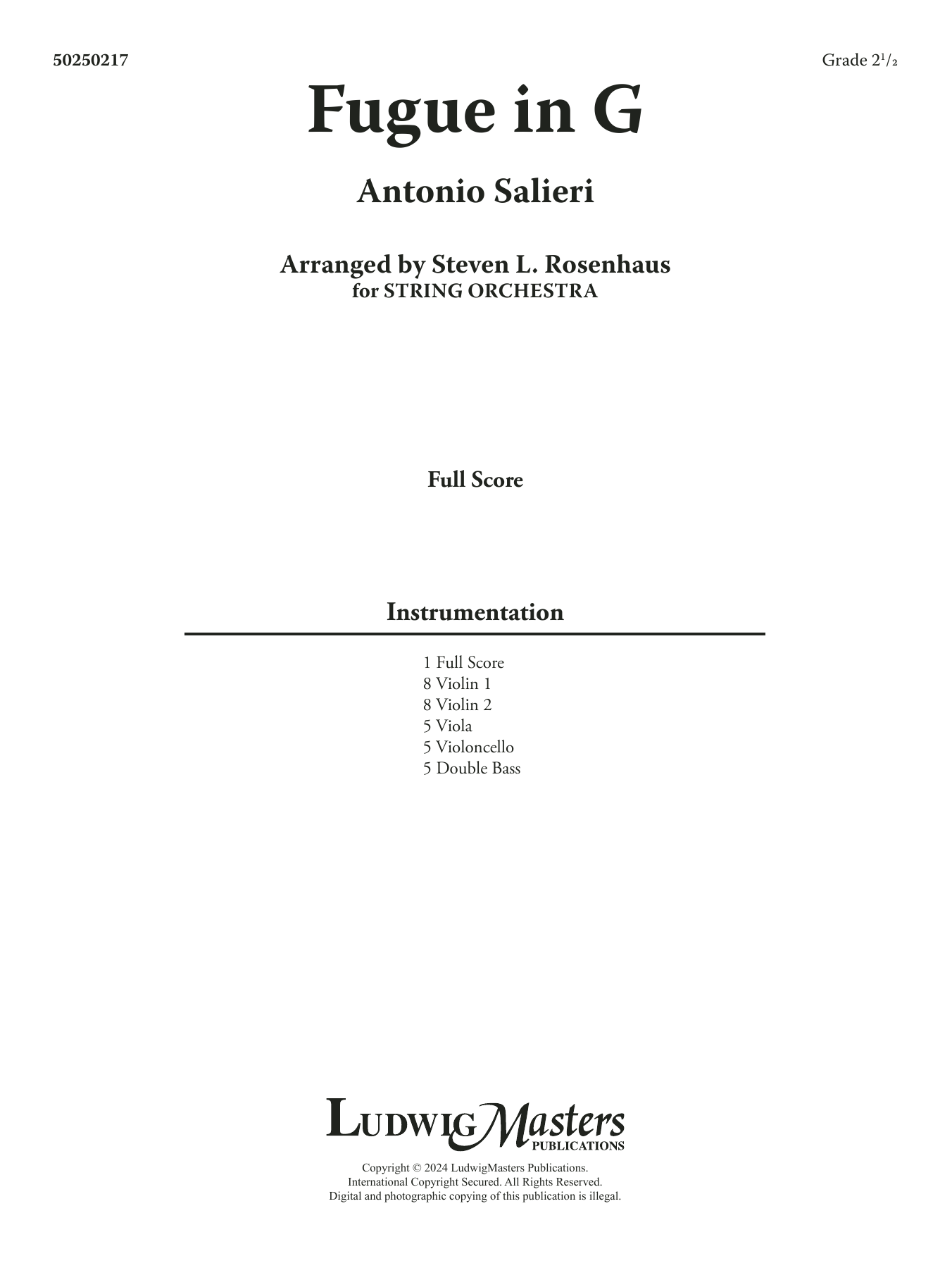

Fugue in G (arr. Steven Rosenhaus): String Orchestra Conductor Score & Parts
By Antonio Salieri / Arranged by Steven Rosenhaus
Grade: 2.5
Item: 35-PK01498738
$45.00
Pickup currently not available
Buy Extra Parts (Digital PDF Download)
Parts Added to Cart!
Description
Salieri originally composed this charming FUGUE IN G MAJOR for string quartet. Composer Steven Rosenhaus has expanded the instrumentation to string orchestra in a style consistent with Salieri's own orchestral writing.


Fugue in G (arr. Steven Rosenhaus): String Orchestra Conductor Score & Parts isn't in MakeMusic Cloud just yet...but it could be. Let us know you'd like to see it, and you'll help shape what comes next. In the meantime, start a free trial and dive into thousands of interactive titles your students can play along with today.
Request This Title
Tell us you want it.
Start Your Free Trial
Explore everything that's ready to play right now.
Sample Audio
No sample audio found.
Sample Video
No sample videos found.
Additional Details
Publisher:
Hal Leonard
SKU:
35-PK01498738
More about this title
About the Composer: Antonio Salieri
Antonio Salieri (1750-1825) was a prolific composer and conductor whose career spanned the Classical era. While often overshadowed by his contemporary Mozart, Salieri was a respected musical figure in Vienna, serving as Kapellmeister and composing across genres including opera, chamber music, and orchestral works. His compositional voice combined the clarity and elegance of the Classical style with genuine melodic invention.
Why we love this
Rosenhaus's orchestration preserves the contrapuntal integrity of Salieri's original while giving young string orchestras a formally coherent work that teaches polyphonic independence. The Grade 2.5 level lands in that sweet spot where students can handle sustained lines and figure work without excessive technical demands, making fugal writing accessible rather than abstract.
What to expect
The piece unfolds with the quiet architecture of a Classical fugue, each voice entering as if continuing a conversation already in progress. Elegant and compact, it feels like chamber music enlarged to ensemble scale, never losing its conversational intimacy even when all voices combine.
Who it's for
String orchestras at the intermediate level who are ready to explore fugal form without tackling the complexity of Bach or Handel. Directors seeking a shorter concert piece that develops ensemble independence and trains students to listen across sections will find this particularly rewarding.
How to get the most out of it
- Balance the fugal entries across your section leaders; each voice needs projection without drowning the texture. A clear pencil mark at each subject entrance helps players recognize their moment to step forward.
- Sustain the long notes with consistent vibrato throughout all sections. Salieri's writing often leans on whole notes and half notes to carry harmony, and any wavering in tone quality will expose the framework.
- Shape the final statement of the subject with intention. Allow a slight broadening if it serves clarity, particularly if the full orchestra enters with all voices stacked together.
How to use it
Pair this with a larger Baroque work or a Romantic showpiece to demonstrate the evolution of string writing across centuries. It also works well as a study piece midway through the year when students have developed ensemble cohesion but benefit from encountering formal structures in live performance.
Skills your students will build
- Following and executing fugal subject entries
- Maintaining independence while supporting harmonic progression
- Sustaining legato lines through harmonic changes
- Balancing dialogue between instrumental sections
- Recognizing and executing counterpoint in ensemble context