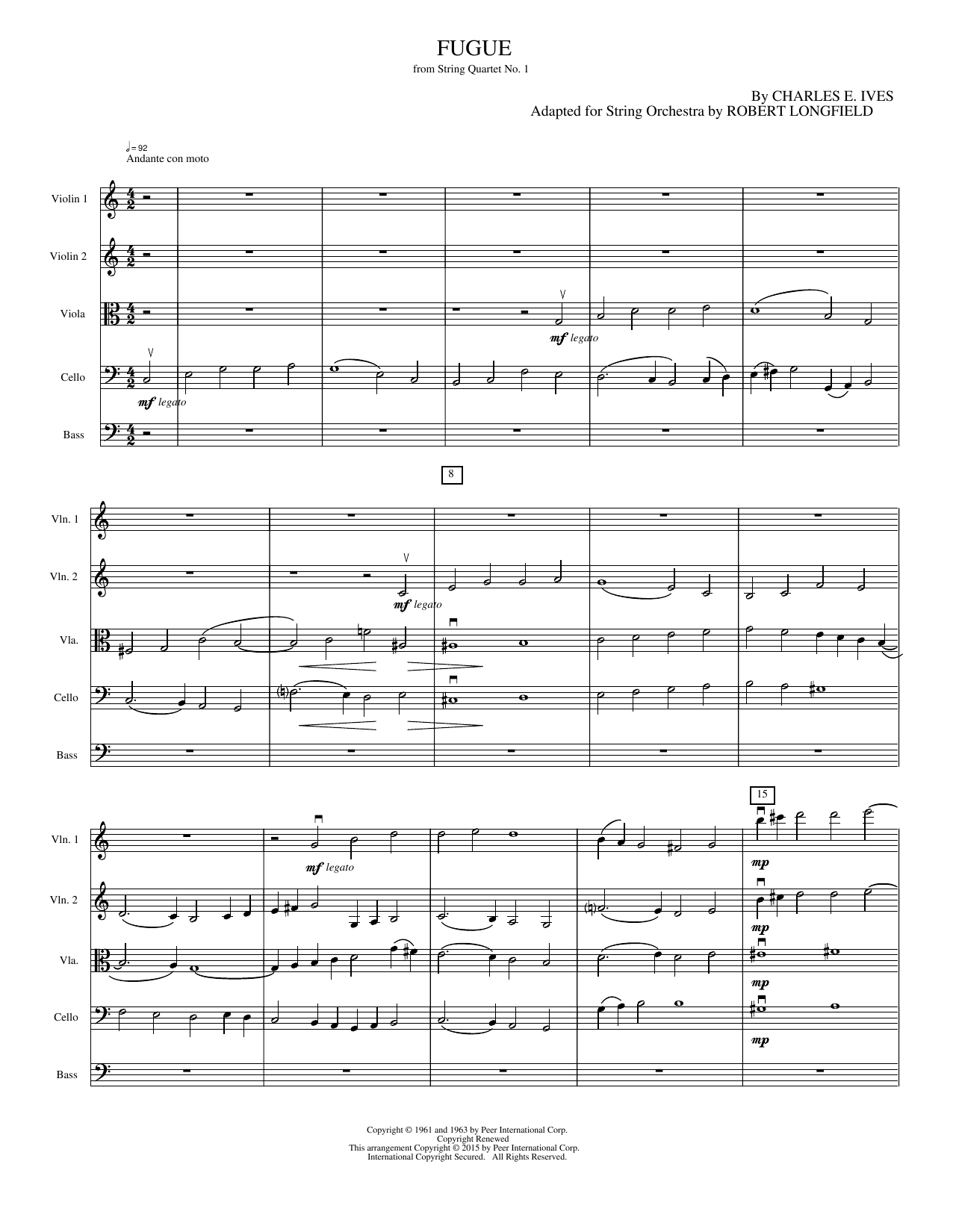
Fugue from String Quartet No. 1 Sheet Music Preview

Fugue from String Quartet No. 1: String Orchestra Conductor Score & Parts

By Charles Ives / Arranged by Robert Longfield

Grade: 3-4

Item: 35-PK00426799

Digital Download
$55.00

Buy Extra Parts (Digital PDF Download)

Parts Added to Cart!

Description
Fugue from String Quartet No. 1

Fugue from String Quartet No. 1: String Orchestra Conductor Score & Parts isn't in MakeMusic Cloud just yet...but it could be. Let us know you'd like to see it, and you'll help shape what comes next. In the meantime, start a free trial and dive into thousands of interactive titles your students can play along with today.

Sample Audio
No sample audio found.
Sample Video
Additional Details
Publisher: Hal Leonard
SKU: 35-PK00426799

More about this title

About the Composer: Charles Ives

Charles Ives (1874–1954) stands as one of American music's most visionary composers, working decades ahead of his time while maintaining a day job as an insurance executive. His willingness to layer dissonant harmonies, juxtapose unrelated musical ideas, and challenge conventional tonality made him a modernist pioneer long before European audiences caught up to his innovations.

Ives drew inspiration from the American soundscape around him: hymn tunes, marching bands, ragtime, and the sonic chaos of urban life. Rather than viewing these elements as incompatible, he wove them into dense, complex textures that demand active listening. For music educators, his work offers students a window into what happens when a composer trusts their own ear over established rules.

Why we love this

This arrangement captures the architectural rigor of a classical fugue while introducing young string players to Ives' harmonic language without overwhelming them. Robert Longfield's orchestration preserves the intellectual scaffolding of the original while making it accessible at grades 3–4, giving students a genuine encounter with early twentieth-century composition that doesn't require apology or simplification.

What to expect

Intellectually precise yet restless, this fugue unfolds with the inevitability of a proof while generating an underlying tension between its tonal anchors and chromatic pulling. It feels neither fully resolved nor unstable, instead occupying a space where traditional logic coexists with subtle disruption.

Who it's for

This arrangement serves groups that have solid fundamentals in four-part writing and are ready to expand beyond Baroque models. String orchestra students benefit from confronting a fugal structure that follows classical rules while operating within a harmonic world that asks them to hear differently.

How to get the most out of it

  • Establish the subject clearly in your opening presentation. The fugal voice needs crystalline articulation so the audience can track its reappearances across the ensemble.
  • Balance the layered entries carefully; this isn't about blending parts into homogeneity but allowing each voice to maintain its line while contributing to overall coherence.
  • Address tuning with particular attention to the harmonic clusters Ives favors. String players often expect traditional voice leading, so rehearse passages where chromatic proximity creates tension rather than resolution.
  • Let the dissonance breathe. The piece gains its character from harmonic friction, not from muddiness that results from rushed tempo or imprecise entrances.

How to use it

Program this work on a concert exploring American composers or as a centerpiece in a repertoire arc that moves from Bach through contemporary writing. It works equally well as a standalone concert piece or as part of a thematic program examining how different composers approach fugal form.

Skills your students will build

  • Following independent contrapuntal lines while maintaining ensemble cohesion
  • Reading and performing in multiple key signatures simultaneously
  • Tuning within extended harmonic vocabularies and chromatic voice leading
  • Identifying fugal subjects and tracking their development across ensemble entries
  • Interpreting twentieth-century compositional practice grounded in classical forms

You May Also Like