
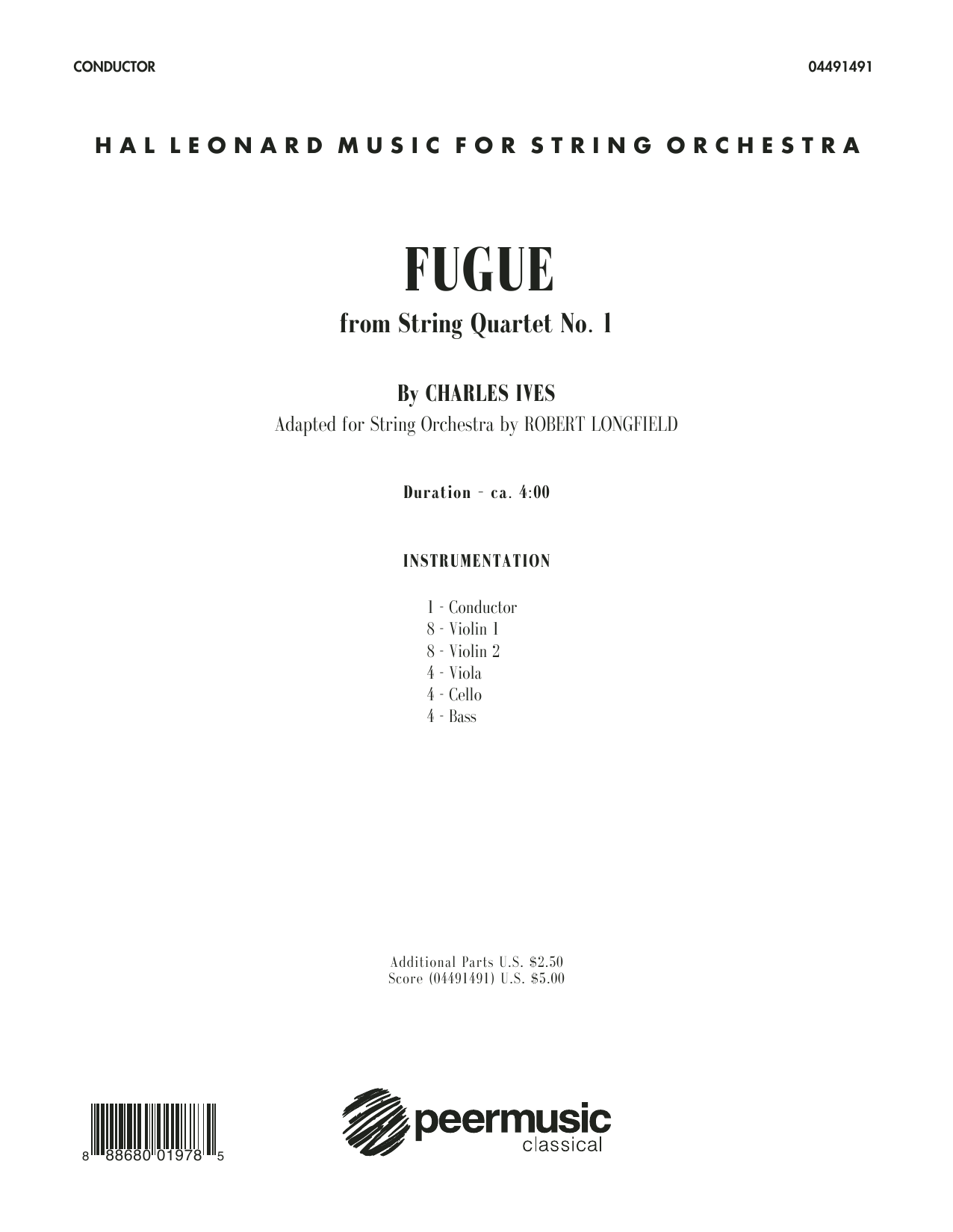

Fugue from String Quartet No. 1: String Orchestra Conductor Score & Parts
By Charles Ives / Arranged by Robert Longfield
Grade: 3-4
Item: 35-PK00409374
$55.00
Pickup currently not available
Buy Extra Parts (Digital PDF Download)
Parts Added to Cart!
Description
This arrangement has been adapted for string orchestra. Dur: 4:00


Fugue from String Quartet No. 1: String Orchestra Conductor Score & Parts isn't in MakeMusic Cloud just yet...but it could be. Let us know you'd like to see it, and you'll help shape what comes next. In the meantime, start a free trial and dive into thousands of interactive titles your students can play along with today.
Request This Title
Tell us you want it.
Start Your Free Trial
Explore everything that's ready to play right now.
Sample Audio
No sample audio found.
Sample Video
No sample videos found.
Additional Details
Publisher:
Hal Leonard
SKU:
35-PK00409374
More about this title
About the Composer: Charles Ives
Charles Ives remains one of American music's most visionary figures. A Connecticut native who worked as an insurance executive while composing in his spare time, Ives experimented with polytonality, tone clusters, and layered rhythmic structures decades before these techniques became commonplace in concert music.
His String Quartet No. 1 exemplifies his willingness to challenge conventional harmony and form. Written early in his career, it balances modernist innovation with accessibility, making it an invaluable resource for students encountering American experimental music.
Why we love this
Ives' fugue gives students a genuine encounter with 20th-century American compositional thinking without requiring the technical demands of more complex works. The Longfield arrangement opens this material to string orchestras at an achievable level, allowing ensembles to grapple with Ives' characteristic layering and rhythmic freedom while building confidence with unconventional harmonic language.
What to expect
Ives' fugue unfolds with a kind of architectural ambition even as it embraces dissonance and rhythmic independence. The music feels both intellectually engaged and oddly accessible, moving through moments of stark beauty alongside passages where traditional rules seem suspended.
Who it's for
String orchestras at the intermediate level seeking authentic repertoire that challenges harmonic thinking without overwhelming technical ability. This works particularly well for groups comfortable with vibrato control and ensemble precision but ready to expand beyond Romantic-era conventions.
How to get the most out of it
- Establish clarity in the fugal subject before full rehearsals begin. Mark its entrances across all parts so players recognize it regardless of which voice carries it.
- Balance the overlapping lines carefully during contrapuntal sections; this isn't about aggressive dynamics but about transparency. The bass line especially needs definition.
- Don't over-rehearse the unfamiliar harmonic language. Players often discover the logic through context and repetition rather than analytical discussion.
- Secure consistent ensemble intonation in the held chords. Ives' harmonies expose tuning issues quickly, so address them directly during sectional rehearsals.
How to use it
Pair this with other American string works to build a concert segment exploring how composers approached form and tradition in the early 20th century. It also serves as a bridge piece for groups making their first serious encounter with contemporary harmonic language, fitting naturally between standard classical repertoire and more experimental selections.
Skills your students will build
- Identifying and tracking fugal subjects across different instrumental lines
- Intonation in unconventional harmonic contexts
- Ensemble balance when multiple lines carry equal importance
- Recognition of polytonality and its compositional function
- Maintaining rhythmic independence within a contrapuntal texture