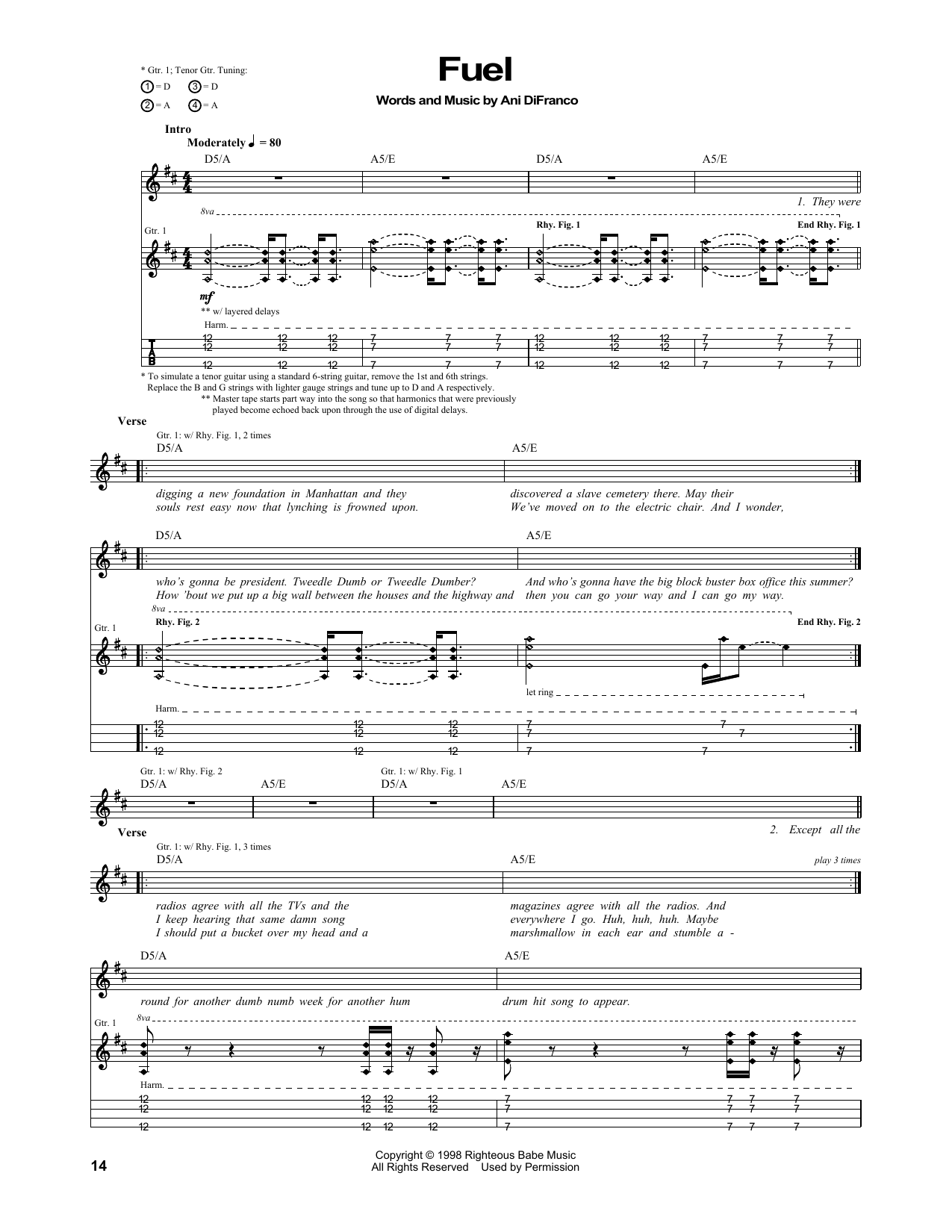
Ani DiFranco built her career on radical independence, founding her own record label in 1990 and releasing over 20 albums while maintaining complete creative control. Her guitar work combines fingerstyle technique with unconventional tunings and percussive approaches, creating a sound that feels both intimate and rhythmically complex. DiFranco's influence on singer-songwriters and folk musicians spans decades, and her commitment to artistic autonomy makes her a compelling figure in music education.
Why we love this
DiFranco's guitar parts demand close listening and reward careful study. The tab captures the fingerpicking patterns and rhythmic idiosyncrasies that define her distinctive sound, giving students a chance to reverse-engineer how she builds momentum and texture without relying on standard song structures.
What to expect
Raw and conversational, like DiFranco is thinking through the song in real time. The guitar work breathes; it expands and contracts with emotional intention rather than locking into a predictable groove.
Who it's for
Intermediate to advanced guitarists who want to understand how DiFranco constructs arrangements using fingerstyle technique and nontraditional approaches. This works well for students exploring alternative and folk songwriting, or anyone looking to expand beyond open chord voicings.
How to get the most out of it
Study the recorded version first to internalize the rhythmic phrasing; DiFranco's timing sits slightly ahead of or behind the beat in ways that won't read naturally from tab alone.
Mark the fingering clearly on your copy before you begin, especially if the tuning differs from standard; this saves frustration during practice.
Practice the percussive elements separately (taps, slaps, muting) at half speed, then gradually increase tempo as muscle memory develops.
How to use it
Feature this in a singer-songwriter or alternative music unit where students analyze how a single instrument can carry an entire arrangement. It pairs naturally with explorations of fingerstyle technique across genres and works as a model for students composing their own pieces.
Skills your students will build
Reading and executing fingerstyle patterns from tab
Navigating alternate or non-standard tunings
Interpreting rhythmic phrasing and rubato notation