
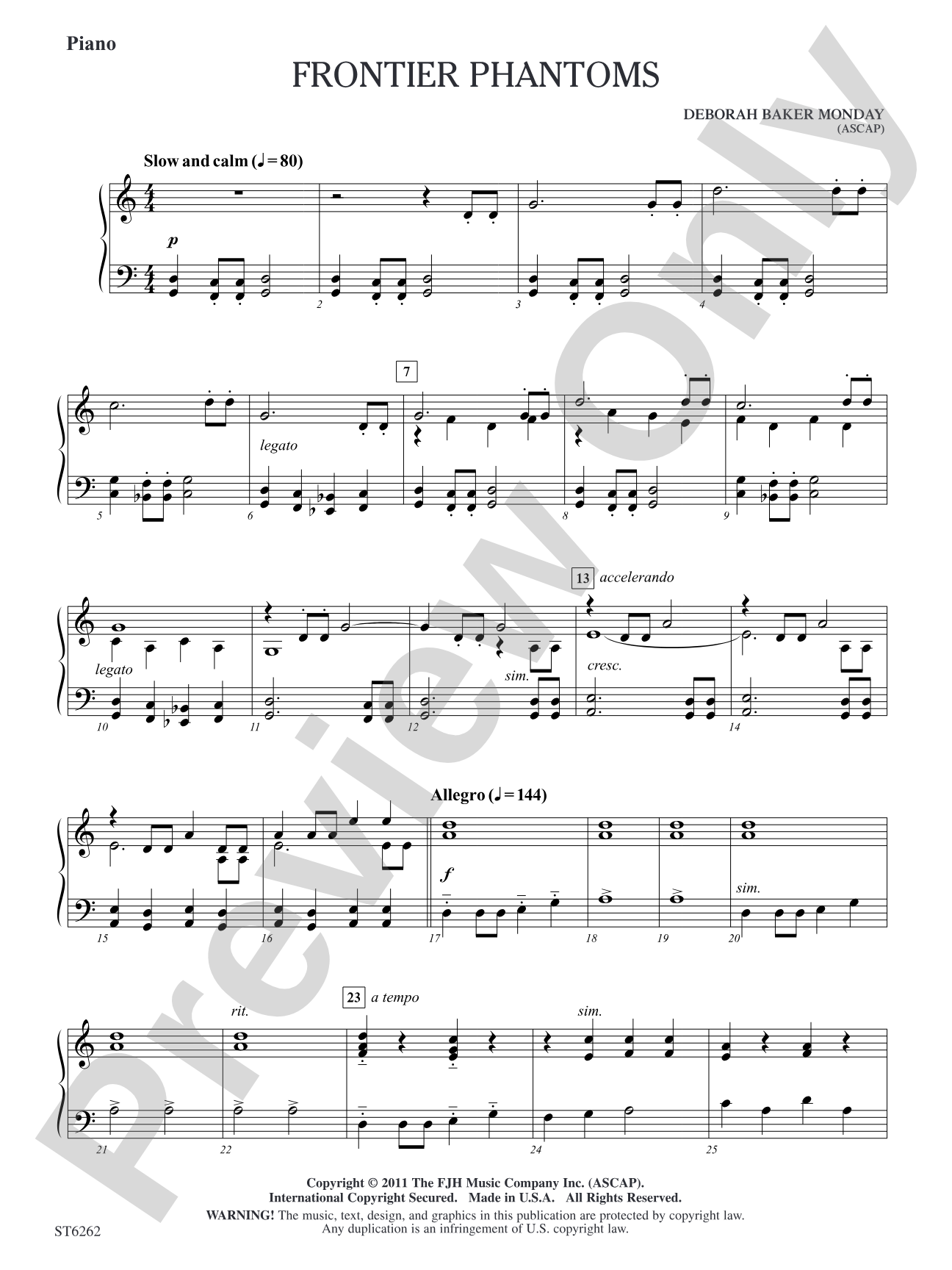

Frontier Phantoms: Rehearsal Piano
By Deborah Baker Monday
Grade: 2
Item: 98-PC-DST6262_K
$7.00
Pickup currently not available
Description
This adventure piece includes only those elements that can be accomplished by very young musicians, yet the sequence of these elements makes for a spectacular performance! Beginning with the sounds of distant drumming, the beat grows stronger before moving into a full-blown western saga. Separate themes represent the "frontiersmen" and the warriors before the two collide in battle over shifting tonalities and rising intensity. All instruments use both F and F-sharp, making this an excellent teaching piece as well. Exciting!


Frontier Phantoms: Rehearsal Piano isn't in MakeMusic Cloud just yet...but it could be. Let us know you'd like to see it, and you'll help shape what comes next. In the meantime, start a free trial and dive into thousands of interactive titles your students can play along with today.
Request This Title
Tell us you want it.
Start Your Free Trial
Explore everything that's ready to play right now.
Sample Audio
1
Audio File
--:--
0:00
0:00
Sample Video
No sample videos found.
Additional Details
Series:
FJH Developing Strings
Publisher:
The FJH Music Company, Inc.
SKU:
98-PC-DST6262_K
More about this title
About the Composer: Deborah Baker Monday

Deborah Baker Monday spent 25 years building the Logan City orchestra program into an award-winning ensemble before transitioning to guest conducting, clinician work, and educational supervision. She holds degrees from Florida State University (B.M.E., magna cum laude, in string education) and the University of Alabama (M.M. in composition), and completed doctoral coursework at Louisiana State University under James Yestadt. Her teachers in composition and theory included Harold Schiffman, John Boda, Frederic Goossen, Paul Hedwall, and Dinos Constantinides.
Monday's 130+ published works span seven publishing companies, reflecting her deep engagement with string pedagogy and arranging. She won the UtahASTA Composition Competition twice (2006, 2011) and earned recognition as Outstanding Elementary Educator and Superior Accomplishment awards from UtahASTA and UtahMEA. As an active bassist, clinician, and adjudicator, she has presented at state and national conferences, The Midwest Clinic, and the Ohio State String Teachers Workshop.
Why we love this
Monday understands exactly what young string players can accomplish and builds from there, creating something genuinely exciting rather than simplified. The programmatic narrative keeps students invested in the details of their individual lines because they're serving a story, distant drums becoming galloping rhythms, contrasting themes that actually collide. The deliberate use of both F and F-sharp transforms a technical challenge into a compositional feature rather than a stumbling block.
What to expect
Frontier Phantoms opens with atmosphere, sparse and mysterious, then accelerates into the kind of western action that makes young players sit taller in their chairs. The collision of themes creates genuine drama without asking for virtuosity, and the shifting tonalities give the piece a modern edge beneath its Americana surface.
Who it's for
Grade 2 string orchestras ready for something with real narrative drive and contemporary programming appeal. It works equally well for festival competition or a concert where you want to showcase young musicians' growing technical control alongside genuine musicianship.
How to get the most out of it
- Start with clarity on the opening percussion effects. Your youngest players need to lock in those distant drumming sounds as the foundation; once they're secure, the energy builds naturally.
- Identify which section carries the 'frontiersmen' theme and which plays the warriors. Rehearse them separately first so each group owns their character before they meet in conflict.
- Shape the intensity curve across the battle section by tracking the tonal shifts. The moving between F and F-sharp isn't just technical; it creates harmonic tension that lifts the music forward.
- Balance the western saga's full sound without losing transparency. Young orchestras often get muddy when playing louder, so insist on articulation clarity even as dynamics rise.
How to use it
This pairs naturally with other novelty and light concert pieces as a centerpiece that justifies its own spot on the program. It's equally effective early in the year as a vehicle for teaching engraved parts and conductor independence, or later as a confident display of how much your orchestra has grown.
Skills your students will build
- Reading and executing F and F-sharp in the same piece (enharmonic awareness)
- Responding to programmatic cues and dramatic shape across sections
- Maintaining rhythmic precision during intensity changes and dynamic shifts
- Ensemble balance and articulation clarity at fuller dynamics
- Individual line identity within a coordinated orchestral texture