
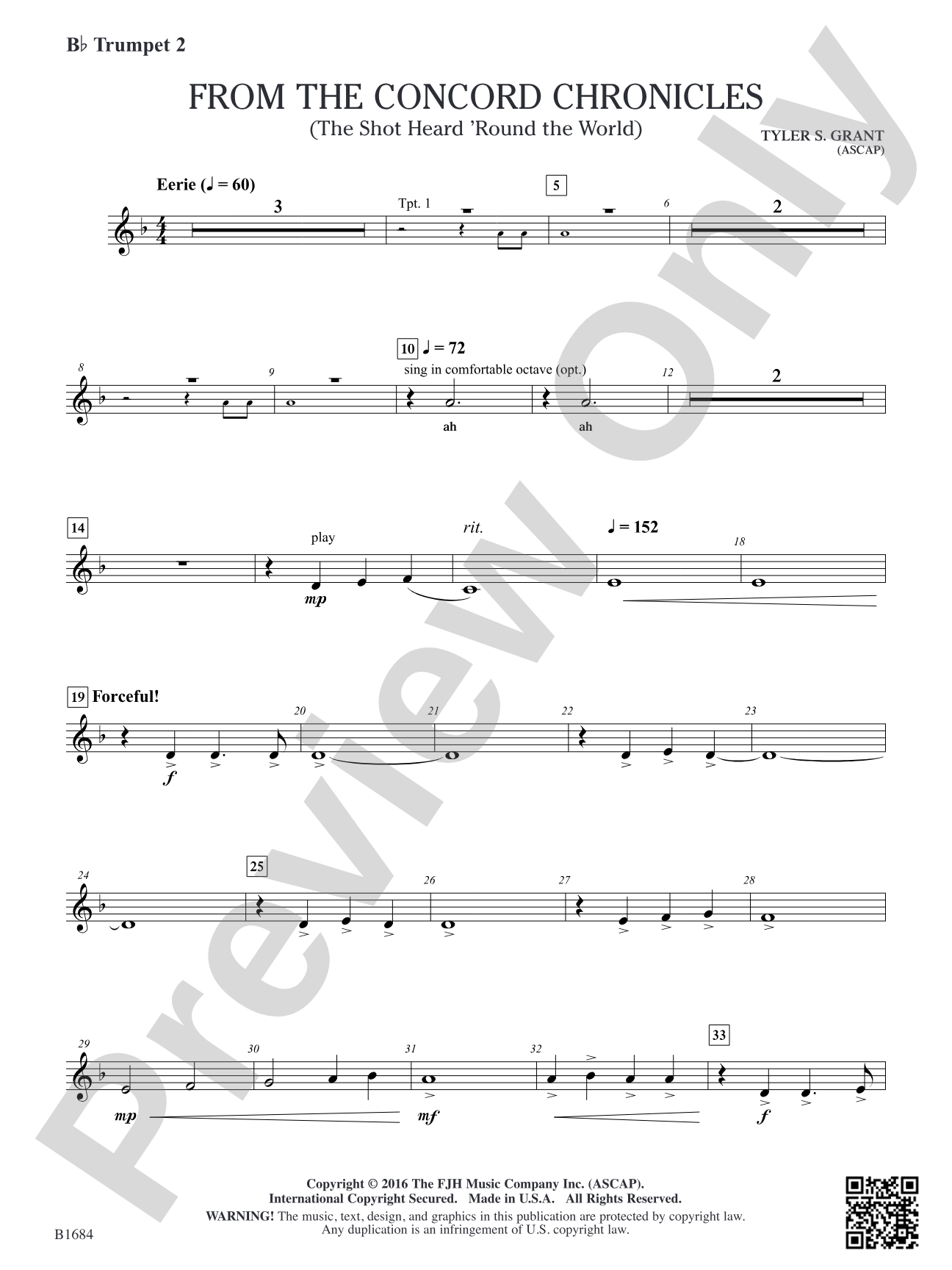

From the Concord Chronicles: B-flat Trumpet 2
By Tyler S. Grant
Grade: 1.5
Item: 98-PC-DB1684_T2
$7.00
Pickup currently not available
Description
Travel back in time to 1775 and the Battle of Lexington and Concord, the tipping point for the American Revolutionary War. This fiery engagement is depicted with a slow, ominous introduction as soldiers gather to await the arrival of British forces. As the battle ensues, the music frantically portrays the struggle between the two sides and the percussion emulates the sound of canon bursts and rifles. An aggressive & historical tribute of significant merit!


From the Concord Chronicles: B-flat Trumpet 2 isn't in MakeMusic Cloud just yet...but it could be. Let us know you'd like to see it, and you'll help shape what comes next. In the meantime, start a free trial and dive into thousands of interactive titles your students can play along with today.
Request This Title
Tell us you want it.
Start Your Free Trial
Explore everything that's ready to play right now.
Sample Audio
1
Audio File
--:--
0:00
0:00
Sample Video
No sample videos found.
Additional Details
Series:
FJH Developing Band
Publisher:
The FJH Music Company, Inc.
SKU:
98-PC-DB1684_T2
More about this title
About the Composer: Tyler S. Grant

Tyler S. Grant composes and arranges for concert bands, orchestras, and chamber ensembles across all levels. His works appear regularly on state and regional honor ensemble programs and have earned recognition on Editor's and Publisher's Choice Repertoire Lists internationally. His composition Panoramic Fanfare won the Dallas Wind Symphony's 2014 "Call for Fanfares" Competition and has since been performed by collegiate and professional ensembles throughout North America.
Since 2010, Grant has produced commissions and new publications annually for bands and orchestras. His works have been heard at major venues including The Midwest Clinic, Carnegie Hall, Music for All's National Concert Band Festival, the Meyerson Symphony Center, and the Macy's Thanksgiving Day Parade. Grant serves as a clinician with school instrumental music programs and honor groups across more than 15 states and holds a bachelor's degree in instrumental music education from the University of Alabama, where he studied conducting with Professor Randall Coleman.
Why we love this
Grant captures a pivotal historical moment with musical storytelling that works at Grade 1.5 without sacrificing dramatic impact. The structural arc from gathering tension through frantic battle to resolution gives your students a clear narrative to conduct and perform, making this both pedagogically sound and genuinely engaging for young musicians. The percussion effects (cannon bursts, rifle shots) create authentic texture that holds student interest while remaining within accessible ranges.
What to expect
From tense silence erupts into frantic motion as the music depicts soldiers gathering and then colliding in battle. Cannon fire and rifle cracks punctuate the struggle, creating a visceral soundscape that pulls the ensemble into a specific moment in time while remaining musically coherent and playable at this level.
Who it's for
Developing concert bands in their first or second year of reading more complex arrangements will find this piece accessible yet purposeful. Directors seeking repertoire that builds student engagement through vivid storytelling and historical context will appreciate how Grant makes the American Revolution tangible through instrumental color.
How to get the most out of it
- Shape the slow introduction with dynamic restraint. Let the gradual crescendo feel inevitable rather than rushed; your front ensemble should listen for the moment when the battle percussion enters to know when to release into the chaos.
- Balance the rapid passages by assigning clear sectional priorities. Woodwinds carry the primary melody while brass maintains rhythmic propulsion; mark these roles in rehearsal so students understand where their line fits in the texture.
- Treat the percussion effects as central characters, not decoration. Timpani and snare drum trades should feel conversational and precise; even at this level, clarity here elevates the whole ensemble's sense of urgency.
How to use it
Place this on a concert exploring American history or patriotic themes, where its programmatic clarity provides an excellent counterpoint to traditional fanfares or marches. It works particularly well in spring festival or contest settings where brief programmatic works with educational value strengthen your overall program flow.
Skills your students will build
- Reading and executing rapid rhythmic figures in mixed meters and syncopation
- Balancing lyrical material against driving accompaniment patterns
- Responding to conductor cueing in complex sectional entrances
- Performing sustained tones and dynamic shaping during introductory material
- Coordinating percussion effects (timpani, snare drum) with band texture changes