
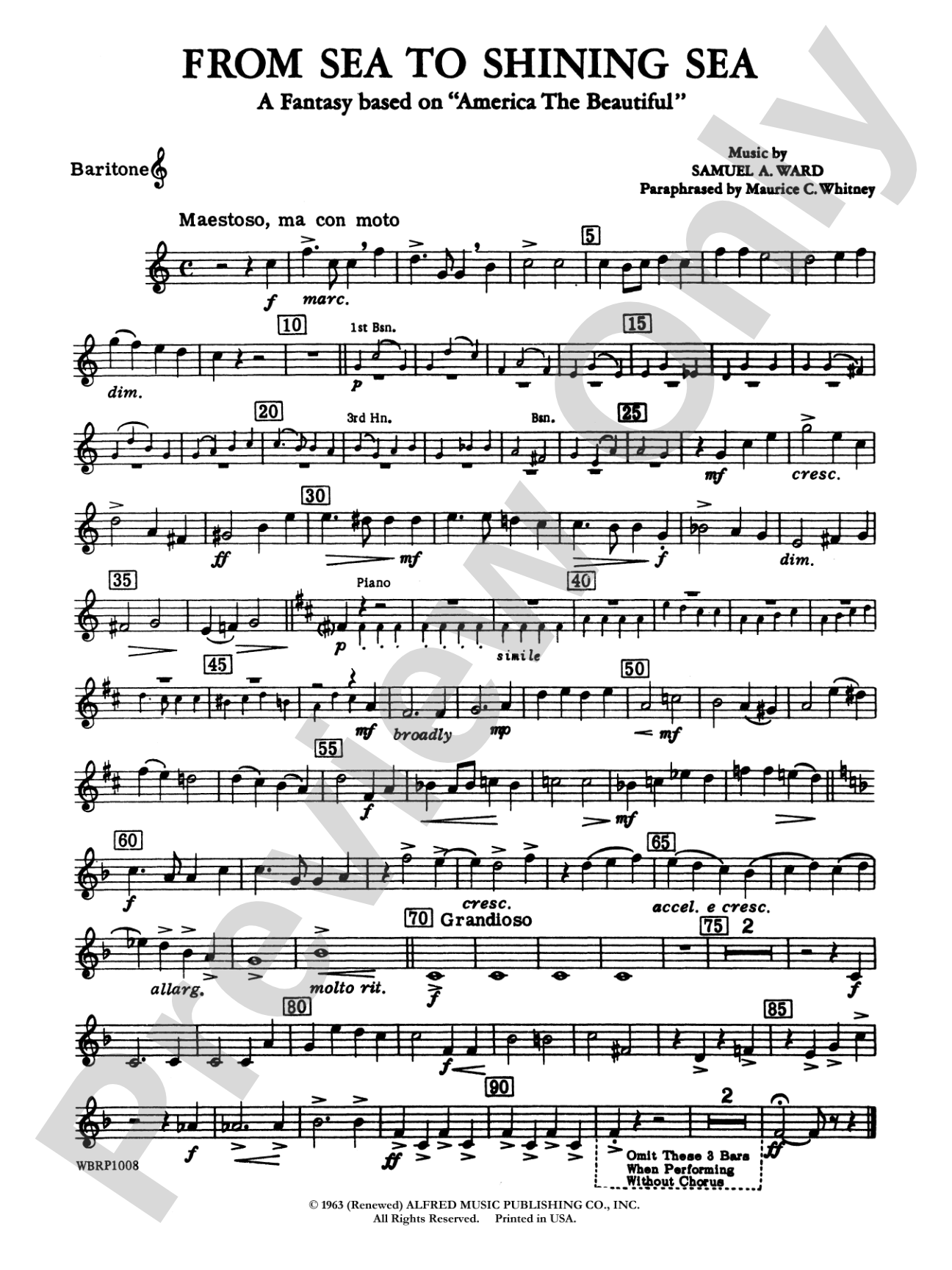

From Sea to Shining Sea (A Fantasy Based on "America the Beautiful"): Baritone T.C.
A Fantasy Based on "America the Beautiful"
Music by Samuel A. Ward, words by Katharine Lee Bates / paraphrased by Maurice C. Whitney
Grade: 3 (Medium Easy)
Item: 00-PC-0014767_BTC1
$5.99
Pickup currently not available
Description
This is an arrangement of "America the Beautiful" which may be performed with band alone, chorus alone, or band with chorus (octavos are available separately.) There are also supplementary string parts available to be played along with the band, or band and chorus. The string parts are available separately (WBRP1008S: 8-8-5-5-5).


Don't just read it, hear it, play along with it, and watch your students grow with it. In MakeMusic Cloud, From Sea to Shining Sea (A Fantasy Based on "America the Beautiful"): Baritone T.C. comes alive with professional accompaniment, adjustable tempo, and built-in practice tools that turn solo practice into real progress.
Open in the Player
Jump straight in and assign it today.
Start Your Free Trial
Open this title and explore the full library in minutes.
Sample Audio
No sample audio found.
Sample Video
No sample videos found.
Additional Details
Series:
Concert Band
Publisher:
Alfred Music
Page Count:
138
SKU:
00-PC-0014767_BTC1
More about this title
About the Composer: Samuel A. Ward
Samuel A. Ward (1848-1903) composed one of America's most enduring patriotic melodies. "America the Beautiful," which set Katharine Lee Bates's 1893 poem to music, has become a cultural touchstone performed at civic ceremonies, sporting events, and concerts across the nation. Ward's gift for memorable, singable melody served him well throughout his career as both composer and music educator.
Ward spent much of his life in Newark, New Jersey, where he was active in church music and composition. His ability to craft accessible yet dignified music made his work particularly valuable in educational and community settings. Though he composed extensively, it is "America the Beautiful" that secured his legacy and continues to connect generations of performers and audiences to American musical tradition.
Why we love this
This arrangement balances accessibility with genuine musicality. Whitney's scoring for Grade 3 band gives every section something meaningful to play while preserving the tune's clarity and emotional weight. The flexibility to perform with band alone, chorus alone, or combined forces, plus the option to add strings, makes this arrangement work across countless programming scenarios without feeling like a compromise.
What to expect
Broad, dignified, and unmistakably American. The arrangement honors Ward's original melody while allowing the band to inhabit the music with pride rather than reverence alone. It has the spaciousness of a landscape and the warmth of a shared civic moment.
Who it's for
Concert bands at the middle school through early high school level will find this arrangement well-suited to their technical abilities and musical maturity. Directors seeking repertoire for patriotic programs, summer concerts, or Independence Day celebrations will appreciate the flexible scoring that adapts to ensemble size and available forces.
How to get the most out of it
- Support the melody from the inner voices. Even when the tune sits in the upper register, balanced harmony voicing from middle woodwinds and brass keeps the arrangement grounded and prevents it from sounding thin.
- Shape the dynamics gradually rather than in sudden steps. The patriotic character reads best when crescendos and diminuendos feel inevitable and flowing, not mechanical.
- If performing with chorus or strings, establish clear visual cues for ensemble attacks during rehearsal. The conductor's preparatory gestures become critical when coordinating multiple groups.
- Give the bass line rhythmic clarity without heaviness. A light, articulate low foundation allows the melody to breathe and helps the band lock into forward motion.
How to use it
This works beautifully as a concert opener or closer for summer performances, outdoor concerts, or 4th of July programming. If your band includes a chorus, the combined performance creates a substantial centerpiece that doesn't overextend a Grade 3 ensemble's resources. Consider pairing it with smaller patriotic selections or contrasting lighter fare to give the program shape.
Skills your students will build
- Balancing melody and accompaniment across multiple sections
- Performing with dynamic control and expressive phrasing in a familiar harmonic context
- Coordinating ensemble entrances and releases with precision
- Reading and maintaining parts within a larger combined ensemble (band with optional chorus and/or strings)
- Understanding arrangement and how orchestration can enhance a familiar tune without obscuring it