
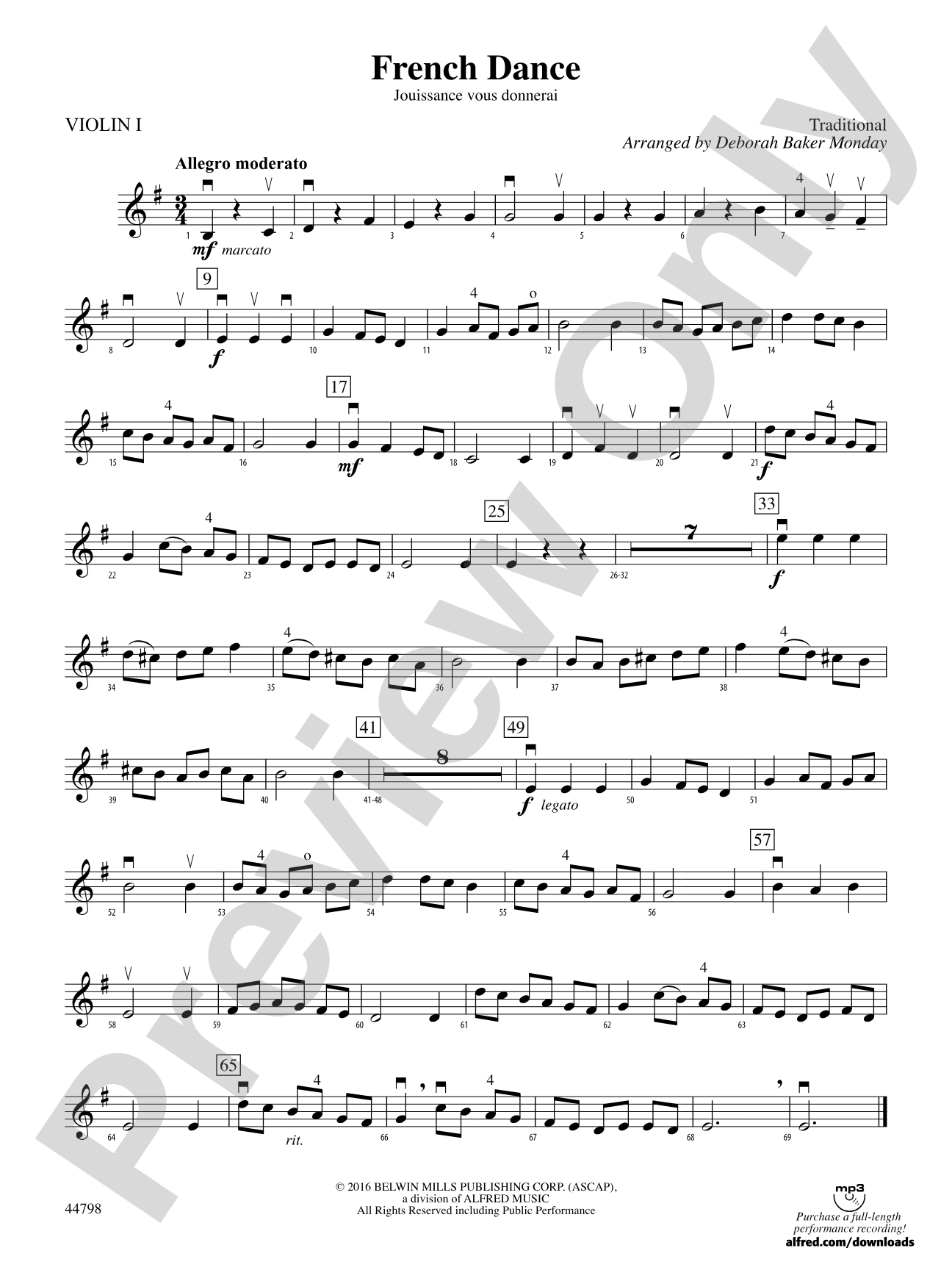

French Dance: 1st Violin
Jouissance vous donnerai
Traditional / arr. Deborah Baker Monday
Grade: 2
Item: 00-PC-0017315_VN1
$5.99
Pickup currently not available
Description
One of several popular dances from time of the French Renaissance, "jouissance" refers to a dance in which the feet stay on the floor, as opposed to one with leaps or lifts. This setting by Deborah Baker Monday has a driving pulse with attractive modal harmonies in the friendly key of E natural minor. All instruments have melodic lines. This arrangement also provides a great opportunity for teaching double up-bows and two-note slurs followed by two separate notes. The added percussion part will make this piece a great selection for festival or your next concert! (1:45)


Don't just read it, hear it, play along with it, and watch your students grow with it. In MakeMusic Cloud, French Dance: 1st Violin comes alive with professional accompaniment, adjustable tempo, and built-in practice tools that turn solo practice into real progress.
Open in the Player
Jump straight in and assign it today.
Start Your Free Trial
Open this title and explore the full library in minutes.
Sample Audio
1
Audio File
--:--
0:00
0:00
Sample Video
Additional Details
Series:
Belwin Intermediate String Orchestra
Publisher:
Alfred Music
Page Count:
80
SKU:
00-PC-0017315_VN1
More about this title
About the Arranger: Deborah Baker Monday

Deborah Baker Monday built her career on string education and composition, spending 25 years as a low string specialist and clinician in the Logan City School District. She holds a B.M.E. from Florida State University and an M.M. in composition from the University of Alabama, where she studied with respected theorists including Harold Schiffman and Dinos Constantinides. Her work has earned recognition from UtahASTA and UtahMEA, including wins in the UtahASTA Composition Competition in 2006 and 2011.
Monday has published over 130 compositions and arrangements with seven publishing companies, focusing on educational string repertoire. Beyond her work in the classroom, she has served as a guest conductor, clinician, and adjudicator at state and national conferences, including presentations at The Midwest Clinic and the Ohio State String Teachers Workshop. Her dual expertise in string pedagogy and composition informs every piece she writes for young orchestras.
Why we love this
Monday's treatment of this Renaissance dance has real personality: the modal harmonies in E natural minor create warmth without sacrificing energy, and the driving pulse keeps young players engaged. Every instrument gets a melodic moment, which means no one sits idle and your entire section feels invested in the performance. The built-in pedagogical payoff (double up-bows and two-note slurs) arrives organically as part of the musical narrative, not as a technical exercise tacked on.
What to expect
A courtly but energetic dance stripped of pretense. The E natural minor tonality gives it an earthy, grounded character; these are feet planted firmly on the floor, moving with purpose and joy rather than spectacle. The modal harmonies create an almost folk-like resonance, welcoming and accessible yet sophisticated enough to hold a concert audience.
Who it's for
Grade 2 orchestras ready for pieces that combine technical growth with genuine musical expression. This works especially well for programs building confidence in bow control and intonation within a single key center.
How to get the most out of it
- Shape the pulse with a light, consistent bow weight throughout the opening sections so the modal color reads clearly without feeling ponderous.
- Isolate the double up-bow passages in rehearsal at half tempo first, then gradually increase speed to lock the articulation across the section simultaneously.
- Balance the melodic lines across all parts during the section work phase; because everyone has a tune, ensemble awareness and blend become essential from day one.
- Engage your percussion player as a section leader for rhythmic security; a confident timpani or bass drum part stabilizes the ensemble's forward motion.
How to use it
Program this as the opening movement of a concert celebrating Renaissance music, or pair it with other Grade 2 dances to create a "Music Through Time" segment. At 1 minute 45 seconds, it fits perfectly into a festival set and provides an uplifting contrast to slower lyrical pieces on the same program.
Skills your students will build
- Double up-bows and bow control in a single key
- Two-note slurs followed by separate articulated notes
- Reading and performing modal harmonies (E natural minor)
- Melodic independence when every instrument carries a line
- Ensemble rhythmic precision with percussion integration