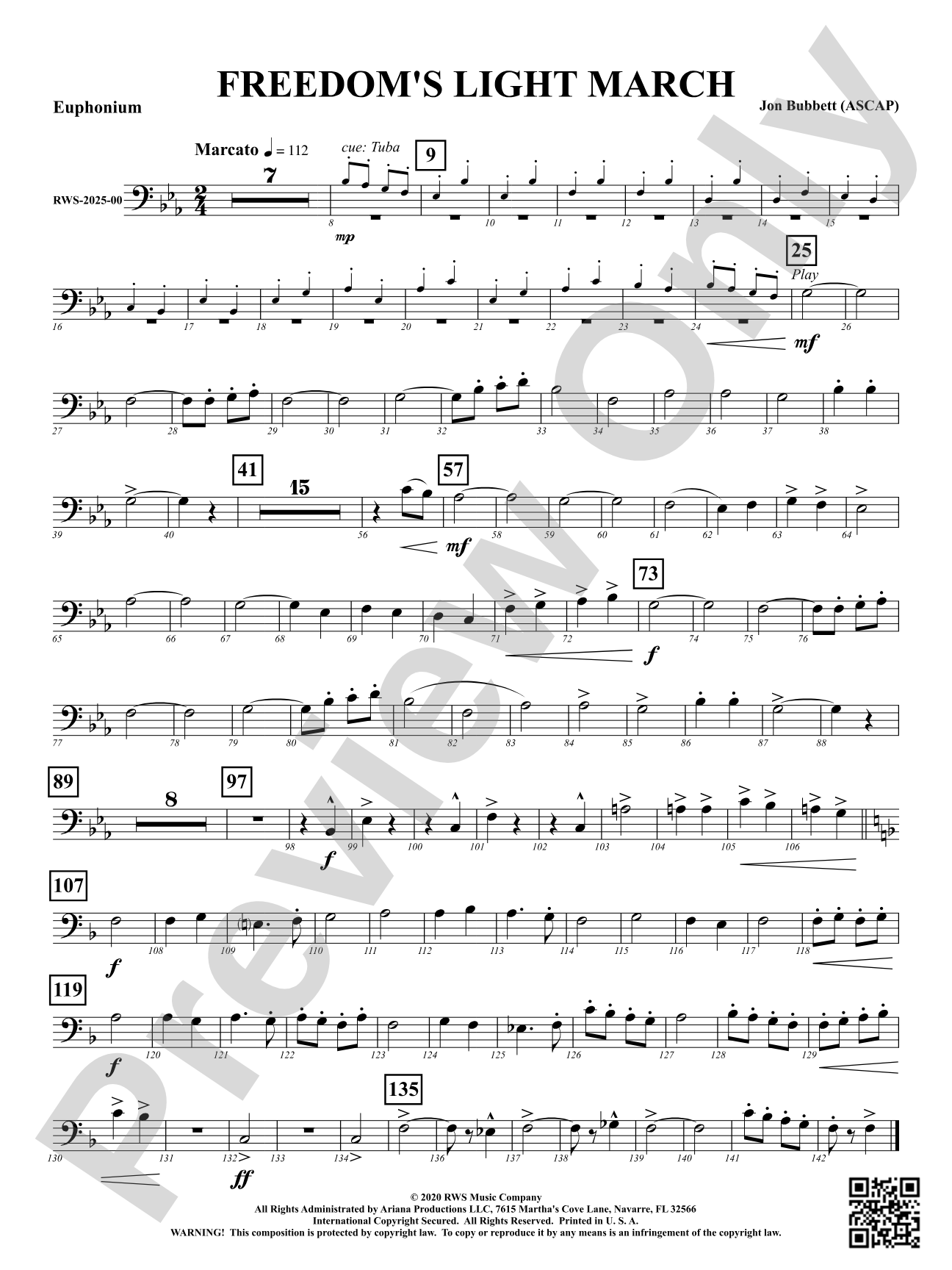
Freedom's Light March: Baritone B.C. Sheet Music Preview

Freedom's Light March: Baritone B.C.

By Jon Bubbett

Grade: 2

Item: 98-PC-RWS2025_BBC1

Digital Download
$3.99
Description
Freedom's Light March is a great concert selection with a melody that all will recognize! This march is very accessible to bands of all levels and is written in the unique American style. Musicians of all ages will enjoy playing Freedom's Light March and will be delighted when they hear "America" in the final strain!

Original Item#: RWS-2025-00

Freedom's Light March: Baritone B.C. isn't in MakeMusic Cloud just yet...but it could be. Let us know you'd like to see it, and you'll help shape what comes next. In the meantime, start a free trial and dive into thousands of interactive titles your students can play along with today.

Sample Audio
0:00
0:00
Sample Video
Additional Details
Series: RWS - Developing Band
Publisher: RWS Music Company
SKU: 98-PC-RWS2025_BBC1

More about this title

About the Composer: Jon Bubbett

Jon Bubbett

Jon Bubbett taught concert band for 26 years at Thompson High School in Alabaster, Alabama, and spent 38 years in music education before retiring from full-time teaching. He has been recognized six times with the NBA Citation of Excellence Award and received the Phi Beta Mu Rho Chapter 2015 "Bandmaster of the Year" Award.

Bubbett remains deeply involved in the band world as a composer, clinician, and adjudicator. He has guest-conducted and judged festivals across Alabama, Georgia, and Mississippi, and has served as a clinician and panelist for the Alabama Music Educators Association and the Midwest International Band and Orchestra Clinic. His compositions appear through Belwin, Make Music, Wingert-Jones, Excelcia Music Publishing, RWS Music, Eighth Note Publishing Company, and his own publishing imprint. He holds memberships in the National Association for Music Education, Alabama Music Educators Association, Phi Mu Alpha Sinfonia, National Band Association, Phi Beta Mu International Bandmasters Fraternity, ASCAP, and conducts the Celebration Winds Community Concert Band.

Why we love this

A Grade 2 march that genuinely feels like concert repertoire, not filler. The harmonic language is sophisticated enough to hold musician interest while remaining accessible for younger or less-experienced bands, and the nod to "America" in the final strain gives your audience an immediate emotional anchor without feeling cheap or gimmicky.

What to expect

A straightforward, energetic march with an American sensibility. The familiar melody that emerges in the final strain catches listeners off-guard with recognition, creating a satisfying "aha" moment that makes the whole performance feel rewarding for both ensemble and audience.

Who it's for

Concert bands at Grade 2 level, including middle school ensembles, high school developmental groups, and community bands with mixed experience. The accessible writing makes it ideal for bands building confidence and musicianship without overwhelming players who are still refining fundamental skills.

How to get the most out of it

  • Bring out the main melody in the first strain; it carries the character of the entire piece, so prioritize clarity in your lead voices over blending them into the texture.
  • Keep the march tempo steady and deliberate through the trio and into the final strain. A slight ritardando leading into "America" helps listeners recognize the familiar tune without losing forward motion.
  • Balance the countermelodies in the trio section so they support rather than overshadow the primary voice. This keeps the piece's architecture clear for younger musicians learning how ensemble parts interact.

How to use it

Program this early in a concert or as a closer on pops programs, where its patriotic flavor and accessibility to audiences work particularly well. It also pairs nicely with other Grade 2-3 repertoire in a concert celebrating American concert band literature.

Skills your students will build

  • Steady march tempo and pulse maintenance
  • Melodic clarity and phrasing within a simple harmonic framework
  • Ensemble balance between primary and supporting voices
  • Recognition and interpretation of stylistic conventions in American march form

You May Also Like