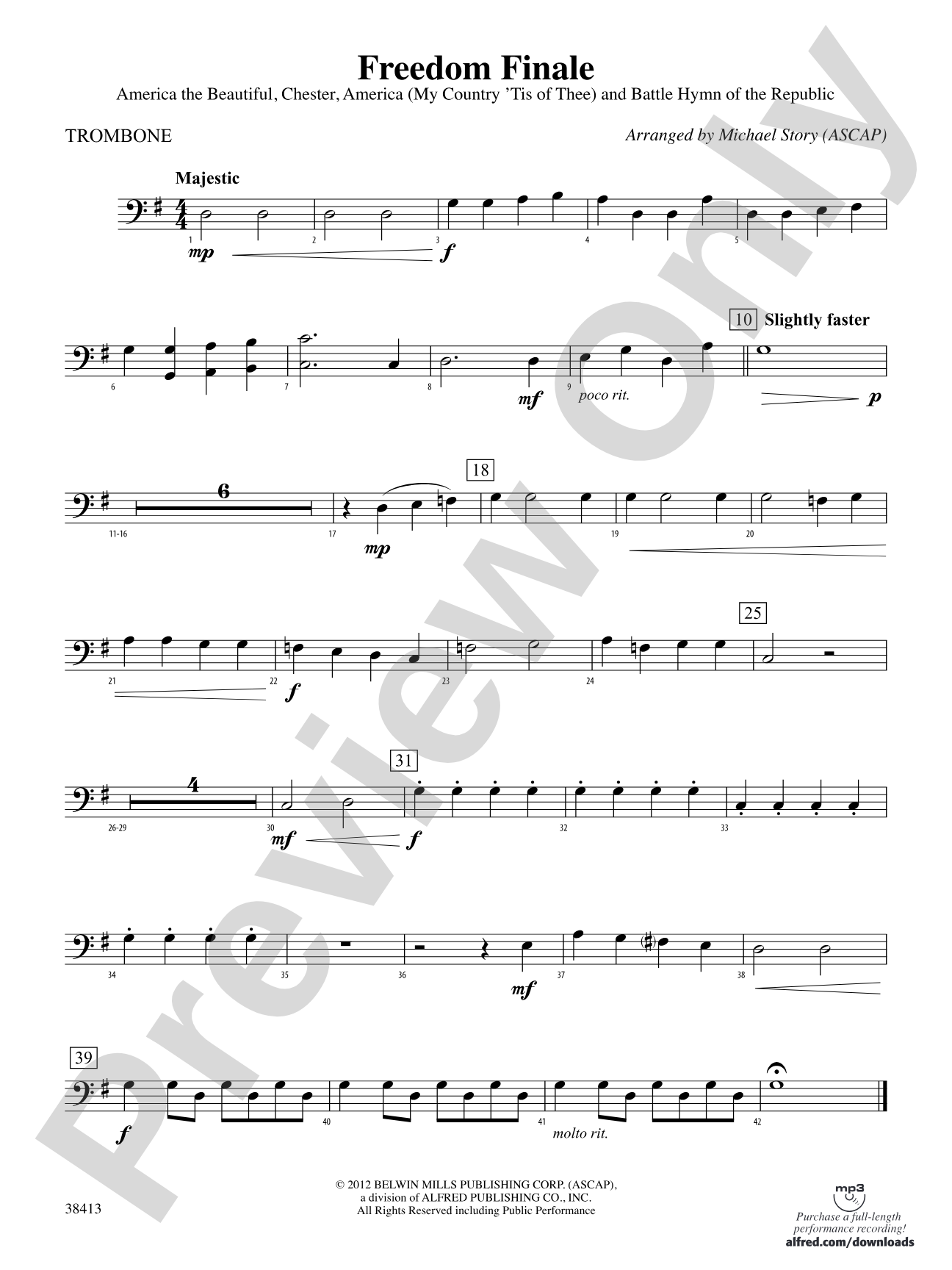
Freedom Finale: 1st Trombone Sheet Music Preview

Freedom Finale: 1st Trombone

Featuring: America the Beautiful / Chester / America (My Country 'Tis of Thee) / Battle Hymn of the Republic

Arr. Michael Story

Grade: 1.5

Item: 00-PC-0015480_TN1

Digital Download
$3.00
Description
Bring your next concert to a stirring conclusion with this patriotic fantasia featuring four popular themes: "America the Beautiful," "Chester," "America (My Country 'Tis of Thee)," and "Battle Hymn of the Republic." The arrangement is scored for full orchestra; however, it is also completely playable by string orchestra alone, or with any number of added winds or percussion. This is an excellent piece to introduce your students to a full orchestra experience! This title is available in MakeMusic Cloud.

Don't just read it, hear it, play along with it, and watch your students grow with it. In MakeMusic Cloud, Freedom Finale: 1st Trombone comes alive with professional accompaniment, adjustable tempo, and built-in practice tools that turn solo practice into real progress.

Sample Audio
0:00
0:00
Sample Video
Additional Details
Series: Belwin Beginning String/Full Orchestra
Publisher: Alfred Music
Page Count: 118
SKU: 00-PC-0015480_TN1

More about this title

About the Arranger: Michael Story

Michael Story has established himself as a prolific composer and arranger for school and community ensembles, with a gift for making quality music accessible across a wide range of ability levels. His arrangements honor the original character of their source material while crafting rewarding parts that engage every section of the ensemble.

Why we love this

Story's orchestration scales beautifully from strings alone to full ensemble, so your students experience the same piece in a configuration that matches your instrumentation without losing coherence or impact. The Grade 1.5 setting keeps the individual parts approachable while the layering of four beloved themes creates genuine emotional power for performers and audiences alike.

What to expect

Patriotic, triumphant, and buoyant. The familiar melodies ground listeners immediately while the full orchestral treatment lifts each theme into something grander than its original form. There's genuine ceremony here, but without heaviness; the Grade 1.5 writing keeps the energy bright and forward-moving.

Who it's for

Conductors of young orchestras or mixed ensembles looking for a musically substantial closer that doesn't demand virtuosity from individual players. This works equally well for a young conductor's first experience leading a full orchestra or a director returning to concert repertoire after primarily working with strings.

How to get the most out of it

  • Balance the thematic material across string and wind sections; let each theme breathe as it passes between choirs rather than blending them into a wall of sound.
  • If you're working with strings alone, mark where winds enter in the full score so ensemble members understand the piece's full architecture and their role within it.
  • Shape the transitions between themes clearly in rehearsal so the fantasia feels like a journey, not a medley of separate pieces.
  • Use the conductor score to identify doubled parts; this helps you assign stand partners strategically and ensures no instrumental line gets lost in the texture.

How to use it

Program this as a concert finale for a 4th of July performance, end-of-year school concert, or community celebration. It also serves beautifully as an opener if you want to establish patriotic or civic themes early. The piece's flexibility means you can write the program in March knowing your full instrumentation will be ready by performance time.

Skills your students will build

  • Playing in full orchestra texture with balanced tone across multiple instrumental families
  • Following thematic material through different instrumental combinations
  • Sustaining musicality at Grade 1.5 technical demands while managing longer ensemble coordination
  • Ensemble balance and blend when layering four distinct melodies
  • Reading and executing the conductor's interpretation across 118 pages of parts

You May Also Like