
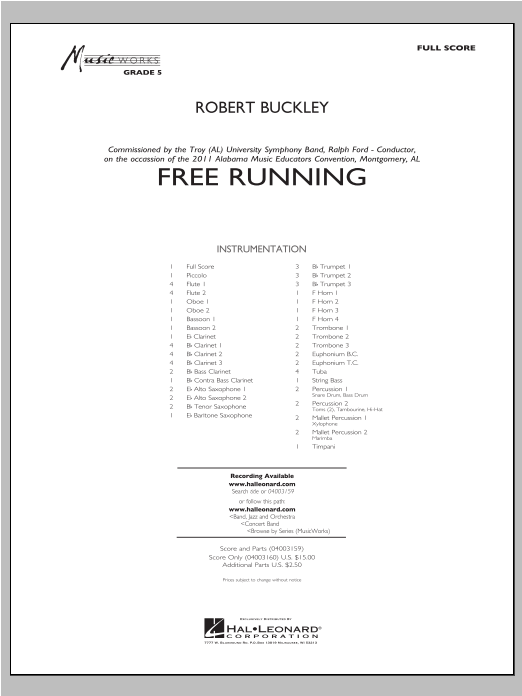

Free Running: Concert Band Conductor Score & Parts
By Robert Buckley
Grade: 5
Item: 35-PK00244406
$85.00
Pickup currently not available
Buy Extra Parts (Digital PDF Download)
Parts Added to Cart!
Description
"Free Running" is an exciting, high velocity tour-de-force that will keep both musicians and the audience on the edge of their seats. Inspiration for the work came from the pointillistic paintings of Seurat (who created images by using tiny spots of primary colors on his canvas) and from Parkour, a form of urban acrobatics in which participants, known as free runners, use the structures of the rural landscape to perform catlike leaps and sprints. The resulting creation is a non-stop piece of music made up of only staccato notes in a constant rhythm moving through different sections of the ensemble. "Free Running" was commissioned by the Troy University Symphony Band for the 2011 Alabama Music Educators Association Convention. Ideal for concert or festival use, it is guaranteed to leave the audience breathless! Dur: 5:10


Free Running: Concert Band Conductor Score & Parts isn't in MakeMusic Cloud just yet...but it could be. Let us know you'd like to see it, and you'll help shape what comes next. In the meantime, start a free trial and dive into thousands of interactive titles your students can play along with today.
Request This Title
Tell us you want it.
Start Your Free Trial
Explore everything that's ready to play right now.
Sample Audio
No sample audio found.
Sample Video
No sample videos found.
Additional Details
Publisher:
Hal Leonard
SKU:
35-PK00244406
More about this title
About the Composer: Robert Buckley
Robert Buckley brings a contemporary sensibility to concert band literature, crafting works that engage both performers and audiences through vivid musical imagery. His compositional approach draws inspiration from visual art and movement, translating those concepts into instrumental color and rhythmic vitality that speaks directly to young musicians.
Why we love this
Buckley captures something rarely achieved in Grade 5 band music: genuine forward momentum without relying on melodic hooks or harmonic complexity. The constant staccato texture and pointillistic distribution across sections creates an almost kinetic energy that keeps players engaged and audiences visibly invested from downbeat to final note.
What to expect
Like watching a free runner navigate an urban landscape in fast-motion: relentless, precisely controlled, yet somehow exhilarating. The music pulses with controlled chaos, all tiny articulations and shifting instrumental colors combining into something propulsive and modern.
Who it's for
Advanced high school and collegiate bands seeking contemporary repertoire that challenges rhythmic precision and ensemble unity without demanding advanced harmonic language. Festivals and concert programs benefit from a piece this distinctive and consistently engaging.
How to get the most out of it
- Establish a rock-solid foundational pulse in the rhythm section before rehearsing with full band. The staccato articulation throughout demands absolute unanimity in rhythmic placement.
- Rotate the staccato passages among different instrumental groups so younger players hear how the texture passes between woodwinds, brass, and percussion. This helps them understand the overall design rather than fixating on their individual line.
- Record a rehearsal and listen back with scores in hand. The pointillist concept becomes much clearer when players can hear how their brief staccato bursts weave into the larger tapestry.
- Keep the energy lifted and the tempo steady. Resist the urge to slow down during complex section transitions; the piece's architecture depends on relentless forward motion.
How to use it
Position this as a concert closer or first-half finale where its five-minute intensity can leave a strong impression before intermission. The staccato texture provides ideal contrast to lyrical or slower repertoire, making it especially effective when paired with ballads or chorale-based works earlier in the program.
Skills your students will build
- Precise staccato articulation under rapid tempo
- Rhythmic cohesion across multiple instrumental sections
- Listening for layered, pointillistic texture rather than traditional melodic lines
- Maintaining dynamic control during sustained repeated figures
- Ensemble balance when individual parts trade fragmentary material