
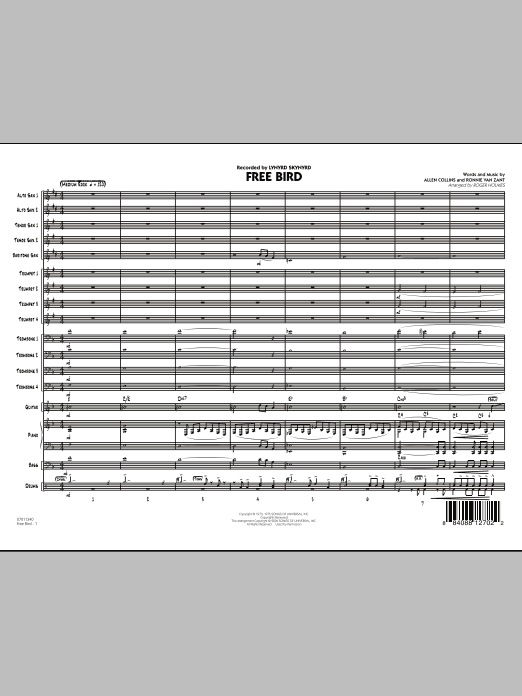

Free Bird: Jazz Ensemble Conductor Score & Parts
By Allen Collins / By Ronnie Van Zant / As performed by Lynyrd Skynyrd / Arranged by Roger Holmes
Grade: 3
Item: 35-PK00160114
$50.00
Pickup currently not available
Buy Extra Parts (Digital PDF Download)
| Product | Price | Quantity |
|---|---|---|
| Free Bird - Full Score | $7.50 | |
| Free Bird - Alto Sax 1 | $6.00 | |
| Free Bird - Alto Sax 2 | $6.00 | |
| Free Bird - Tenor Sax 1 | $6.00 | |
| Free Bird - Tenor Sax 2 | $6.00 | |
| Free Bird - Baritone Sax | $6.00 | |
| Free Bird - Trumpet 1 | $6.00 | |
| Free Bird - Trumpet 2 | $6.00 | |
| Free Bird - Trumpet 3 | $6.00 | |
| Free Bird - Trumpet 4 | $6.00 | |
| Free Bird - Trombone 1 | $6.00 | |
| Free Bird - Trombone 2 | $6.00 | |
| Free Bird - Trombone 3 | $6.00 | |
| Free Bird - Trombone 4 | $6.00 | |
| Free Bird - Guitar | $6.00 | |
| Free Bird - Piano | $6.00 | |
| Free Bird - Bass | $6.00 | |
| Free Bird - Drums | $6.00 |
Parts Added to Cart!
Description
Originally recorded by Lynyrd Skynyrd, this is one of the most powerful "arena rock" tunes of all time. Opening in a rock ballad style, the chart finishes with a driving rock vamp featuring guitar or other soloists. Guaranteed to bring down the house.


Free Bird: Jazz Ensemble Conductor Score & Parts isn't in MakeMusic Cloud just yet...but it could be. Let us know you'd like to see it, and you'll help shape what comes next. In the meantime, start a free trial and dive into thousands of interactive titles your students can play along with today.
Request This Title
Tell us you want it.
Start Your Free Trial
Explore everything that's ready to play right now.
Sample Audio
No sample audio found.
Sample Video
No sample videos found.
Additional Details
Publisher:
Hal Leonard
SKU:
35-PK00160114
More about this title
About the Composer: Allen Collins
Allen Collins co-wrote Free Bird with Ronnie Van Zant, creating one of rock music's most enduring anthems. As the guitarist and a principal songwriter for Lynyrd Skynyrd, Collins helped define the Southern rock sound of the 1970s with his distinctive instrumental voice and songwriting instincts.
Why we love this
Roger Holmes's arrangement preserves the song's emotional arc while making it accessible for student ensembles, opening as a contemplative ballad before building into that unforgettable rock surge. The Grade 3 level keeps the demands manageable without sacrificing the visceral power that makes this tune such a crowd favorite. Your students will feel the difference between playing a chart and playing a real moment.
What to expect
The first half unfolds like a quiet moment of reflection, intimate and spacious, with room for nuance in every phrase. Then the energy shifts completely: the rhythm locks in, the tempo drives forward, and the ensemble becomes a unified force backing a soaring soloist. It's the feeling of a spotlight gradually widening until the entire stage is ablaze.
Who it's for
Jazz ensembles and contemporary music programs looking for repertoire that bridges the gap between artistic integrity and genuine audience appeal. This works equally well for groups seeking a crowd-pleasing closer or programs aiming to show that jazz and rock can coexist meaningfully.
How to get the most out of it
- Shape the opening ballad section with long, singing lines; resist the urge to rush. The quiet opening is where you earn the audience's full attention before the intensity builds.
- Lock the rhythm section tight once the vamp kicks in. The soloist needs a solid, driving groove underneath to fly.
- Balance the solo space carefully. Whether it's your best guitarist, saxophonist, or trumpet player taking the lead, give them room to breathe while keeping ensemble energy constant.
- Use dynamics strategically in the transition from ballad to rock section. A clear decrescendo followed by a sudden full-ensemble entrance makes the contrast hit harder.
How to use it
Anchor a concert with this piece as your closer; the built-in climactic energy and immediate gratification make it perfect for leaving audiences energized as they leave. Alternatively, use it mid-program to shift the mood and demonstrate your ensemble's stylistic range, especially if the rest of your set leans classical or straight-ahead jazz.
Skills your students will build
- Balancing intensity in ballad playing with dynamic restraint
- Locking a rhythm section groove under a featured soloist
- Transitioning between contrasting musical styles within a single piece
- Reading rock rhythmic figures and syncopation patterns
- Supporting a solo voice with ensemble energy and focus