
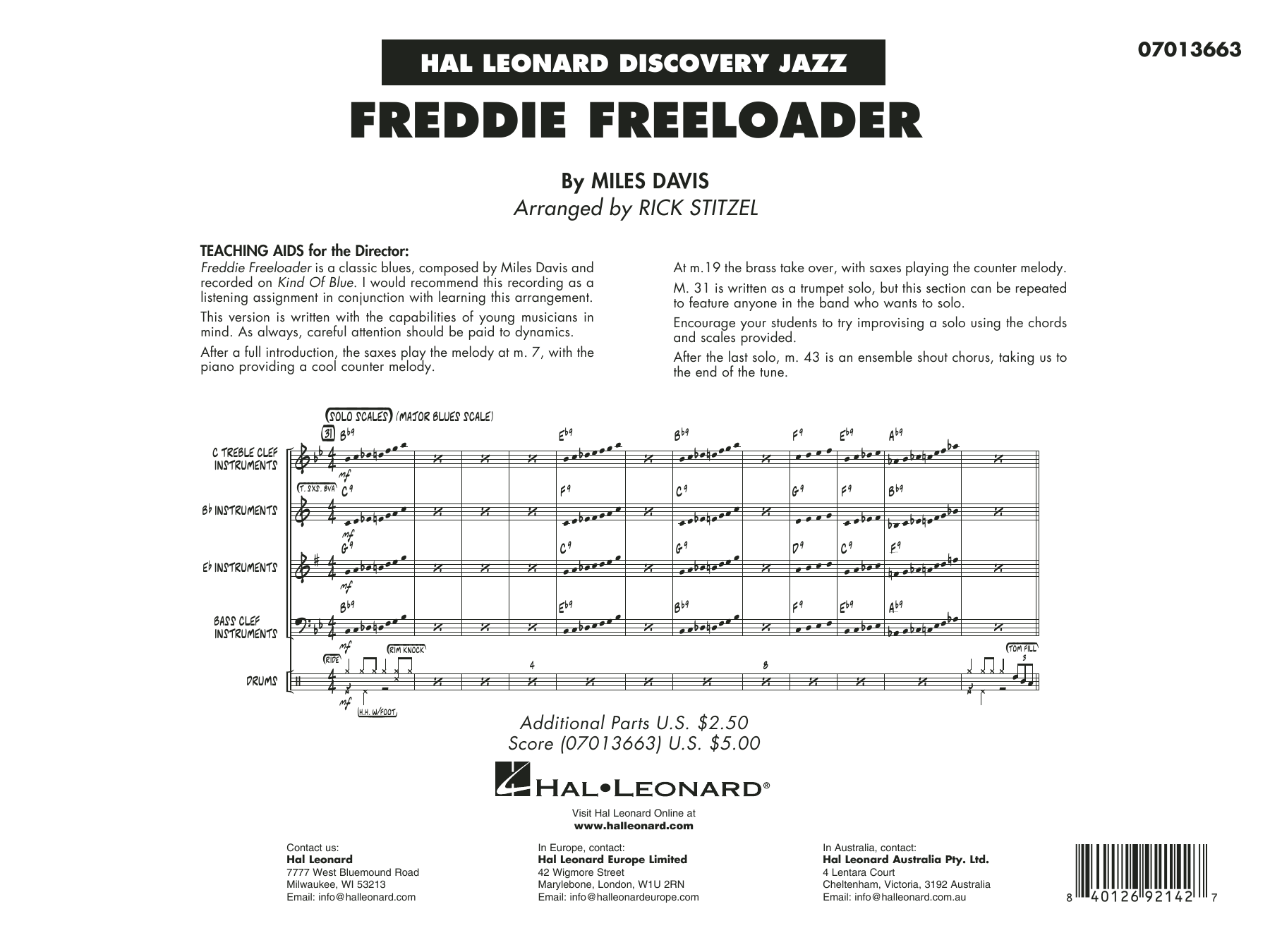

Freddie Freeloader (arr. Rick Stitzel): Jazz Ensemble Conductor Score & Parts
By Miles Davis / Arranged by Rick Stitzel
Item: 35-PK00527365
$40.00
Pickup currently not available
Buy Extra Parts (Digital PDF Download)
Parts Added to Cart!
Description
Recorded on the landmark album "Kind of Blue", this Miles Davis blues standard is a perfect improvising tool for beginning players, and a great introduction to a legendary jazz figure.


Freddie Freeloader (arr. Rick Stitzel): Jazz Ensemble Conductor Score & Parts isn't in MakeMusic Cloud just yet...but it could be. Let us know you'd like to see it, and you'll help shape what comes next. In the meantime, start a free trial and dive into thousands of interactive titles your students can play along with today.
Request This Title
Tell us you want it.
Start Your Free Trial
Explore everything that's ready to play right now.
Sample Audio
No sample audio found.
Sample Video
No sample videos found.
Additional Details
Publisher:
Hal Leonard
SKU:
35-PK00527365
More about this title
About the Composer: Miles Davis
Miles Davis (1926-1991) defined cool jazz and modal improvisation for generations of musicians. His 1959 album "Kind of Blue" remains the best-selling jazz record ever made, introducing millions to the sound of ensemble interplay without bebop's harmonic density. Davis shaped how we think about trumpet tone, bandleading philosophy, and the relationship between composition and improvisation in jazz education.
Why we love this
Rick Stitzel's arrangement captures the groove and accessibility that made "Kind of Blue" a gateway drug to jazz, while preserving the blues changes that let every section member improvise meaningfully. Your students will recognize this recording, connect instantly to the idiom, and spend less time decoding the chart and more time playing.
What to expect
Walking into a cool, dimly lit club where the groove is patient and the soloists take their time. The blues changes unfold with the ease of a familiar conversation, inviting each musician to say something honest without pretense. It swings, it breathes, and it feels lived in.
Who it's for
Beginning jazz ensemble students who are ready to improvise but need a straightforward harmonic framework. Directors seeking an immediate motivator that connects classroom work to recorded jazz history without requiring advanced harmonic literacy.
How to get the most out of it
- Establish the shuffle feel in the rhythm section before adding horns. The pocket of this blues depends entirely on how the bass and drums lock together on the backbeat.
- Balance the melody line so it sits comfortably above the comping voices without oversinging. This is a laid-back groove, not a statement of urgency.
- Give soloists permission to sit back in the pocket and mine the blues scale rather than chase chromatic runs. Some of the strongest moments come from space and repetition.
- Let the drums breathe on the head; over-playing the kick drum flattens the shuffle rhythm that defines this tune.
How to use it
Feature this as the opener for a jazz concert or as a bridge between a classical set and a more adventurous improv showcase. It also works well mid-season as a sectional building block when you're teaching blues harmony and basic comping patterns across your ensemble.
Skills your students will build
- Shuffling the eighth note feel in ensemble context
- Improvisation over a 12-bar blues progression
- Listening and reacting to soloists while maintaining harmonic support
- Balancing melody and accompaniment in a swing idiom
- Reading and executing basic jazz articulation and phrasing