
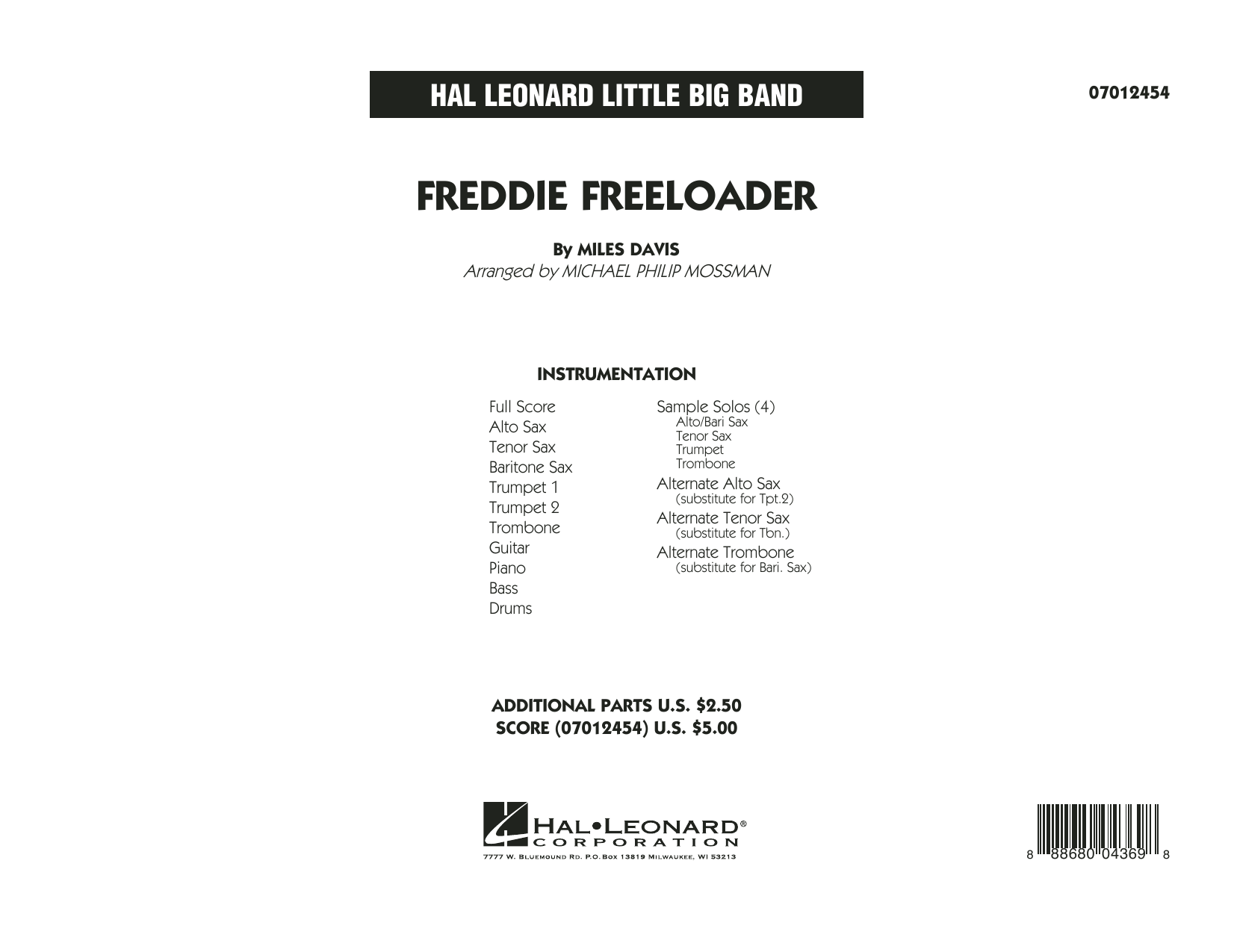

Freddie Freeloader: Jazz Ensemble Conductor Score & Parts
As performed by Miles Davis / Arranged by Michael Philip Mossman
Grade: 4
Item: 35-PK00312034
$45.00
Pickup currently not available
Buy Extra Parts (Digital PDF Download)
| Product | Price | Quantity |
|---|---|---|
| Freddie Freeloader - Full Score | $6.00 | |
| Freddie Freeloader - Alto Sax | $6.00 | |
| Freddie Freeloader - Tenor Sax | $6.00 | |
| Freddie Freeloader - Baritone Sax | $6.00 | |
| Freddie Freeloader - Trumpet 1 | $6.00 | |
| Freddie Freeloader - Trumpet 2 | $6.00 | |
| Freddie Freeloader - Trombone | $6.00 | |
| Freddie Freeloader - Guitar | $6.00 | |
| Freddie Freeloader - Piano | $6.00 | |
| Freddie Freeloader - Bass | $6.00 | |
| Freddie Freeloader - Drums | $6.00 | |
| Freddie Freeloader - Sample Solos | $6.00 | |
| Freddie Freeloader - Alternate Alto Sax | $6.00 | |
| Freddie Freeloader - Alternate Tenor Sax | $6.00 | |
| Freddie Freeloader - Alternate Trombone | $6.00 |
Parts Added to Cart!
Description
In this small band format, Michael Mossman carefully maintains the medium swing style and flavor of the original Miles Davis version, but then adds creative touches with counterlines and harmonic wrinkles. Also included is a flexible solo section and a marvelous tutti chorus for the entire ensemble.


Freddie Freeloader: Jazz Ensemble Conductor Score & Parts isn't in MakeMusic Cloud just yet...but it could be. Let us know you'd like to see it, and you'll help shape what comes next. In the meantime, start a free trial and dive into thousands of interactive titles your students can play along with today.
Request This Title
Tell us you want it.
Start Your Free Trial
Explore everything that's ready to play right now.
Sample Audio
No sample audio found.
Sample Video
No sample videos found.
Additional Details
Publisher:
Hal Leonard
SKU:
35-PK00312034
More about this title
About the Artist: Miles Davis
Miles Davis shaped modern jazz across seven decades, moving fluidly between bebop, cool jazz, modal exploration, and fusion. His 1959 album Kind of Blue remains the best-selling jazz record ever made, introducing audiences to the modal approach that would influence generations of improvisers. For music educators, Davis represents a composer and bandleader who listened intently to his musicians, constantly evolved his sound, and created vehicles for both structured composition and uninhibited soloing.
Freddie Freeloader, the blues-based groove that opens Kind of Blue, exemplifies Davis's gift for writing simple, compelling heads that serve as springboards for ensemble interaction and individual voices. The tune has become a staple of jazz pedagogy precisely because its straightforward form and infectious rhythm make it accessible to student ensembles while its harmonic richness rewards deeper exploration.
Why we love this
Michael Mossman's arrangement honors the original's swagger and groove while giving student ensembles real textural variety and independence. The counterlines and harmonic details create scoring depth without overwhelming young players, and the flexible solo section lets you tailor the piece to your ensemble's strengths rather than forcing soloists into a predetermined straitjacket.
What to expect
Freddie Freeloader swings with the ease of a conversation between old friends. There's nothing flashy or urgent about it; instead, the tune settles into a medium groove where every voice has something intelligent to say, whether holding a counterline, comping underneath a soloist, or riding the melody together as one.
Who it's for
Jazz ensemble directors looking for accessible but musically substantial repertoire that builds ensemble cohesion and improvisation skills. Student soloists at intermediate levels who need a melodically clear, harmonically rewarding vehicle to develop their voice over a groove they understand.
How to get the most out of it
- Lock into the medium swing feel early in rehearsals. Have the rhythm section anchor the pulse while horn players focus on landing their figures on top of the beat, not rushing ahead of it.
- Balance the tutti chorus so voices blend rather than compete. The full ensemble sound works best when section leaders project without overpowering the overall texture.
- Shape solo sections by establishing clear handoff points between improvisers. A brief nod or eye contact from the conductor before each solo entrance prevents drag and keeps momentum alive.
- Emphasize the weight and relaxation in the blues changes. This isn't about technical difficulty; it's about swing pocket, so encourage players to sing the form rather than merely read it.
How to use it
Place this early in a jazz concert to establish the ensemble's swing credentials and warm up the audience with something familiar enough to invite them in. It also works as a teaching performance midyear, where you can showcase individual soloists while demonstrating ensemble maturity without the pressure of a more complex arrangement.
Skills your students will build
- Medium swing interpretation and rhythmic pocket
- Blues form navigation and harmonic awareness
- Improvisation over chord changes within a structured solo section
- Ensemble balance and blend across tutti passages
- Call-and-response phrasing between sections
- Reading and executing countermelodies independent of the head