
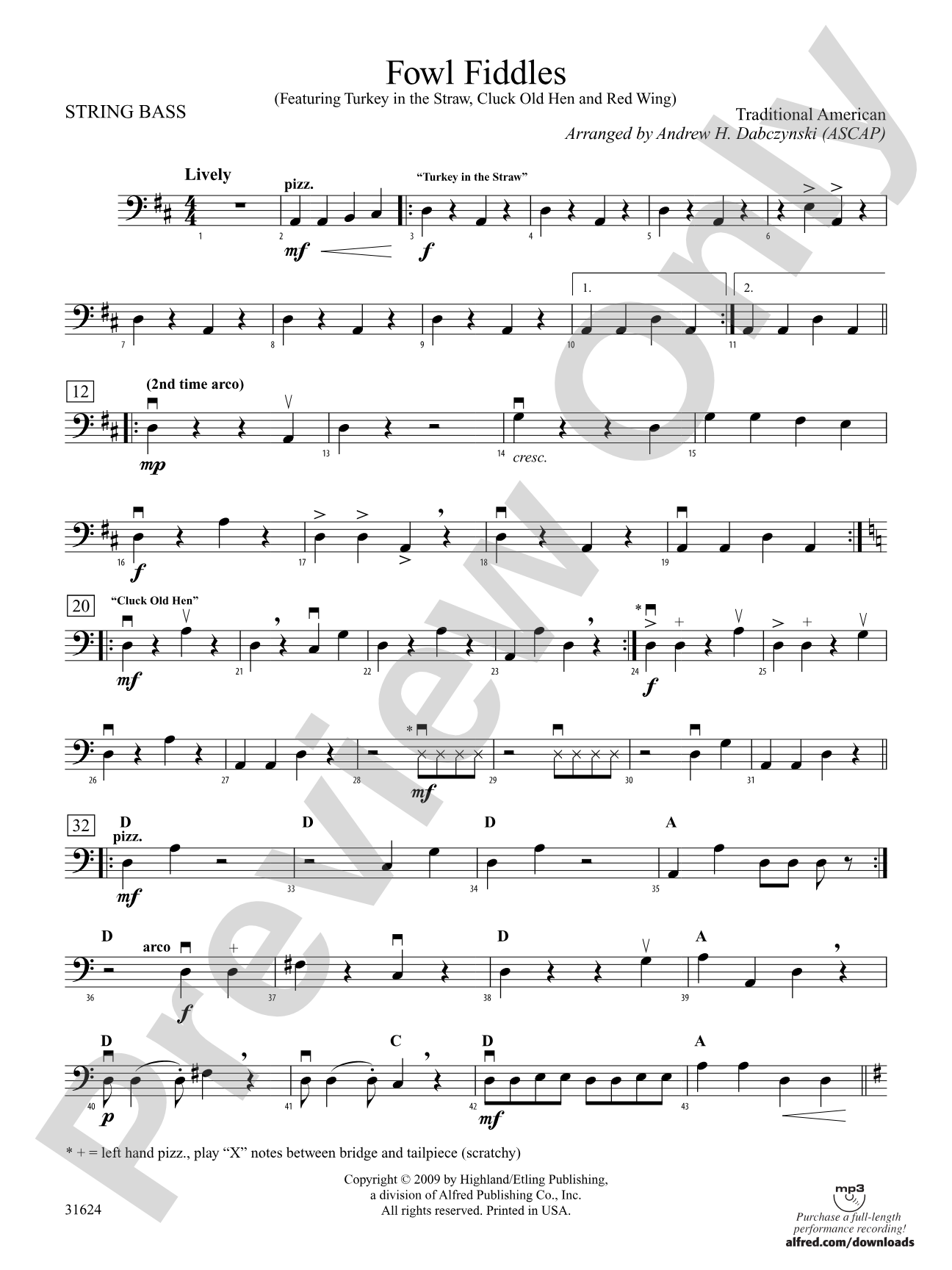

Fowl Fiddles: String Bass
Featuring: Turkey in the Straw / Cluck Old Hen / Red Wing
Traditional American / arr. Andrew H. Dabczynski
Grade: 2
Item: 00-PC-0001784_SB
$5.99
Pickup currently not available
Description
A sure winner---a "bird-in-hand!" Here's a terrific medley of three beloved fiddle tunes that beginning string players will have the skills to play, but more advanced students will find delightfully challenging. The contrasting tunes---"Turkey in the Straw," "Cluck Old Hen" and "Red Wing"---give all sections of the orchestra a chance to play the tunes and clever variations. Easy-but-effective special techniques extend students' performance abilities and add interest and humor. Certain to delight players and audience alike---two birds with one musical stone!


Don't just read it, hear it, play along with it, and watch your students grow with it. In MakeMusic Cloud, Fowl Fiddles: String Bass comes alive with professional accompaniment, adjustable tempo, and built-in practice tools that turn solo practice into real progress.
Open in the Player
Jump straight in and assign it today.
Start Your Free Trial
Open this title and explore the full library in minutes.
Sample Audio
1
Audio File
--:--
0:00
0:00
Sample Video
No sample videos found.
Additional Details
Series:
Highland/Etling String Alternatives
Publisher:
Alfred Music
Page Count:
128
SKU:
00-PC-0001784_SB
More about this title
About the Arranger: Andrew H. Dabczynski

Andrew H. Dabczynski served on the faculty at Brigham Young University as Emeritus Professor of Music Education, where he founded the BYU "New Horizons Orchestra," a beginning string ensemble for adults that also served as a training laboratory for string educators. His work in string pedagogy earned him BYU's Joseph E. White Fellowship for Teaching and Learning, Utah ASTA's "Higher Education Teacher of the Year" award in 2005, and recognition for outstanding contributions to music education in 2014.
Dabczynski's career spans teaching positions at the Eastman School of Music and in public school districts across New York and Michigan, where he also served as Fine Arts Education Supervisor. He holds degrees in viola performance from Eastman and advanced degrees in music education from the University of Connecticut and University of Michigan. As a performer, he has played viola with multiple regional orchestras and was a member of the Colden String Quartet at Western Michigan University. His dual expertise in string pedagogy and folk music traditions has shaped his approach to arrangement and education; he co-authored the String Explorer method series with Alfred and has focused research on fiddling and traditional music transmission.
Why we love this
Dabczynski understands exactly what beginning string orchestras need: immediate success alongside genuine musical challenge. By layering three classic fiddle tunes with clever variations and accessible special techniques, he creates a piece that holds the attention of mixed-ability rooms while keeping advanced players engaged. The humor and folk authenticity make this an audience favorite, which matters just as much in programming as it does in the orchestra.
What to expect
This arrangement captures the joy and informal spirit of American fiddle music, transporting players and listeners to barn dances and folk gatherings. The three tunes move with natural swing and humor, and the clever orchestral variations add color and surprise while staying rooted in traditional character. There's a lightness here, an absence of pretense, that makes even technical challenges feel playful rather than serious.
Who it's for
String orchestras at the Grade 2 level benefit most from this arrangement, whether those players are in their first year or returning to strings after a break. The piece works equally well for beginning adult ensembles and school orchestras, offering material that feels musically complete without demanding high technical sophistication.
How to get the most out of it
- Assign the three tunes across different sections as the piece progresses so every player experiences the melodic material. This builds ownership and keeps less-featured players invested through the entire arrangement.
- Lock in the rhythmic character of each fiddle tune before layering special techniques. Fiddle music lives or dies on groove and lilt, so establish the traditional feel first.
- Highlight the contrasts between tunes by adjusting articulation and dynamics. "Turkey in the Straw" plays differently than "Red Wing," and letting those personalities shine makes the medley structure audible.
- Use the special techniques as teaching moments in sectional rehearsals. Introduce them gradually so students build confidence rather than feeling overwhelmed.
How to use it
Place this in a concert's middle section to refresh the room's energy after more formal repertoire, or open a pops concert with it to set a celebratory tone. It pairs well with other American folk or light concert works and works beautifully as an audience engagement piece for community concerts where accessibility matters.
Skills your students will build
- Playing multiple articulation styles within a single piece (staccato, legato, pizzicato)
- Reading and executing special techniques (col legno, sul ponticello, or similar orchestral effects as arranged)
- Sustaining ensemble cohesion across sectional melody exchanges
- Responding to style changes and tempo variations across three distinct tunes
- Building rhythmic precision in folk idioms with characteristic syncopation and phrasing