
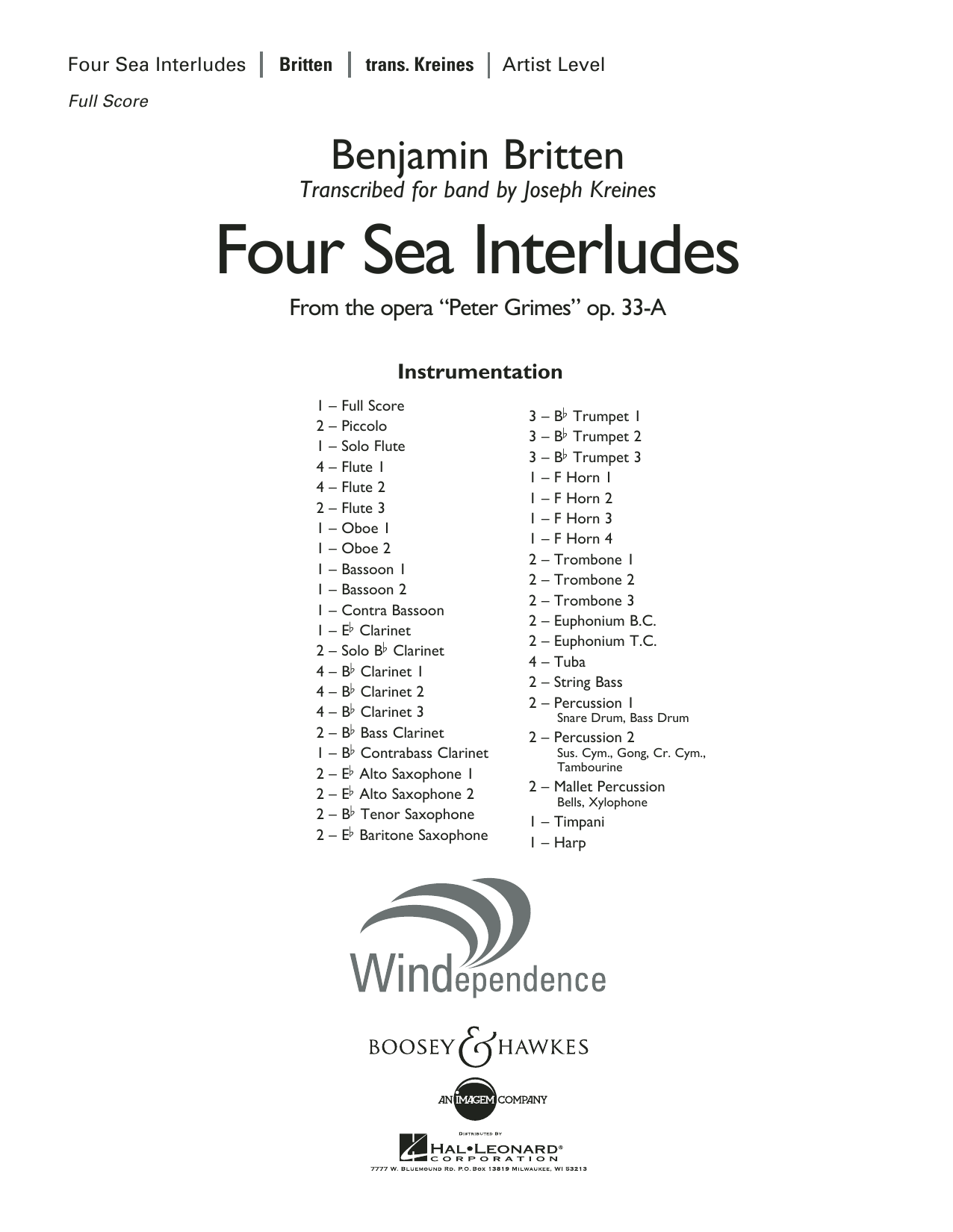

Four Sea Interludes (from the opera "Peter Grimes"): Concert Band Conductor Score & Parts
As performed by Benjamin Britten / Arranged by Joseph Kreines
Grade: 5
Item: 35-PK00309083
$225.00
Pickup currently not available
Buy Extra Parts (Digital PDF Download)
Parts Added to Cart!
Description
Britten's critically acclaimed opera "Peter Grimes" was first performed in 1945 and has become a part of the standard repertoire. Additionally, the orchestral concert suite "Four Sea Interludes" is frequently performed, and includes the movements "Dawn, Sunday Morning, Moonlight" and "Storm". This authentic transcription by Joseph Kreines is a masterful work for mature ensembles, and an important addition to the repertoire for wind band. (Boosey Hawkes Windependence - Artist Level)


Four Sea Interludes (from the opera "Peter Grimes"): Concert Band Conductor Score & Parts isn't in MakeMusic Cloud just yet...but it could be. Let us know you'd like to see it, and you'll help shape what comes next. In the meantime, start a free trial and dive into thousands of interactive titles your students can play along with today.
Request This Title
Tell us you want it.
Start Your Free Trial
Explore everything that's ready to play right now.
Sample Audio
No sample audio found.
Sample Video
No sample videos found.
Additional Details
Publisher:
Hal Leonard
SKU:
35-PK00309083
More about this title
About the Artist: Benjamin Britten
Benjamin Britten (1913-1976) was one of the twentieth century's most versatile composers, equally gifted at writing for orchestra, chamber ensembles, voices, and wind band. His opera Peter Grimes, premiered in 1945, marked a watershed moment in British music; the work restored confidence in native opera and established Britten as a major voice in contemporary composition. Beyond the opera house, Britten proved himself a brilliant orchestrator with an acute ear for instrumental color and a gift for writing music that was both sophisticated and direct.
Why we love this
Kreines captures the seascape atmosphere and orchestral richness of Britten's original score without sacrificing the work's emotional impact or structural clarity. This transcription respects the mature harmonic language and subtle instrumental interplay that make the Sea Interludes concert staples, while opening the work to wind band repertoire where it genuinely belongs. Programming all four movements creates a coherent journey through contrasting moods, from the shimmer of dawn to the raw power of storm.
What to expect
These interludes evoke the North Sea coast with remarkable specificity: gentle mists dissolving in morning light, the peculiar stillness of a Sunday village, moonlit water, and the raw violence of a gathering tempest. Britten's orchestration shimmers and surges by turns, always precise in its emotional gesture and never indulgent.
Who it's for
Concert bands at the advanced high school or collegiate level seeking substantial classical repertoire with proven artistic merit. Directors who want to introduce their students to twentieth-century British opera literature and showcase the band's capacity for lyrical, sophisticated music making.
How to get the most out of it
- Balance the sustained sonorities in Dawn carefully; the interlude lives in soft, shimmering textures, so resist the urge to push dynamics beyond mezzo-forte.
- Shape Sunday Morning's gentle, almost hymn-like character through careful voicing in the woodwind choir rather than aggressive articulation.
- Let Moonlight breathe with space between phrases; Britten's orchestration relies on the clarity of individual lines more than harmonic density.
- The Storm movement builds inexorably toward its climax. Maintain ensemble rhythmic precision throughout the driving figures to maximize the impact of the final surge.
How to use it
Build an entire concert around the Sea Interludes as a centerpiece work, pairing them with shorter band pieces and perhaps a contrasting contemporary work. Alternatively, program them as the concert's second half, allowing the audience to settle into Britten's meditative opening before returning to more active repertoire. The suite works equally well as a season opener or closer, depending on your programming arc.
Skills your students will build
- Sustaining transparent textures at soft dynamics without loss of intonation or ensemble blend
- Shaping long melodic lines across multiple phrases and instrumental families
- Balancing rhythmic precision with expressive rubato in dramatic passages
- Reading divisi passages and complex orchestral voicings specific to Britten's technique
- Understanding twentieth-century harmonic language and its relationship to traditional tonal centers