Four Piano Blues Sheet Music Preview

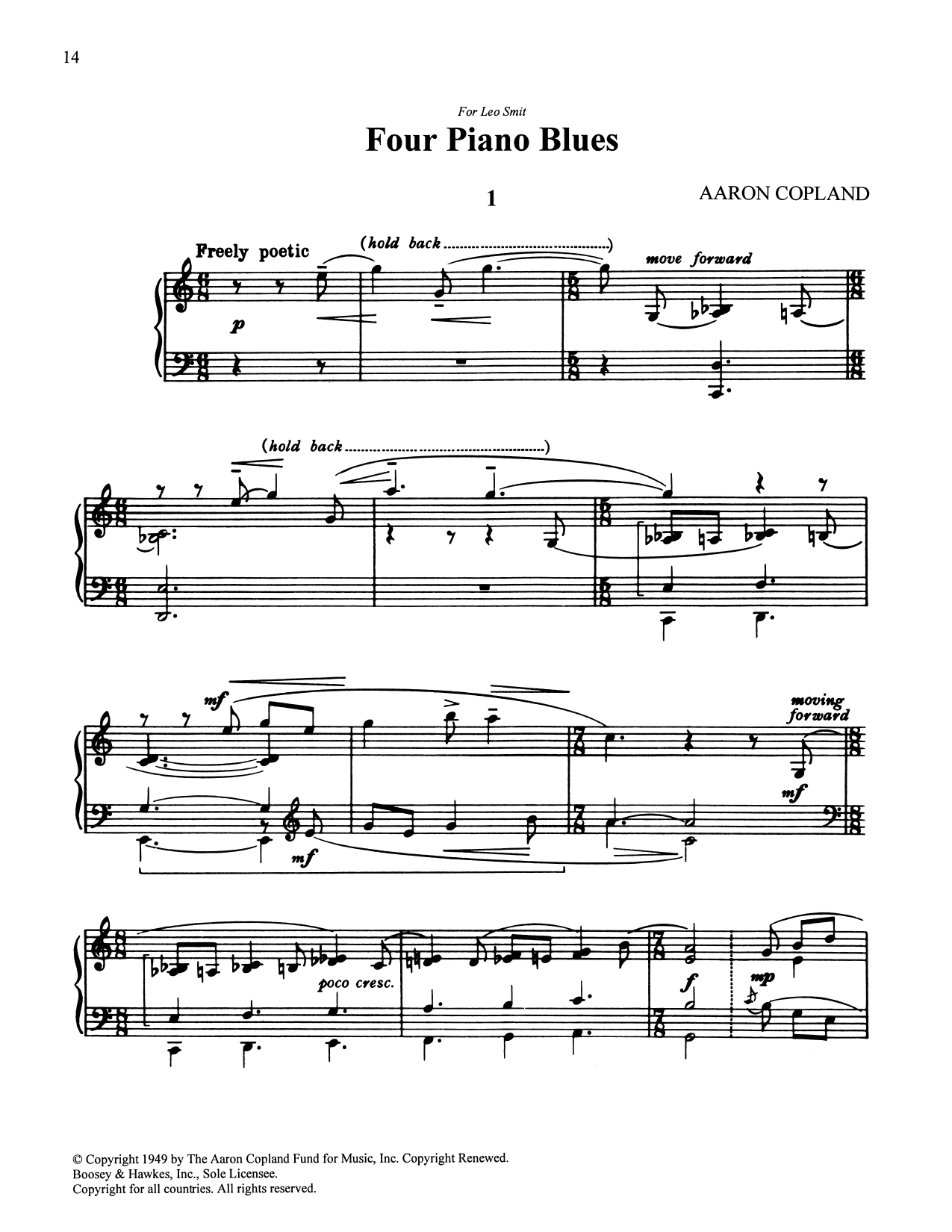
Four Piano Blues: Piano Solo

By Aaron Copland

Item: 35-DS01979706

Digital Download
$5.99
One moment…
Description

Discover MakeMusic Cloud: thousands of interactive titles your students can play along with today.

Sample Audio
No sample audio found.
Sample Video
Additional Details
Publisher: Hal Leonard
Page Count: 10
SKU: 35-DS01979706

More about this title

About the Composer: Aaron Copland

Aaron Copland (1900-1990) shaped American classical music by grounding his compositions in folk idioms, hymn tunes, and the rhythmic energy of jazz. His gift for accessibility meant that concert hall audiences and students alike could hear something recognizably American in his work without sacrificing musical sophistication. Copland's piano works reveal his ability to translate orchestral color and expansive gesture onto the keyboard, making them invaluable for pianists seeking to understand twentieth-century American style.

His approach to the blues stands apart from purely improvisational models. Rather than mimicking jazz performance practice, Copland absorbed blues tonality, melodic shapes, and harmonic coloration into a composed framework. This collection demonstrates his analytical ear for what makes blues language musically compelling while maintaining the structural clarity of classical forms.

Why we love this

Copland's blues pieces land in a rare pedagogical sweet spot: they sound genuinely bluesy without requiring the student to swing or interpret jazz idioms on the fly. The writing is idiomatic for the piano while remaining direct enough that intermediate-advanced players can access the style authentically. These works serve as a gateway to understanding how concert composers of the early twentieth century engaged with American popular music.

What to expect

These pieces inhabit the emotional territory between introspection and resilience. A blues piano solo by Copland carries lyrical warmth but never sentimentality, with harmonic language that sometimes surprises you into a minor-key melancholy, then recovers with a shift in color or register. The ten pages unfold with the easy inevitability of someone who knows exactly what they have to say.

Who it's for

Intermediate to advanced pianists working to broaden their stylistic range and understand American classical music from the inside. Teachers seeking repertoire that bridges concert music and vernacular idioms without compromising either. Students preparing for competitions or recitals who want to explore a distinctly American voice.

How to get the most out of it

  • Attend closely to harmonic coloration in the left hand. Copland's blues chords often contain chromatic passing tones and unexpected voice leading that add color without muddiness; clarity in the bass makes the whole piece breathe.
  • Shape the melodic line with the kind of gentle, behind-the-beat phrasing you hear in vocal blues. This isn't classical line singing, and it isn't jazz swing; find the middle ground where the melody sits forward but never rushes.
  • Let repetition serve your advantage. Where a figure returns, use dynamics or tonal adjustment to deepen the listener's engagement rather than playing it identically.
  • Balance the introspective moments with confident forward motion. Blues feel melancholic on the surface, but the harmonic movement and rhythmic pulse need steady propulsion underneath.

How to use it

Open a recital focused on twentieth-century American works, or position one piece as a solo interlude between chamber or ensemble pieces. These works also fit excellently into a thematic concert exploring blues across genres, sitting comfortably alongside folk arrangements or art songs. A single movement can serve as a substantial standalone performance or an educational demonstration for students learning about form and harmonic language.

Skills your students will build

  • Interpreting blues tonality and inflection within a notated score
  • Voice leading and harmonic analysis in twentieth-century American idiom
  • Balancing lyrical phrasing with rhythmic forward motion
  • Understanding how composed works adapt jazz and vernacular materials
  • Pedal technique for color and harmonic resonance
  • Structural listening across a multipart work

You May Also Like