
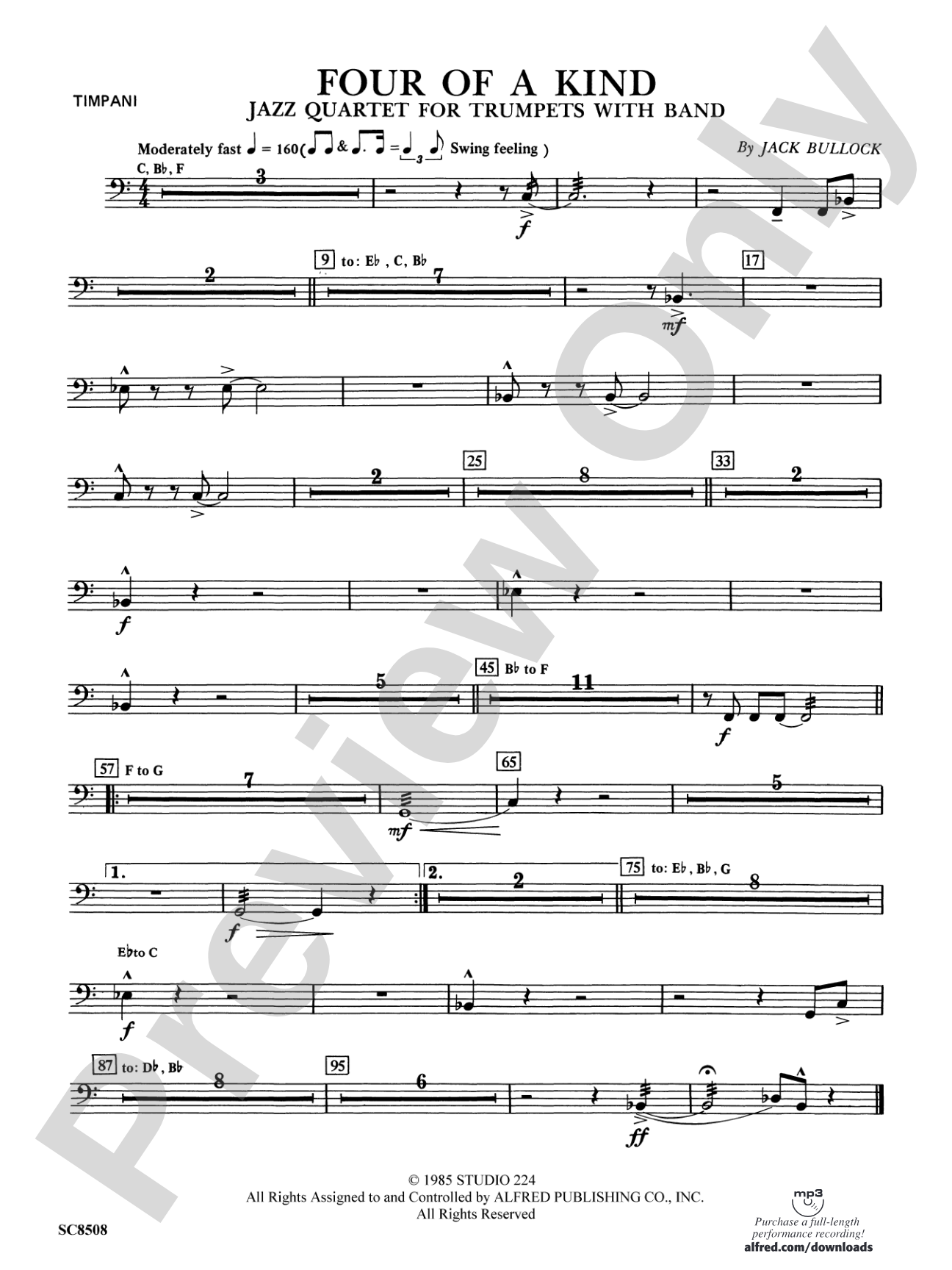

Four of a Kind: Timpani
Jazz Quartet
By Jack Bullock
Grade: 3 (Medium Easy)
Item: 00-PC-0002551_TMP
$5.99
Pickup currently not available
Description
Feature four trumpets in this swing-era style work for concert band. Reflect on the 40s, 50s and 60s musically as the trumpets set the stage for grand memories of the big-band sound. The key to the accompaniment is attention to articulation. Highly programmatic.


Don't just read it, hear it, play along with it, and watch your students grow with it. In MakeMusic Cloud, Four of a Kind: Timpani comes alive with professional accompaniment, adjustable tempo, and built-in practice tools that turn solo practice into real progress.
Open in the Player
Jump straight in and assign it today.
Start Your Free Trial
Open this title and explore the full library in minutes.
Sample Audio
1
Audio File
--:--
0:00
0:00
Sample Video
No sample videos found.
Additional Details
Series:
Belwin Concert Band
Publisher:
Alfred Music
Page Count:
176
SKU:
00-PC-0002551_TMP
More about this title
About the Composer: Jack Bullock

Jack Bullock brings decades of real-world music experience to his compositions. A trumpet performer who played with the Miami Philharmonic Orchestra, Miami Opera Company, and touring dance bands across the country, he understands the instruments he writes for from the inside. His educational credentials include undergraduate, graduate, and doctoral degrees in Music Education, grounded in formal training under accomplished trumpet teachers including Harry Glantz, James Ode, and Craig McHenry.
As a composer and arranger, Bullock has created over 600 published works spanning concert band, orchestra, jazz ensemble, and marching band. He taught instrumental music in K-12 classrooms for 20 years and served as an assistant band director at Ithaca College's School of Music, where he also chaired the Music Education Department. His contributions to music education include co-authoring the Belwin 21st Century Band Method and arranging for Music Expressions, Alfred Music's innovative school curriculum. An ASCAP member since 1980, he has conducted clinics and workshops throughout the United States, Canada, and England.
Why we love this
Bullock nails the swagger and energy of the big-band era while keeping the writing accessible to developing ensembles. The trumpet feature roles demand musicianship without overwhelming Grade 3 players, and his attention to articulation patterns in the accompaniment creates a teaching moment around style and groove that elevates the entire band's musical thinking.
What to expect
Step into a time machine where big-band nostalgia meets modern concert band energy. Four bright trumpet voices trade lines and harmonize over a rhythmically engaging accompaniment, evoking the glamour and swing of the 1940s through 1960s without ever feeling quaint or stale.
Who it's for
This score is ideal for intermediate concert bands looking for substantial programming that feels both approachable and artistically rewarding. Directors at the Grade 3 level will find a piece that challenges musicianship without demanding advanced technical facility, making it well-suited for all-district festivals or community concert series.
How to get the most out of it
- Isolate the articulation patterns in the rhythm section and reeds early in rehearsal. Bullock's swing style depends on crisp, coordinated tonguing, so mark these clearly with your players and drill them until they're second nature.
- Balance the four trumpet parts so each voice is heard distinctly without overshadowing the ensemble. Have players practice their individual lines independently first, then blend gradually during sectionals.
- Shape the phrasing of the trumpet features to echo the vocal quality of jazz singers from that era. Ask players to think about where they would breathe if they were singing the melody, not just playing through long phrases mechanically.
- Let the recorded accompaniment help establish the swing feel and tempo if available separately. A solid groove foundation frees your trumpet section to focus on tone, style, and their featured moment.
How to use it
Program this as a feature piece in a concert celebrating American musical styles, pairing it with other era-specific works to create thematic flow. Its contest-ready credentials and historical appeal make it equally effective for festival competition or a standalone tribute concert to the swing era.
Skills your students will build
- Swing articulation and style (legit vs. tongued quarter notes and eighth notes in a jazz groove)
- Four-part trumpet blending and balance
- Listening to and responding to featured melodic voices while maintaining accompaniment integrity
- Rhythmic precision and ensemble cohesion in syncopated figures
- Stylistic interpretation of historical musical language (1940s-60s swing conventions)