
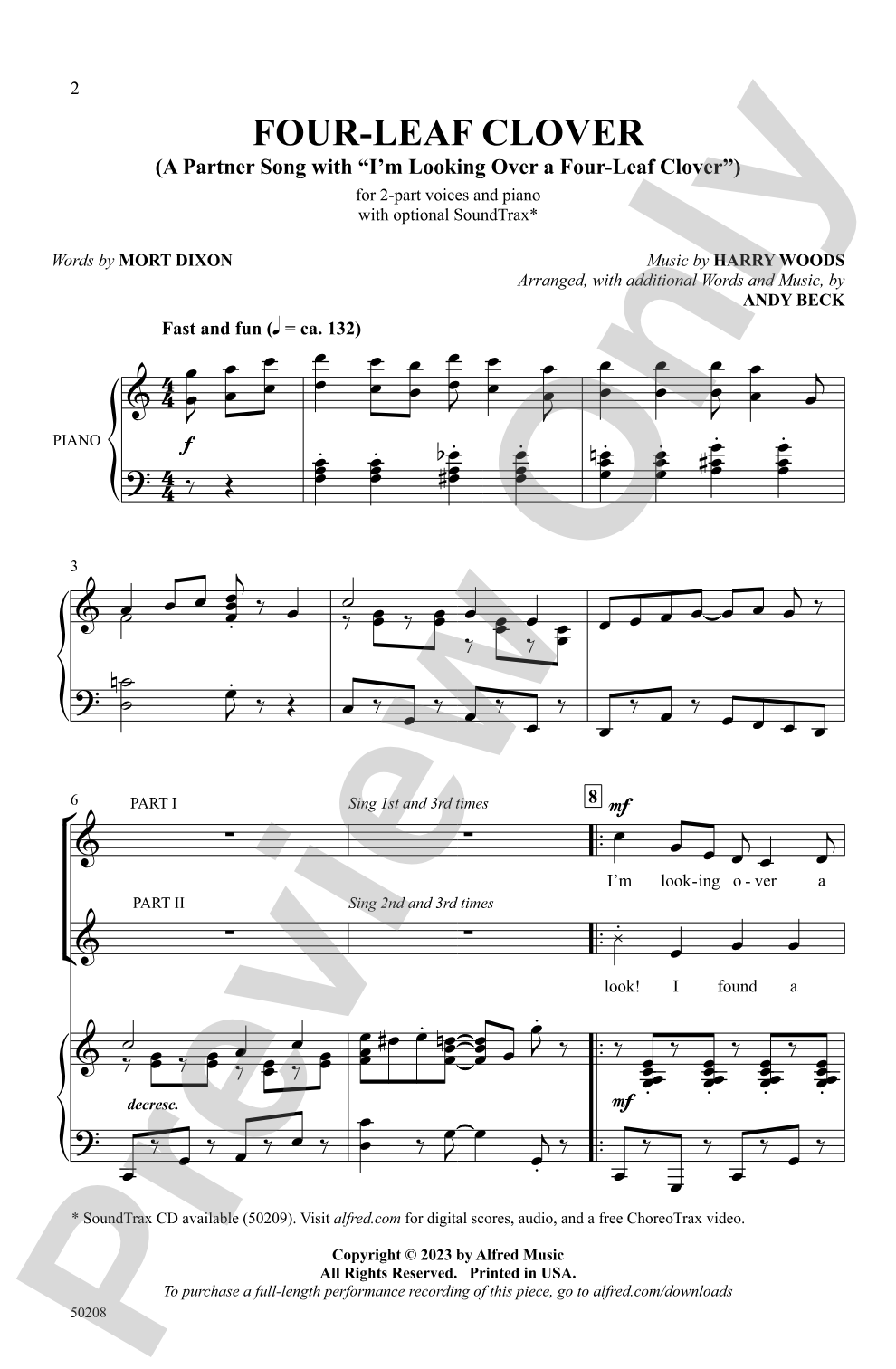

Four-Leaf Clover: 2-Part Choral Octavo
(A Partner Song with "I'm Looking Over a Four-Leaf Clover")
Words by Mort Dixon, music by Harry Woods / arr., with additional words and music, by Andy Beck
Item: 00-PO-0007056
$2.05
Minimum order quantity: 20 copies
Pickup currently not available
Description
It's your lucky day! Here's a perky partner song that pairs new words and music with the traditional "I'm Looking Over a Four Leaf Clover." Perfect for choirs just learning to sing in parts, both short songs are first heard on their own before everything fits together. Check out the free ChoreoTrax video for staging ideas.


Four-Leaf Clover: 2-Part Choral Octavo isn't in MakeMusic Cloud just yet...but it could be. Let us know you'd like to see it, and you'll help shape what comes next. In the meantime, start a free trial and dive into thousands of interactive titles your students can play along with today.
Request This Title
Tell us you want it.
Start Your Free Trial
Explore everything that's ready to play right now.
Sample Audio
1
Audio File
--:--
0:00
0:00
Sample Video
1 / 2
Additional Details
Series:
Alfred Choral Designs
Publisher:
Alfred Music
Page Count:
8
SKU:
00-PO-0007056
More about this title
About the Composer: Harry Woods
Harry Woods (1896-1970) was an American songwriter and composer known for his work in popular music during the 1920s and 1930s. "I'm Looking Over a Four Leaf Clover," one of his most enduring compositions, became a standard that has been recorded countless times across multiple genres and continues to appear in educational choral literature.
Woods composed for film, theater, and popular recording artists of his era, establishing himself as a reliable craftsman of melody and lyrics. His ability to write memorable, singable tunes made his work accessible to amateur musicians and performers, a quality that keeps his pieces relevant in music education today.
Why we love this
Andy Beck's arrangement respects the charm of the original while creating something genuinely useful for young singers learning part independence. The structure—introducing each song separately before combining them—removes the confusion that often trips up developing choirs and lets singers build confidence in their own lines before managing the blend.
What to expect
Cheerful and uncomplicated, with a swing era warmth that feels both vintage and immediate. The novelty element lifts the mood without becoming precious, and the partner song structure creates a satisfying sense of arrival when both melodies lock into place together.
Who it's for
This arrangement serves choirs making their first real commitment to two-part singing, whether in middle school general music, church youth choirs, or community groups. Singers need to be past unison basics but don't require advanced part-singing skills. The straightforward harmonic language and recognizable melody make it an ideal trust-builder for singers worried about singing harmony.
How to get the most out of it
- Prepare each part individually in sectional rehearsals before bringing the full choir together. This ensures singers hear the integrity of their own melody and reduces balance struggles when parts combine.
- Use the recorded accompaniment to establish tempo and harmonic context while singers learn. Gradually fade the backing track once parts are secure so the choir owns the sound.
- Keep the energy bright and forward throughout both songs. The novelty charm fades quickly if the tempo sags or dynamics flatten.
- Attend to the choreography suggestions in the ChoreoTrax video early in rehearsals. Simple staging integrated from the start eliminates the stop-and-start problems that come when movement is added late.
How to use it
This works beautifully in spring or end-of-year programs as a mood-lightener between more serious repertoire. It's also an ideal selection for holiday or casual community concerts where accessible, feel-good music builds audience connection. Consider pairing it with another two-part selection to reinforce developing singers' confidence in this emerging skill.
Skills your students will build
- Singing independent melodic lines while hearing a contrasting harmony
- Building part security through rehearsal structures that isolate each voice before combining
- Maintaining ensemble rhythm and tempo while tracking a different melodic contour
- Responding to staging cues while maintaining vocal focus and blend
- Recognizing and interpreting stylistic markers of early 20th-century popular song