
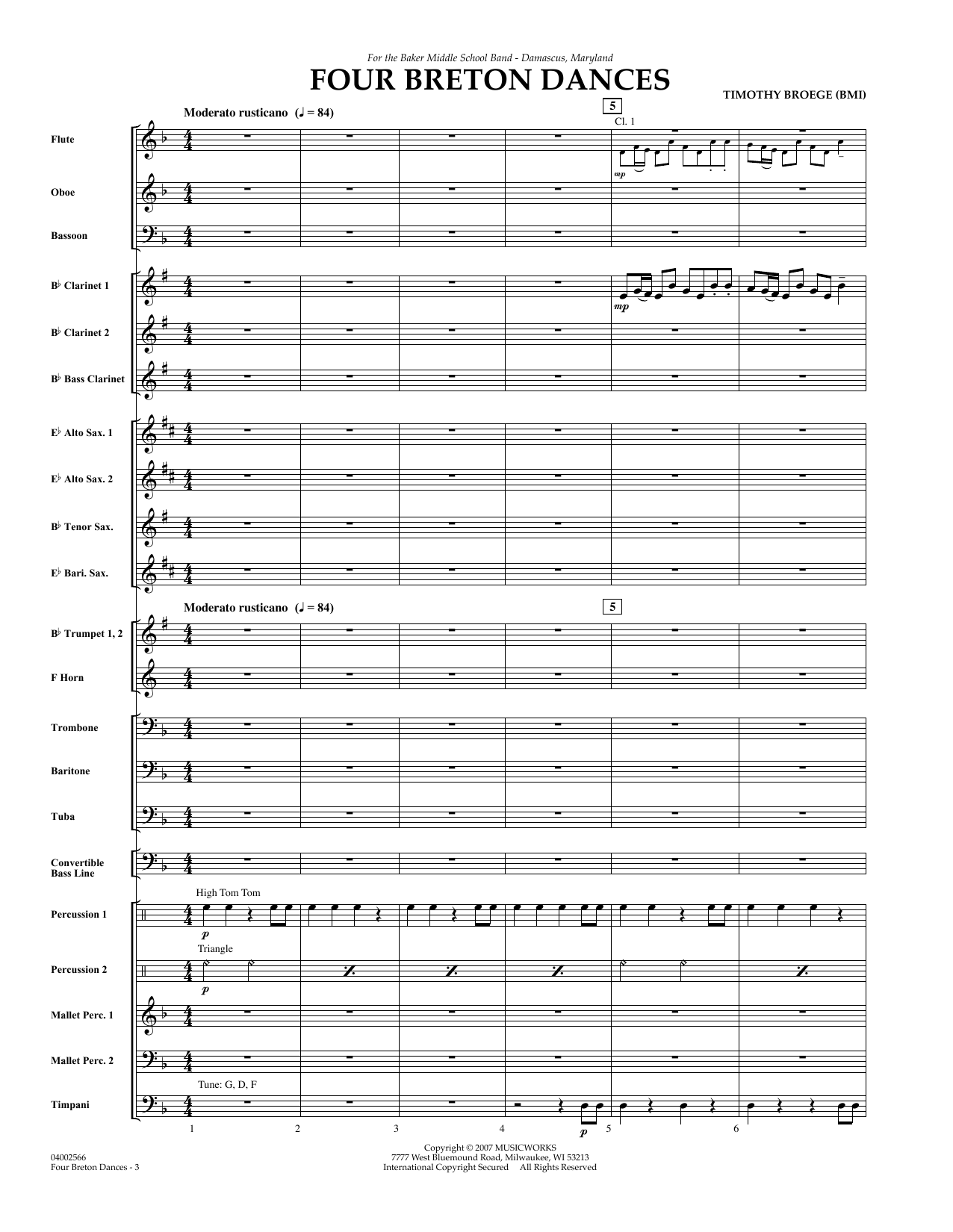

Four Breton Dances: Concert Band Conductor Score & Parts
By Timothy Broege
Grade: 2
Item: 35-PK00324616
$55.00
Pickup currently not available
Buy Extra Parts (Digital PDF Download)
Parts Added to Cart!
Description
The Brittany, or Breton, region of France has been heavily influenced by Celtic traditions, retaining much of its earlier heritage from Scotland and Wales. This composition evolves from four folk dances from this region, and features a captivating mix of modal tunefulness and characteristic harmonic drones.
Dur: 4:20


Four Breton Dances: Concert Band Conductor Score & Parts isn't in MakeMusic Cloud just yet...but it could be. Let us know you'd like to see it, and you'll help shape what comes next. In the meantime, start a free trial and dive into thousands of interactive titles your students can play along with today.
Request This Title
Tell us you want it.
Start Your Free Trial
Explore everything that's ready to play right now.
Sample Audio
No sample audio found.
Sample Video
No sample videos found.
Additional Details
Publisher:
Hal Leonard
SKU:
35-PK00324616
More about this title
About the Composer: Timothy Broege
Timothy Broege has built a distinguished career as a composer and educator with deep roots in band and wind ensemble literature. His works span concert music, educational pieces, and arrangements that consistently demonstrate sophisticated harmonic thinking paired with accessibility for student musicians.
Why we love this
Broege captures the essence of Breton folk tradition without resorting to literal quotation, instead building original melodies that breathe modal color and harmonic depth. The drone-based writing gives your ensemble a textural sophistication rarely found at Grade 2, making this piece as rewarding to conduct as it is to hear.
What to expect
The music evokes wind-swept coastal villages and centuries-old traditions, anchored by characteristic harmonic drones that give it rootedness and warmth. Each dance moves between stately and spirited, offering the ensemble moments of introspection alongside rhythmic vitality.
Who it's for
Grade 2 bands ready to explore something beyond standard folk arrangements. This works beautifully for directors seeking pieces that introduce harmonic sophistication and cultural color without overwhelming younger ensembles with technical demands.
How to get the most out of it
- Lean into the modal character of the melodies by keeping vibrato subtle in the lyrical passages; let the harmonic drones anchor the sound rather than the melody alone.
- Balance the upper woodwinds carefully against sustained lower voices so the folk tune emerges naturally without forcing volume.
- Shape each dance as a distinct character rather than treating the four sections as variations of one idea; tempo and articulation changes will highlight their individual identities.
How to use it
Use this as a bridge piece on a concert pairing classical and contemporary works, or program all four dances as a thematic suite when exploring world music traditions. Its moderate length and intermediate accessibility make it ideal for early-season programming when fundamentals are still settling into place.
Skills your students will build
- Reading modal melodic writing and understanding harmonic function beyond major/minor tonality
- Sustaining harmonic drones without wavering while others carry melodic material
- Balancing blend between upper melodic voices and supporting harmonic layers
- Differentiating character and tempo across contrasting sections within a single piece