
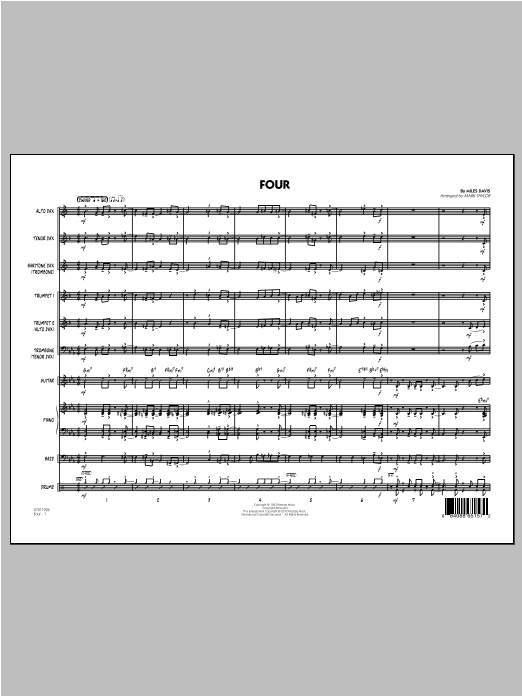

Four: Jazz Ensemble Conductor Score & Parts
By Miles Davis / Arranged by Mark Taylor
Grade: 3
Item: 35-PK00247734
$50.00
Pickup currently not available
Buy Extra Parts (Digital PDF Download)
| Product | Price | Quantity |
|---|---|---|
| Four - Full Score | $7.50 | |
| Four - Alto Sax | $6.00 | |
| Four - Tenor Sax | $6.00 | |
| Four - Baritone Sax | $6.00 | |
| Four - Trumpet 1 | $6.00 | |
| Four - Trumpet 2 | $6.00 | |
| Four - Trombone | $6.00 | |
| Four - Guitar | $6.00 | |
| Four - Piano | $6.00 | |
| Four - Bass | $6.00 | |
| Four - Drums | $6.00 | |
| Four - C Solo Sheet | $6.00 | |
| Four - Bb Solo Sheet | $6.00 | |
| Four - Eb Solo Sheet | $6.00 | |
| Four - Bass Clef Solo Sheet | $6.00 | |
| Four - Alternate Alto Sax | $6.00 | |
| Four - Alternate Tenor Sax | $6.00 | |
| Four - Alternate Trombone | $6.00 |
Parts Added to Cart!
Description
In the skilled hands of Mark Taylor, this medium uptempo jazz standard from Miles Davis works perfectly in this 6 horn format. Carefully using the combination of saxes and brass to full advantage, this one swings hard from start to finish. Includes solos for alto and guitar. (Grade 3)


Four: Jazz Ensemble Conductor Score & Parts isn't in MakeMusic Cloud just yet...but it could be. Let us know you'd like to see it, and you'll help shape what comes next. In the meantime, start a free trial and dive into thousands of interactive titles your students can play along with today.
Request This Title
Tell us you want it.
Start Your Free Trial
Explore everything that's ready to play right now.
Sample Audio
No sample audio found.
Sample Video
No sample videos found.
Additional Details
Publisher:
Hal Leonard
SKU:
35-PK00247734
More about this title
About the Composer: Miles Davis
Miles Davis reshaped jazz repeatedly across his six-decade career, moving fluidly from bebop through cool jazz, modal improvisation, and fusion. His influence on ensemble writing runs deep; his compositions and conceptual approaches have become core repertoire in jazz education, demonstrating how a soloist's voice can drive ensemble cohesion. For student musicians, studying Davis's works opens doors to understanding how jazz standards function as platforms for individual expression within collective sound.
Why we love this
Mark Taylor's arrangement captures what makes this standard endure: the harmonic sophistication and melodic grace of Davis's original, delivered through a lean but colorful horn section that lets each voice breathe. At Grade 3, the parts stay accessible while the energy never flags. Your ensemble gets to inhabit real jazz vocabulary without drowning in technical barriers.
What to expect
Sophisticated yet swinging, the piece moves with unhurried confidence. The interplay between saxes and brass creates a warm, conversational texture that recalls Davis's famous quintet and sextet recordings. Soloists get room to express themselves while the ensemble supplies smart, supportive voicings.
Who it's for
Directors building a Grade 3 jazz repertoire who want substantive material beyond novelty charts. Your players need engaging solo vehicles and honest ensemble writing without excessive demands on range or endurance.
How to get the most out of it
- Let the rhythm section lock the groove first. Once bass and drums establish pocket, the horns can relax into the swing feel rather than forcing it.
- Balance the sax section carefully in the opening statement. The alto should sit naturally above the tenor and bari rather than dominating.
- Encourage the alto soloist to listen closely to the trumpet voicings during their chorus. The conversation between sections is half the content.
- Mark any section hits or hits clearly in rehearsal. Precision on these moments makes the ensemble sound tighter and sharper.
How to use it
Pair this with a blues or another Davis standard to build a focused set that shows depth of repertoire. It works equally well as a winter concert feature or as a springtime closer that leaves the audience satisfied. The medium tempo makes it ideal for programs that need to balance a full evening of material across various tempos and moods.
Skills your students will build
- Swing feel and jazz articulation
- Listening for blend and balance within a section
- Responding to harmonic movement in real time
- Building confidence as a soloist within an ensemble context
- Navigating a jazz standard's form and solo structure