Fortunate Son: Piano/Vocal/Chords Digital Sheet Music

Fortunate Son: Piano/Vocal/Chords Digital Sheet Music

Creedence Clearwater Revival, John C. Fogerty

Item: 00-PS-0007592

Digital Download
$2.95
Description

Fortunate Son: Piano/Vocal/Chords Digital Sheet Music isn't in MakeMusic Cloud just yet...but it could be. Let us know you'd like to see it, and you'll help shape what comes next. In the meantime, start a free trial and dive into thousands of interactive titles your students can play along with today.

Sample Audio
No sample audio found.
Sample Video
Additional Details
SKU: 00-PS-0007592

More about this title

About the Artist: Creedence Clearwater Revival

Creedence Clearwater Revival formed in El Sobrante, California in 1967 and became one of the most commercially successful rock bands of their era. Led by John Fogerty's distinctive vocals and songwriting, the band combined swamp rock, blues, and country influences into a sound that dominated radio and defined late-1960s rock. Their catalog remains a cornerstone of American rock music, with songs that captured the political and social tensions of their time while maintaining immediate, infectious appeal.

The band's influence on popular music education is substantial. Their songs appear consistently in music curricula because they demonstrate strong melodic writing, accessible harmonic structures, and the power of rhythm section work. "Fortunate Son" in particular exemplifies how rock music can carry social commentary while remaining musically engaging across skill levels.

Why we love this

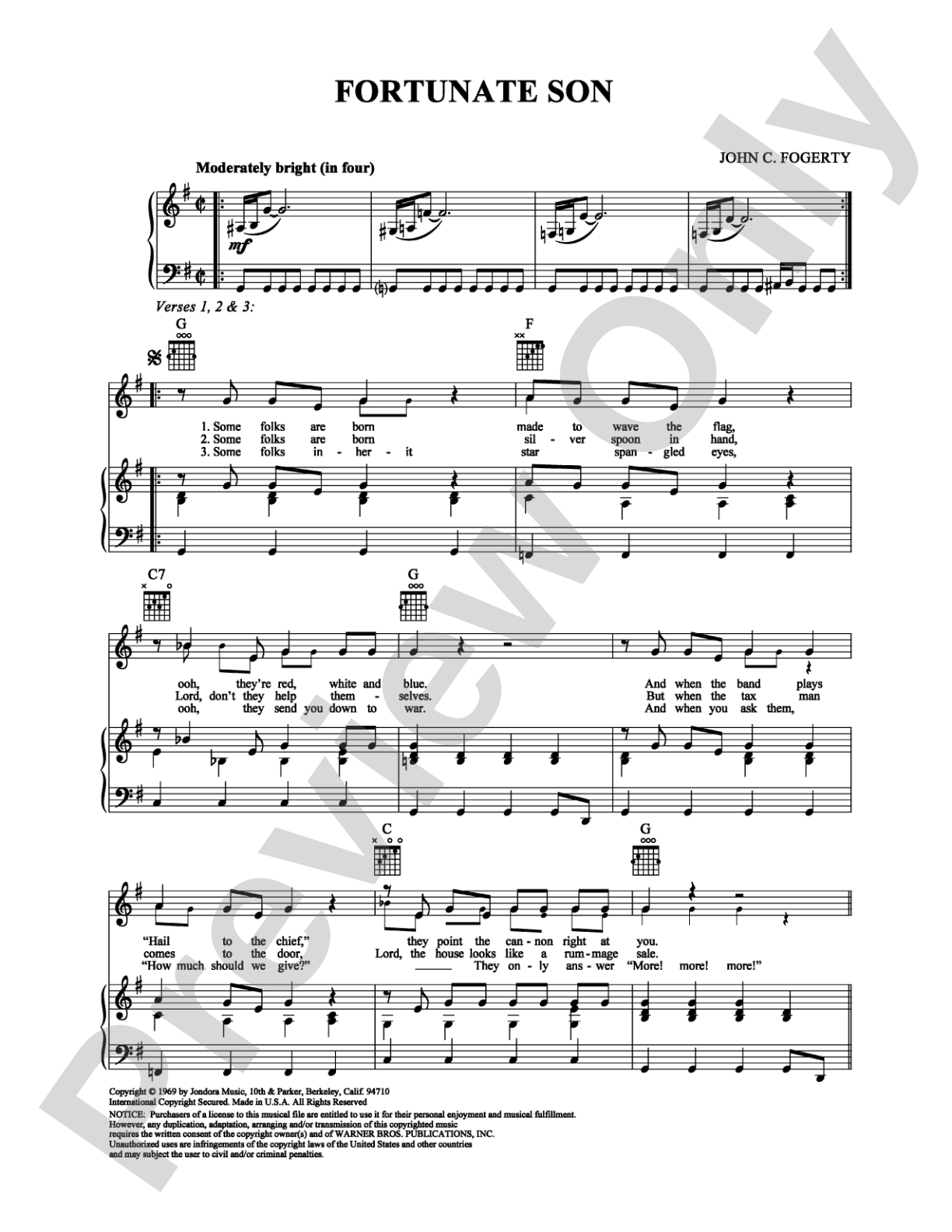
This arrangement captures the driving energy of one of rock's most recognizable protest songs in a format that works equally well for solo performance or classroom exploration. The piano/vocal/chords layout opens the piece to singers, pianists, and guitarists simultaneously, making it ideal for interdisciplinary music study or ensemble arrangements. Students engage with authentic rock songwriting while building sight-reading skills in a cultural context they already recognize.

What to expect

Defiant and grounded. The piano arrangement sits in the pocket with a hypnotic, repeating figure that drives the song forward while the vocal line pulls upward with sarcasm and conviction. There is no lushness here—just forward motion, clarity, and the kind of raw emotion that made Creedence Clearwater Revival's music resonate across generations.

Who it's for

Pianists and singers looking to expand their rock repertoire with a song that has genuine cultural weight. Equally suited to solo recital, guitar-piano-voice ensemble exploration, or music history study in schools where students are learning to analyze rock songwriting and arrangement. This piece works for intermediate and advanced musicians who want to engage with music beyond classical or contemporary commercial pop.

How to get the most out of it

  • Lock the rhythm with a steady 16th-note subdivision in your left hand; the groove lives in the consistency of the accompaniment figure, not in pushing or pulling the beat.
  • Maintain the cynical edge in the vocal delivery—this is not a gentle ballad. Let the attitude come through in your phrasing and dynamic control.
  • Keep the chord voicings relatively open and guitar-like rather than thick and orchestral; sparse texture preserves the song's original rock character.
  • Pay attention to dynamics across verses and chorus; the song's power builds through repetition and intensity, not necessarily through added instrumentation.

How to use it

Slot this into a "Rock and Protest Music" concert or a program exploring American songwriting across genres. It pairs well with folk traditions and contemporary singer-songwriter repertoire, creating a conversation about how melody and message intersect. Alternatively, use it as a bridge between traditional music study and popular music literacy in ensemble or solo contexts.

Skills your students will build

  • Reading rhythmic figures with syncopation and repeated patterns in rock style
  • Balancing vocal expression with accompaniment texture in piano/vocal arrangements
  • Understanding chord progression analysis in popular music (I, IV, V functionality)
  • Interpreting historical and social context within musical performance
  • Managing tempo stability in groove-based music

You May Also Like