
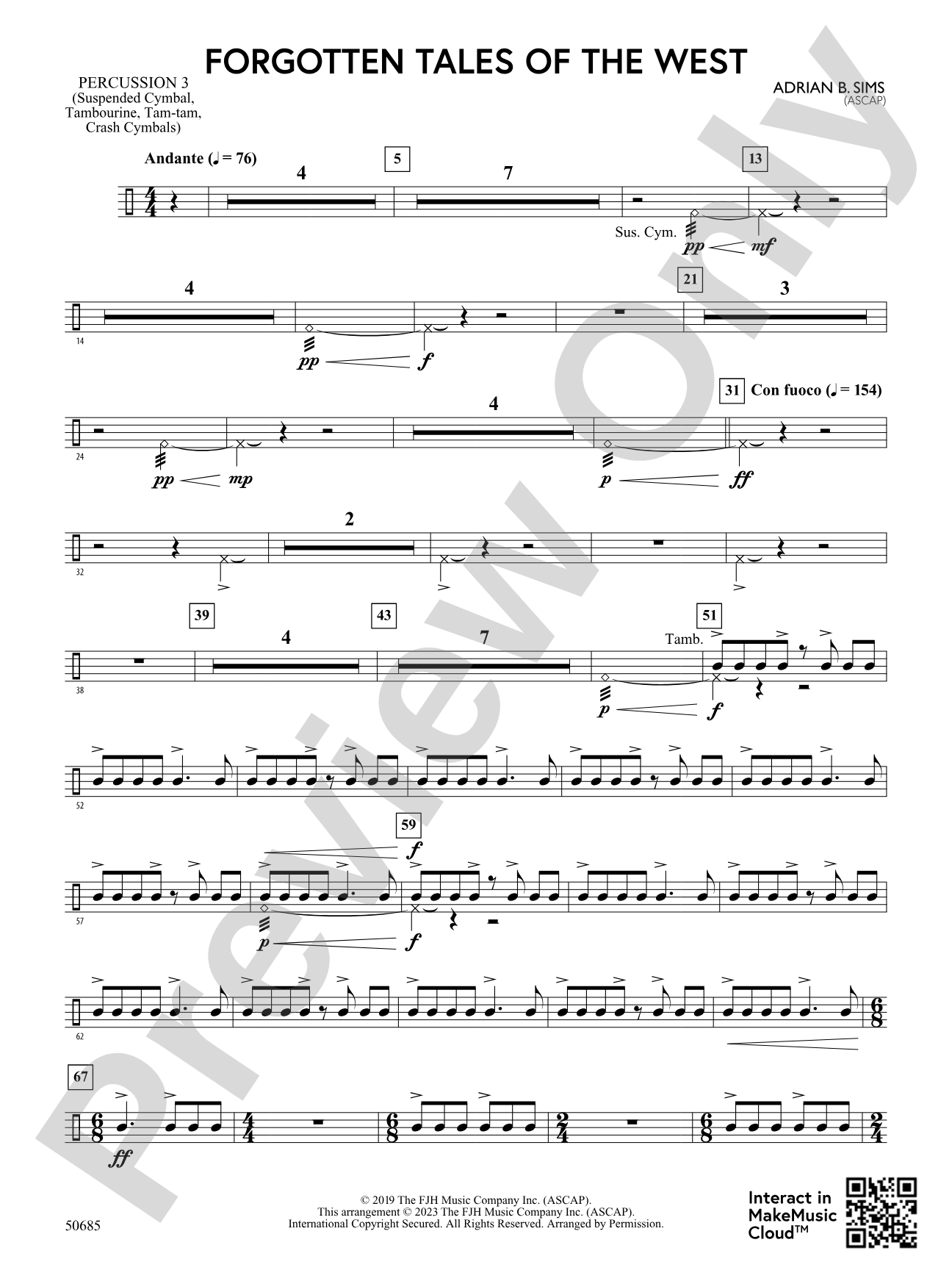

Forgotten Tales of the West: 3rd Percussion
By Adrian B. Sims
Grade: 3.5
Item: 00-PC-0019105_PC3
$3.00
Pickup currently not available
Description
Now in ColorFlex format for groups with limited instrumentation! This powerful work pays tribute to the many battles fought between the Native Americans and Europeans. Forgotten Tales of the West moves between Native American-influenced themes and western harmonies before adapting into an amalgamation of the two. Incredible writing by Adrian B. Sims, who was a teenager when he composed this piece! (4:15)
About ColorFlex
Conductors no longer need to choose between function and texture! Ensembles with instrumentation challenges still have numerous options to cover all parts, yet orchestration is elevated significantly to be faithful to the composer's original intent. Musicians have more opportunities to rest, and timbre once again becomes a central element of each work. So go ahead and have the best of both worlds: flexible and colorful.

Don't just read it, hear it, play along with it, and watch your students grow with it. In MakeMusic Cloud, Forgotten Tales of the West: 3rd Percussion comes alive with professional accompaniment, adjustable tempo, and built-in practice tools that turn solo practice into real progress.
Open in the Player
Jump straight in and assign it today.
Start Your Free Trial
Open this title and explore the full library in minutes.
Sample Audio
1
Audio File
--:--
0:00
0:00
Sample Video
Additional Details
Series:
MakeMusic Symphonic Band
Publisher:
MakeMusic Publications
SKU:
00-PC-0019105_PC3
More about this title
About the Composer: Adrian B. Sims
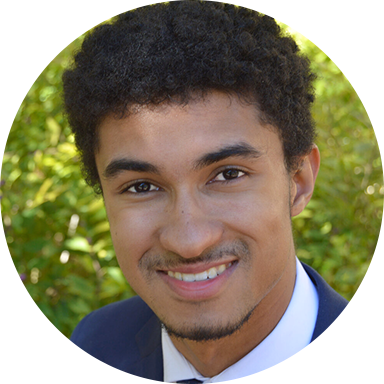
Adrian B. Sims (b. 2000) grew up in Seattle, Washington, and earned his high school diploma from Catonsville High School in Maryland in 2018. His compositions have been performed at The Midwest Band and Orchestra Clinic and appeared on the Bandworld Top 100 List, and he has won awards in the Maryland Music Educators Association Young Composers Project and the Make Music Young Composers Contest.
Sims is a trombonist, conductor, and educator who has performed with pit orchestras, symphony orchestras, jazz ensembles, and concert bands. During high school, he was selected multiple times for the Maryland All-State Band and performed alongside the Baltimore Symphony Orchestra. He is currently pursuing a dual degree in Music Education and Composition at The University of Maryland, where he studies with Matthew Guilford, solo bass trombonist with the National Symphony Orchestra. His musical development has been shaped by his band directors Christopher Gnagey and Cindy Stevenson, as well as mentorship from Dr. Robert Gibson and composer Brian Balmages.
Why we love this
Sims brings genuine dramatic weight to a subject often treated superficially in educational band music. The harmonic and thematic integration of Native American idioms with western tonality creates real compositional sophistication, and the ColorFlex scoring means you're not sacrificing orchestral color to solve your instrumentation puzzle. A work this musically substantial coming from a teenage composer is genuinely impressive.
What to expect
Forgotten Tales of the West sweeps between two musical worlds without apology. The opening honors Native American musical traditions with respect and authenticity, while western harmonies gradually enter as a conversation rather than a conquest. By the end, both voices speak together in a unified sound that feels earned rather than imposed.
Who it's for
Band directors working with groups that lack full instrumentation but refuse to compromise on musical substance. This is also ideal for conductors seeking festival or contest repertoire that combines accessibility with genuine artistic merit.
How to get the most out of it
- Balance the Native American-influenced passages with clarity; these thematic statements anchor the entire piece and deserve space in the ensemble texture.
- Shape the transition into the amalgamated section deliberately. This shift is the emotional climax, so conduct it with intention and allow the harmonic blend to settle.
- Use the ColorFlex options to highlight different instrumental choirs; when one section rests, another gains prominence, which keeps the texture moving forward even at grade 3.5 difficulty.
How to use it
Program this as a concert centerpiece on a festival or contest performance where cultural storytelling matters as much as technical display. Its 4:15 runtime and dramatic arc also make it effective as the first major work on a mixed-difficulty concert, establishing the tone for what follows.
Skills your students will build
- Identifying and sustaining contrasting thematic material across structural sections
- Balancing programmatic intent with ensemble blend in grade 3.5 textures
- Adjusting to ColorFlex instrumentation changes without losing musical continuity
- Reading and performing across diverse harmonic language (modal and functional tonality)
- Responding to conductor shaping of transitions and climactic moments