
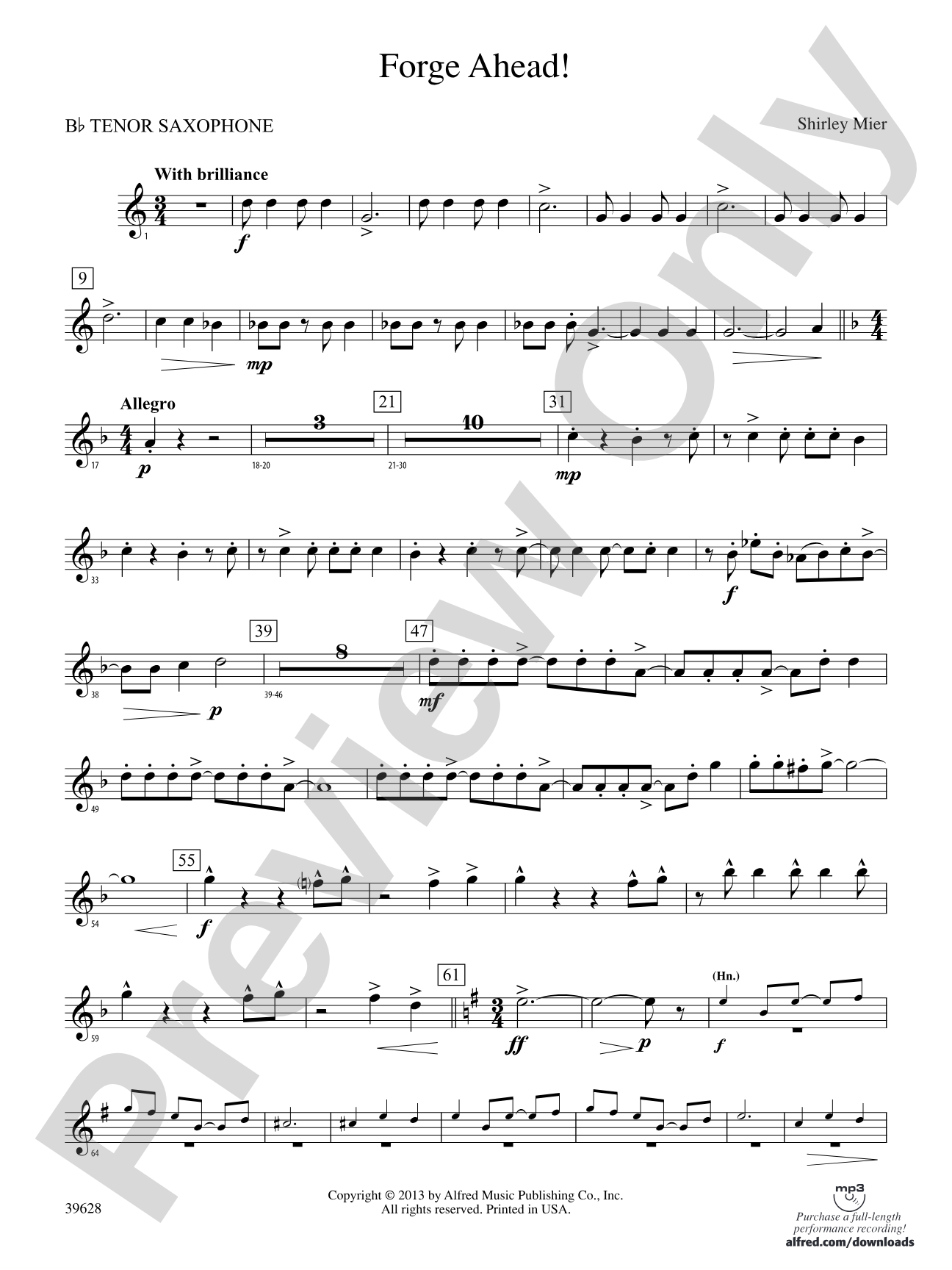

Forge Ahead!: B-flat Tenor Saxophone
By Shirley Mier
Grade: 2.5 (Medium Easy)
Item: 00-PC-0015902_TX1
$3.00
Pickup currently not available
Description
Beginning with a celebratory fanfare, followed by a hushed yet animated melody in the clarinets, the music intensifies, growing in excitement and volume while exploring different themes and sounds as various instrument groups are highlighted. After a moment of reflection and remembrance, the original melody returns in a new key, with a new melody joining in counterpoint as the music drives ever faster toward its exhilarating conclusion. (4:15)


Don't just read it, hear it, play along with it, and watch your students grow with it. In MakeMusic Cloud, Forge Ahead!: B-flat Tenor Saxophone comes alive with professional accompaniment, adjustable tempo, and built-in practice tools that turn solo practice into real progress.
Open in the Player
Jump straight in and assign it today.
Start Your Free Trial
Open this title and explore the full library in minutes.
Sample Audio
1
Audio File
--:--
0:00
0:00
Sample Video
No sample videos found.
Additional Details
Series:
Young Symphonic
Publisher:
Alfred Music
Page Count:
276
SKU:
00-PC-0015902_TX1
More about this title
Why we love this
Mier designs this piece to showcase multiple instrument sections without overwhelming younger players, which means your band stays engaged throughout rather than sitting out for long stretches. The architecture is genuinely clever: a fanfare hook that anchors the piece, contrasting moments of restraint that give players room to breathe, and a final acceleration that feels earned rather than forced. It programs well on a mixed-level concert because it sounds polished and ambitious at 4 minutes 15 seconds without requiring virtuosic technical chops.
What to expect
Forge Ahead opens with brightness and forward motion, then pulls back into something more introspective before surging forward again. The clarinets carry a lyrical thread that feels genuinely songful rather than technical, and as more voices join the texture, the piece builds genuine excitement without ever feeling hectic or out of control.
Who it's for
This works for concert bands at the 2.5 grade level, which includes middle school bands and younger high school ensembles that are reading comfortably in treble and bass clefs but not yet tackling advanced key signatures or complex syncopation. It also suits experienced elementary bands and community ensembles building confidence in performance and balance.
How to get the most out of it
- Shape the opening fanfare with clear articulation and unified tone across the brass. This is your audience's first impression, so commit to the celebratory character without rushing the tempo.
- Balance the clarinet melody in the quieter passage by asking the section to play from the diaphragm rather than backing off the embouchure. Young clarinetists often disappear when told to play softly.
- Mark a clear baton preparation during the moment of reflection. This transition needs to feel intentional and connected, not like the band has lost its way.
- Build momentum gradually in the final section. Resist the urge to jump into the exhilarating conclusion at full speed; let the acceleration emerge naturally so it lands with impact.
How to use it
Program this as an opening number to set an upbeat tone for a concert, or use it as the centerpiece of a program showing range if you want to demonstrate your band's ability to handle both reflective and energetic writing in one piece. It pairs well with slower lyrical selections since Mier's contrasts give you natural programming variety without needing to search for completely disparate styles.
Skills your students will build
- balancing multiple melodic lines across different sections
- maintaining tempo during varied dynamic and textural changes
- executing articulation cues cleanly in fanfare-style figures
- shaping a melodic line with phrase direction and breath awareness
- responding to conductor cues for transitions and key changes
- blend and intonation in sustained harmonic passages