
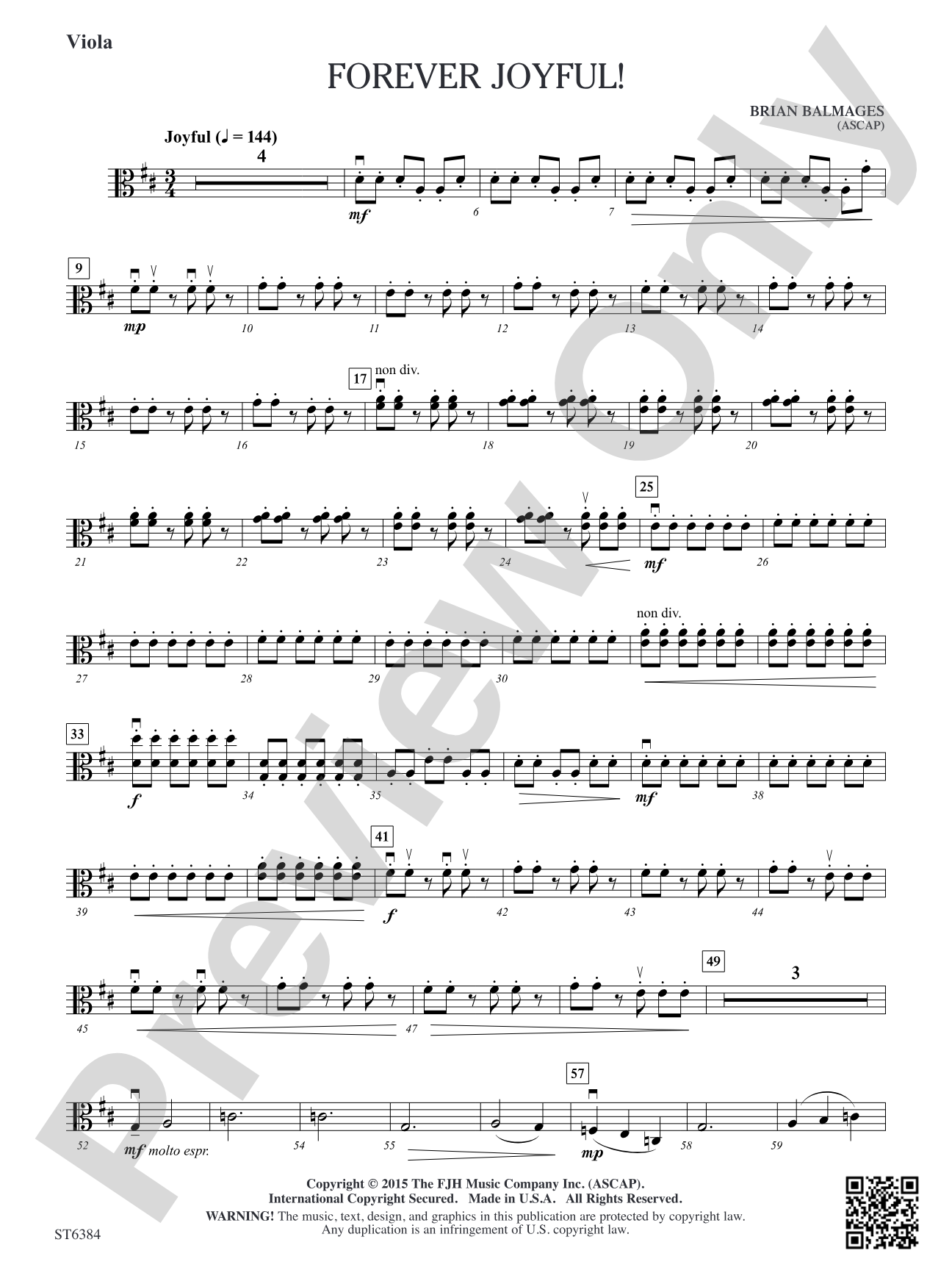

Forever Joyful!: Viola
By Brian Balmages
Grade: 2.5
Item: 98-PC-DST6384_VA1
$7.00
Pickup currently not available
Description
Inspired by pure joy, this work explores uplifting and lighthearted emotions. The music has a constant rhythmic pulse that gently interacts with graceful melodic lines and countermelodies. Engaging harmonies create a complex tapestry without overtaxing any of the individual performers. Wonderful!


Don't just read it, hear it, play along with it, and watch your students grow with it. In MakeMusic Cloud, Forever Joyful!: Viola comes alive with professional accompaniment, adjustable tempo, and built-in practice tools that turn solo practice into real progress.
Open in the Player
Jump straight in and assign it today.
Start Your Free Trial
Open this title and explore the full library in minutes.
Sample Audio
1
Audio File
--:--
0:00
0:00
Sample Video
No sample videos found.
Additional Details
Series:
FJH Developing Strings
Publisher:
The FJH Music Company, Inc.
SKU:
98-PC-DST6384_VA1
More about this title
About the Composer: Brian Balmages

Brian Balmages has established himself as a composer and conductor working across orchestral, band, and chamber music with equal facility. His works have been performed by ensembles ranging from professional symphony orchestras to elementary school groups in prestigious venues including Carnegie Hall, the Kennedy Center, and the Sydney Opera House. He received the A. Austin Harding Award from the American School Band Directors Association and won the 2020 NBA William D. Revelli Composition Contest with Love and Light. Balmages is an elected member of the American Bandmasters Association.
As a conductor, Balmages maintains active guest conducting relationships with all-state and regional ensembles, university orchestras, and professional groups worldwide. His conducting appearances have included the Midwest Clinic, Western International Band Clinic, and numerous state ASTA conferences. He received the inaugural James Madison University Distinguished Alumni Award from the School of Visual and Performing Arts and was commissioned by the University of Miami to compose music for the inauguration of the institution's sixth president. Currently, he serves as Director of MakeMusic Publications and Digital Education for Alfred and MakeMusic.
Why we love this
Balmages constructs this work with genuine care for the young string player. The constant rhythmic pulse provides structural clarity while graceful melodic lines give cellists, violists, and violinists genuinely musical material to shape. The engaging harmonies avoid the trap of being either overly simplistic or unnecessarily dense, which means your rehearsals will focus on musicmaking rather than technical survival.
What to expect
The music radiates genuine warmth without sentimentality. A steady rhythmic foundation anchors graceful melodic gestures that emerge and interweave, creating forward momentum and harmonic richness. The overall effect is uplifting and affirming, the kind of piece that reminds young string players why they love making music together.
Who it's for
String orchestras at the early intermediate level will find immediate success with this work. Directors working with Grade 2.5 ensembles, whether in developing string programs or established orchestras seeking accessible yet rewarding repertoire, will appreciate both the musical quality and the approachable technical demands.
How to get the most out of it
- Cultivate consistency in the rhythmic pulse across all sections rather than allowing it to become mechanical. The pulse should feel organic, not metronomic, even at a young ensemble's tempo.
- Balance the melodic line against the countermelodies and accompanying voices. Balmages layers musical interest throughout the texture, so resist the urge to let any single section dominate the sound.
- Let the uplifting character breathe naturally. The music invites joy without requiring exaggeration; clarity and ensemble precision will convey the emotional content more effectively than forced brightness.
How to use it
This work fits naturally into a concert celebrating accessible orchestral writing or as part of a spring program emphasizing lighter works. It also serves well as a contest or festival selection where the combination of musical substance and achievable technical level can showcase ensemble growth to adjudicators.
Skills your students will build
- Maintaining rhythmic consistency while executing graceful melodic phrasing
- Balancing melodic and accompanimental roles within a layered texture
- Reading and performing countermelodies and secondary voices with independence
- Sustaining tone quality across longer phrases at moderate dynamics