
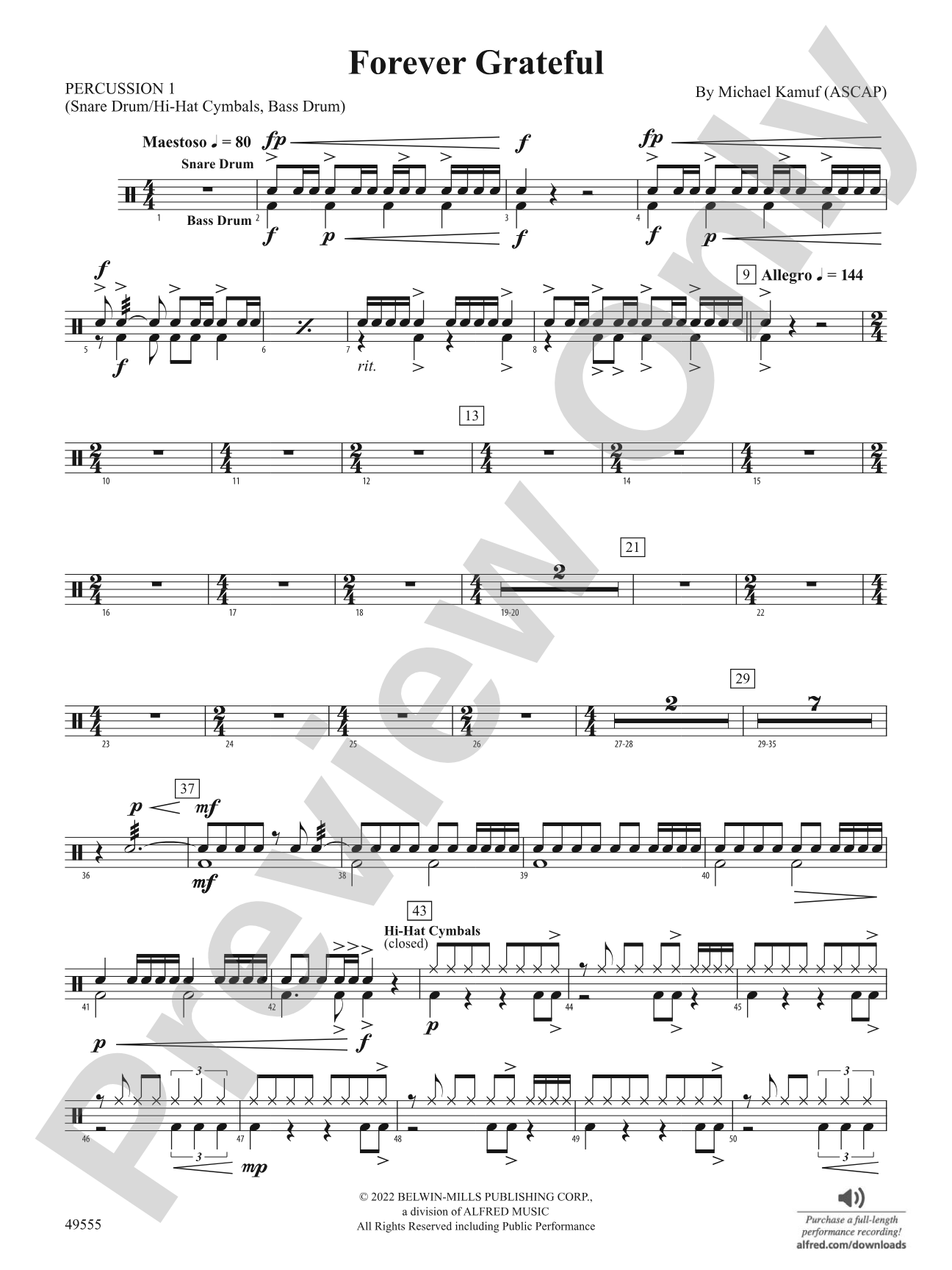

Forever Grateful: 1st Percussion
By Michael Kamuf
Grade: 2.5
Item: 00-PC-0018828_PC1
$3.00
Pickup currently not available
Description
With soaring melodies, driving percussion rhythms, and use of non-traditional harmonies, composer Michael Kamuf's fanfare-like work, Forever Grateful, will help you reinforce phrasing and subdivision in a fun way with your students. This is the perfect opening selection for next your young band performance! (2:52)


Don't just read it, hear it, play along with it, and watch your students grow with it. In MakeMusic Cloud, Forever Grateful: 1st Percussion comes alive with professional accompaniment, adjustable tempo, and built-in practice tools that turn solo practice into real progress.
Open in the Player
Jump straight in and assign it today.
Start Your Free Trial
Open this title and explore the full library in minutes.
Sample Audio
1
Audio File
--:--
0:00
0:00
Sample Video
Additional Details
Series:
Belwin Young Band
Publisher:
Alfred Music
SKU:
00-PC-0018828_PC1
More about this title
About the Composer: Michael Kamuf

Michael Kamuf earned Bachelor of Music degrees in Jazz Performance and Music Education from the Dana School of Music at Youngstown State University, followed by a Master of Arts in Instrumental Conducting from George Mason University. His compositions and arrangements have been performed by major ensembles including the Woody Herman and Glenn Miller Orchestras, the USAF Airmen of Note, the US Navy Commodores, and soloists such as James Moody, Eddie Daniels, and Sean Jones. As an exclusive writer for Belwin, he has published over 100 works across jazz, orchestra, and concert band catalogs, with additional titles through UNC Jazz Press, Kjos, and FJH Music.
Kamuf taught instrumental music in Maryland public schools for three decades, spending twenty-seven years as Director of Bands and Orchestras at John T. Baker Middle School in Damascus. Under his leadership, the Baker ensembles earned consistent festival recognition and commissioned multiple works for young bands. He continues to perform and lead the Mike Kamuf Little Big Band, a jazz octet based in the Baltimore and Washington, DC region.
Why we love this
Kamuf writes with young band ensembles in mind, balancing musical substance with teachable moments. The fanfare-style approach and soaring melodic writing keep students engaged while the rhythmic clarity and non-traditional harmonies create natural teaching opportunities without feeling didactic. This is the kind of opener that energizes an audience and your musicians from the first downbeat.
What to expect
Bright, energetic, and celebratory, with soaring melodic lines that give musicians something meaningful to play. The driving percussion work propels the music forward while Kamuf's harmonic language adds sophistication and keeps the sound from feeling predictable. At just under three minutes, it delivers full musical impact in a compact, digestible form.
Who it's for
Grade 2.5 concert bands seeking an engaging, musically substantial opening work that teaches phrasing and rhythmic precision without sacrificing style. Directors preparing young ensembles for festivals or concerts will find the fanfare energy and moderate technical demands ideal for building confidence and audience connection.
How to get the most out of it
- Shape the soaring melodies with clear phrase arcs; mark your breathing points in parts so students understand where lines breathe and how sustained tones connect the fanfare sections.
- Lock the driving percussion rhythms early in rehearsal so the rhythm section anchors the subdivision for the full ensemble; consider sectional work with mallets and battery before full-band rehearsals.
- Balance the non-traditional harmonic language by having musicians listen for how each chord resolves; this trains ears and prevents the harmonies from feeling muddy even when the sonorities are unconventional.
- Record a rehearsal once the piece is performance-ready and play it back for the band; student musicians often hear phrase shaping and articulation refinement instantly when they hear themselves.
How to use it
This is a natural concert opener; it establishes energy and sets a celebratory tone without overshadowing the repertoire that follows. It works equally well as a festival selection at the Grade 2.5 level or as a feature piece for a spring concert that highlights young ensemble musicianship. The contest/festival designation makes it a smart choice for groups targeting multiple competitive platforms.
Skills your students will build
- Phrasing across longer melodic lines with clear breath points
- Subdivision clarity in driving rhythmic sections
- Reading and balancing non-traditional harmonic progressions
- Coordinating between melodic and rhythmic sections in fanfare-style writing