
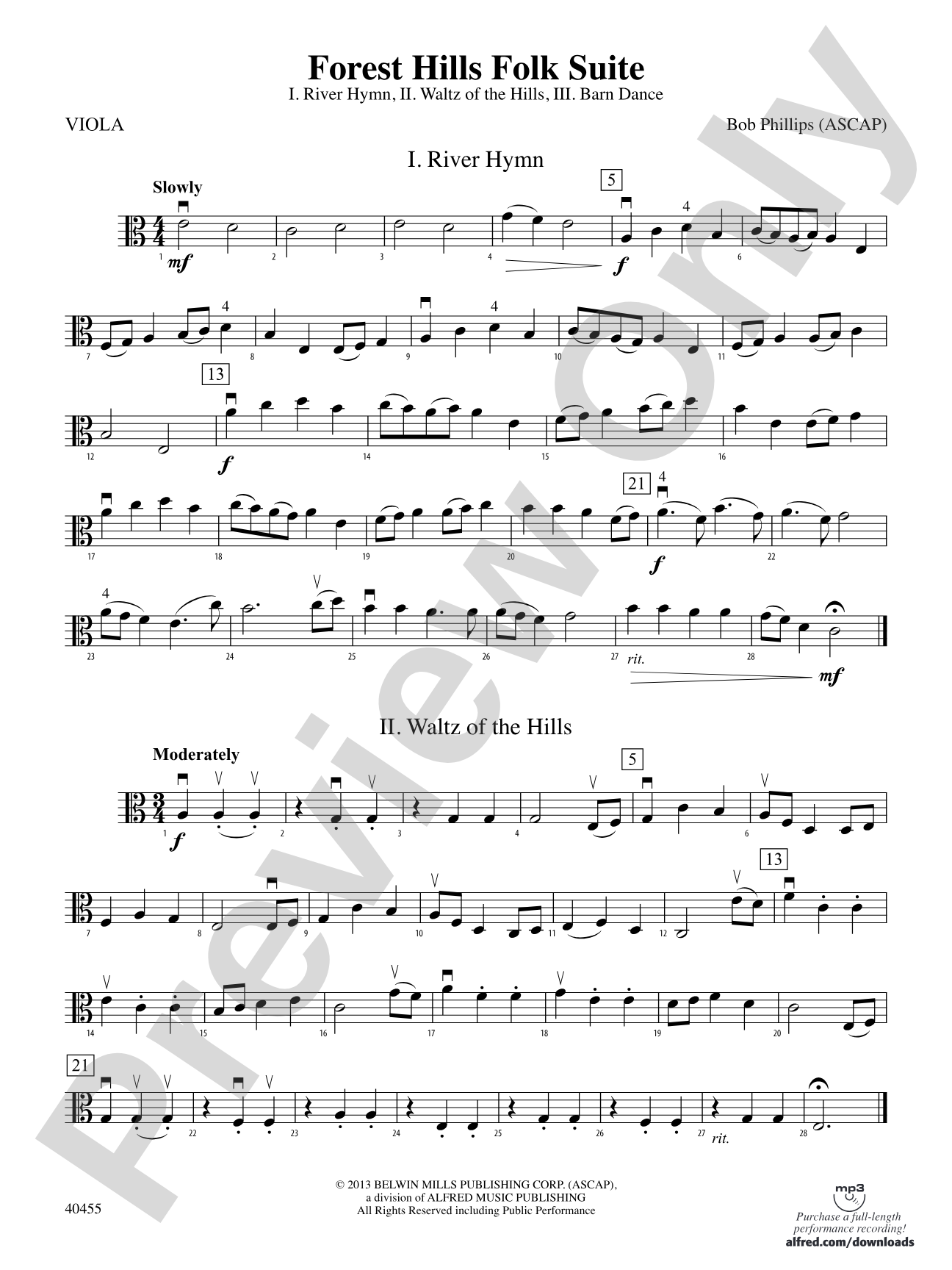

Forest Hills Folk Suite: Viola
I. River Hymn, II. Waltz of the Hills, III. Barn Dance
By Bob Phillips
Grade: 2
Item: 00-PC-0015989_VA1
$5.99
Pickup currently not available
Description
Beautiful, original melodies abound in all sections, but the violas and cellos really get a chance to shine in this suite comprised of three movements: "River Hymn," "Waltz of the Hills," and "Barn Dance." In C Major, this piece is ideal to teach F and C natural. The movements are brief and can be performed individually or as a suite. Remaining true to the early Americana feel of the piece, the last movement is an upbeat, old-timey tune! Correlates to Sound Innovations Book 2, Level 2. This title is available in MakeMusic Cloud.


Don't just read it, hear it, play along with it, and watch your students grow with it. In MakeMusic Cloud, Forest Hills Folk Suite: Viola comes alive with professional accompaniment, adjustable tempo, and built-in practice tools that turn solo practice into real progress.
Open in the Player
Jump straight in and assign it today.
Start Your Free Trial
Open this title and explore the full library in minutes.
Sample Audio
1
Audio File
--:--
0:00
0:00
Sample Video
No sample videos found.
Additional Details
Series:
Sound Innovations for String Orchestra
Publisher:
Alfred Music
Page Count:
140
SKU:
00-PC-0015989_VA1
More about this title
About the Composer: Bob Phillips

Bob Phillips has shaped string education across multiple decades through his prolific output as a composer and pedagogue. Since the 1980s, he has published over 200 works for orchestras and bands while authoring more than 25 instructional series; his Sound Innovations curriculum alone reaches thousands of string students annually. His compositional work spans classical foundations and eclectic styles (jazz, rock, mariachi, Latin, and folk traditions), earning him recognition as an ASCAP award-winning composer whose pieces appear regularly at the Midwest Clinic.
Phillips built an exemplary string program in Saline, Michigan that grew to over 700 students and became a national model for both classical and stylistically diverse repertoire. His ensemble Saline Fiddlers Philharmonic gained international prominence through frequent performances at major venues and conferences, including multiple appearances at the White House. He has conducted honors orchestras, all-state groups, and youth ensembles across the country, and served as resident conductor for the Wintergrass Festival in Seattle.
Why we love this
Phillips writes idiomatically for strings at this level, ensuring that middle-grade players get genuinely musical material rather than exercises dressed as pieces. The suite structure lets you program flexibly: teach all three movements together or extract individual selections for concerts without losing coherence. Violas and cellos finally step into the spotlight with substantial melodic writing, a welcome shift from typical Grade 2 repertoire where these voices often carry harmonic filler.
What to expect
Forest Hills Folk Suite unfolds like a lyrical journey through American pastoral landscape: "River Hymn" opens with reverent, hymn-like phrasing; "Waltz of the Hills" dances gracefully with period charm; "Barn Dance" erupts with infectious, old-time fiddle energy and joy. The writing is consistently lyrical without ever feeling saccharine, and the folk idiom gives students permission to phrase generously and play with stylistic warmth.
Who it's for
String orchestras in grades 2-3 who have solid rhythmic foundation and are ready for pieces with genuine character and melodic substance. Directors seeking material that engages all sections equally will appreciate Phillips's approach to voice balance here. This suite works equally well for festival preparation or standard concert programming.
How to get the most out of it
- Honor the early Americana character by finding the legit folk roots of each movement; "River Hymn" should breathe like a hymnal, while "Barn Dance" needs rhythmic drive without rushing.
- Balance the inner voices carefully in "Waltz of the Hills," where viola and cello lines carry as much musical weight as the first violins.
- Use the three-movement structure strategically: rehearse movements individually before combining them, which also gives students concrete short-term goals and builds stamina progressively.
- The C Major and F natural focus means intonation work pays immediate dividends; lock those tonalities early so students hear the harmonic center throughout the suite.
How to use it
Program the entire suite as a concert centerpiece, or select individual movements to pair with contrasting classical repertoire for programmatic variety. The brief, self-contained movements make this ideal for festival competition, where you can feature it as a complete submission or remix the lineup depending on rehearsal progress. Align the teaching timeline with Sound Innovations Book 2 instruction if you use that curriculum; the correlation strengthens both the method work and this performance piece.
Skills your students will build
- Intonation in F and C natural across all string sections
- Sustained legit and phrasing in hymn-like material
- Viola and cello independence and confidence with primary melodic lines
- Stylistic awareness of early Americana fiddle and folk traditions
- Rhythmic precision and lift in waltz meter (3/4) and traditional dance figures