
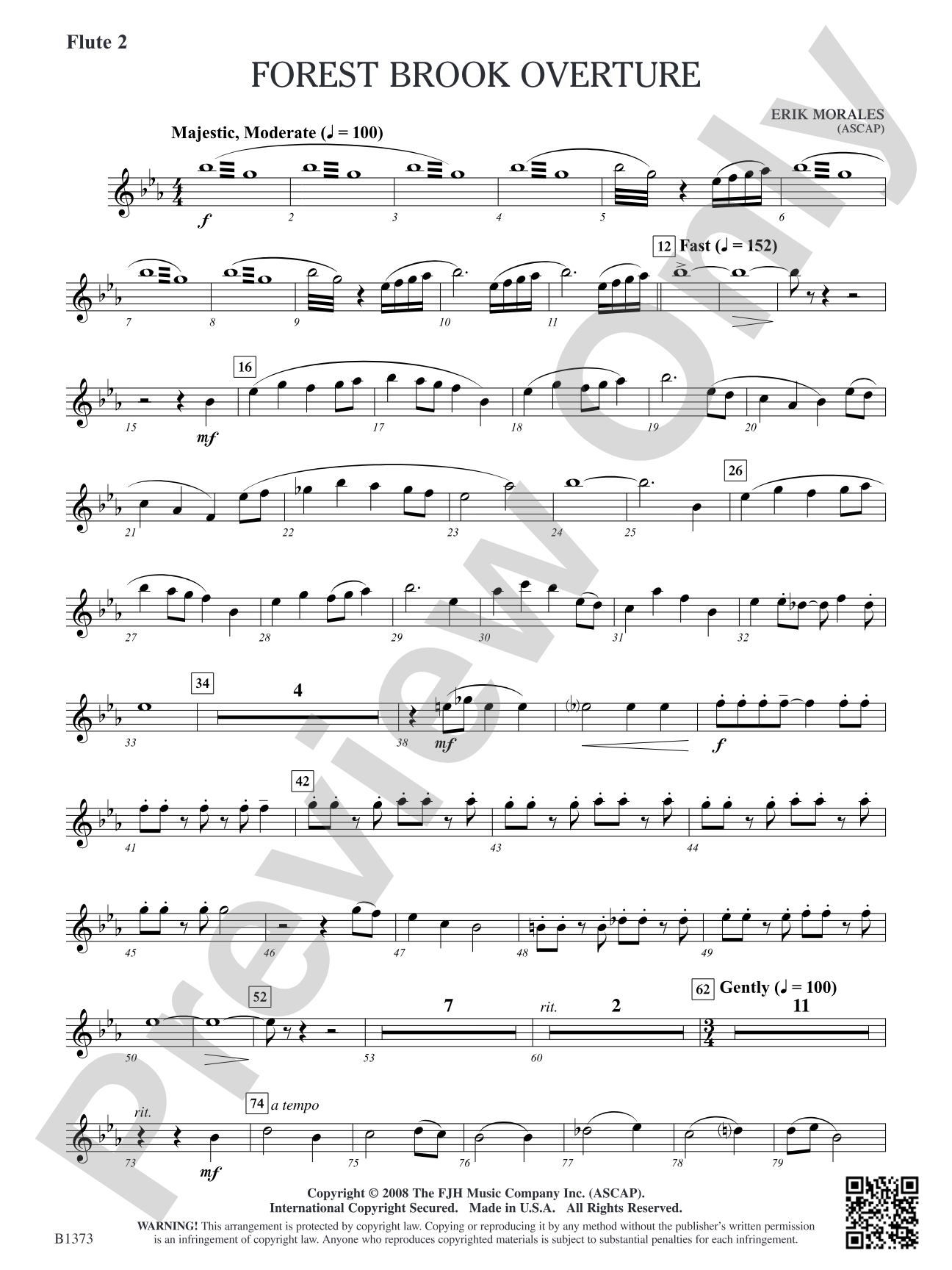

Forest Brook Overture: Flute 2
By Erik Morales
Grade: 2.5
Item: 98-PC-DB1373_F2
$7.00
Pickup currently not available
Description
This quintessential festival work will showcase your band with its bold brass fanfares, playful melodies, and an emotional uplifting middle section. Invigorating harmonies really set this apart from other overtures at this level, and the closing section somehow combines all prior themes in a fury of rhythmic activity to really bring this to an exciting conclusion. Outstanding writing that will surely be the highlight of your next program or contest performance!


Forest Brook Overture: Flute 2 isn't in MakeMusic Cloud just yet...but it could be. Let us know you'd like to see it, and you'll help shape what comes next. In the meantime, start a free trial and dive into thousands of interactive titles your students can play along with today.
Request This Title
Tell us you want it.
Start Your Free Trial
Explore everything that's ready to play right now.
Sample Audio
1
Audio File
--:--
0:00
0:00
Sample Video
No sample videos found.
Additional Details
Series:
FJH Young Band
Publisher:
The FJH Music Company, Inc.
SKU:
98-PC-DB1373_F2
More about this title
About the Composer: Erik Morales

Erik Morales has built a prolific composing career spanning over four decades, with more than 150 published works across wind, orchestral, jazz, and chamber settings. Born in New York City in 1966, he studied composition at Florida International University and earned his bachelor's degree from the University of Louisiana, Lafayette in 1989. His early career took shape when a high school band director in south Florida commissioned arrangements in 1985, launching him into educational music publishing by 2002.
As a trumpet player and composer, Morales has made significant contributions to the trumpet repertoire. His trumpet ensemble works have earned first place honors at the 2006 and 2008 National Trumpet Competitions, and his Concerto for Trumpet in C and Piano premiered at the 2009 International Trumpet Guild conference. In 2012, a consortium commissioned his Concerto for Two Trumpets, which debuted at the 2013 ITG conference. Morales was inducted into the Louisiana Association for Jazz Education's Hall of Fame in 2016. His compositions consistently balance artistic integrity with pedagogical accessibility, making them staples in school and festival programming worldwide.
Why we love this
Morales writes overtures that actually feel like overtures: purposeful thematic development, intelligent orchestration at the Grade 2.5 level, and genuine emotional architecture rather than a string of separate vignettes. The harmonic language elevates what could be a straightforward opener into something memorable without demanding virtuosity that doesn't yet exist in young bands.
What to expect
Forest Brook Overture opens with bold confidence and playground energy, then settles into a warmly introspective moment before accelerating into a satisfying, tightly woven conclusion. The writing captures both the brightness of young musicianship and the deeper musicality that happens when a band commits to ensemble precision and balance.
Who it's for
This work fits Grade 2.5 bands that have solid fundamentals and are ready to tackle genuine musical architecture without excessive technical demands. Festival and contest-bound ensembles will find a showpiece that judges respect, and programs benefit from a piece that announces capability without requiring a high school or university-level skill set.
How to get the most out of it
- Balance the opening brass fanfares so they project authority without overwhelming the full ensemble; the clarinets and upper woodwinds need room to carry their counter-melodies.
- Shape the middle section's slower material with genuine lyricism from your melody carriers; this is where emotional impact lives, and it requires patient phrasing from individual players.
- Build the final rhythmic drive carefully in rehearsal by locking the percussion section's subdivisions first, then layering brass and woodwind rhythmic figures underneath so the conclusion feels coordinated rather than chaotic.
- Use the printed dynamics as written to create the arc from bold opening through tender middle to triumphant close; underplaying early sections makes the finale land with greater force.
How to use it
Program this as the first major work on a festival or concert program to establish both energy and credibility. It pairs well with lighter fare in the second half and gives conductors a piece that showcases refinement and musical maturity at a grade level where many programs default to simpler selections.
Skills your students will build
- Ensemble balance between brass, woodwinds, and percussion in fast-moving textures
- Phrasing and dynamic shaping in slower, legit writing
- Rhythmic precision in syncopated and staggered ensemble figures
- Reading and responding to clear but detailed conductor gestures across multiple thematic sections