
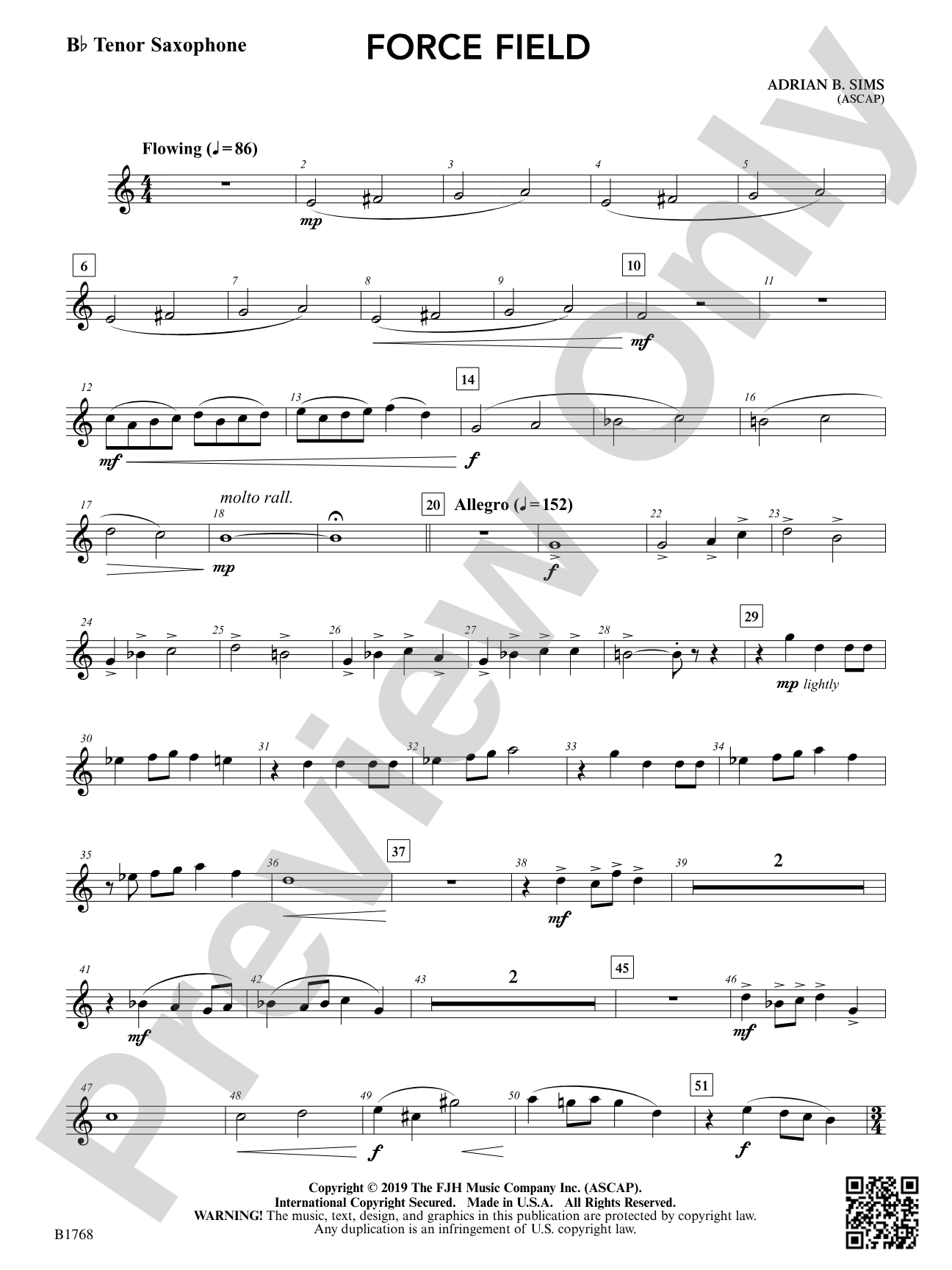

Force Field: B-flat Tenor Saxophone
By Adrian B Sims
Grade: 2.5
Item: 98-PC-DB1768_TX1
$7.00
Pickup currently not available
Description
The teenage composer writes that this piece signifies “strength and durability.” The bold statements at the beginning and end represent the power with which a force field stands, while the middle lyrical section depicts protection. Highly engaging music written by an emerging young composer!


Force Field: B-flat Tenor Saxophone isn't in MakeMusic Cloud just yet...but it could be. Let us know you'd like to see it, and you'll help shape what comes next. In the meantime, start a free trial and dive into thousands of interactive titles your students can play along with today.
Request This Title
Tell us you want it.
Start Your Free Trial
Explore everything that's ready to play right now.
Sample Audio
1
Audio File
--:--
0:00
0:00
Sample Video
Additional Details
Series:
FJH Young Band
Publisher:
The FJH Music Company, Inc.
SKU:
98-PC-DB1768_TX1
More about this title
About the Composer: Adrian B Sims

Adrian B Sims (b. 2000) is a composer, conductor, educator, and trombonist from Seattle, Washington who studied composition at the University of Maryland under Dr. Robert Gibson and received mentorship from world-renowned composer Brian Balmages. His works have been performed at The Midwest Band and Orchestra Clinic, recognized on the Bandworld Top 100 List, and selected as winners in the Maryland Music Educators Association Young Composers Project and the Make Music Young Composers Contest.
As a trombonist, Sims has performed across multiple ensembles including symphony orchestras, jazz bands, and concert bands, and was selected multiple times for the Maryland All-State Band while in high school. He earned his degrees in Music Education and Composition from the University of Maryland, where he studies with Matthew Guilford, solo bass trombonist with the National Symphony Orchestra, and regularly conducts his own works in performance settings across Maryland schools.
Why we love this
A young composer writing with compositional maturity and clear structural intention: this piece opens with genuine force, builds a lyrical middle section that contrasts rather than merely interrupts, and closes with conviction. At Grade 2.5, the writing sits at that sweet spot where students feel the satisfying weight of a concert piece without drowning in technical demands, making it ideal for groups seeking repertoire that sounds more substantial than its grade level suggests.
What to expect
Force Field opens with commanding presence, its bold statements demanding attention. The middle section softens into a protective, lyrical landscape before the opening theme returns with even greater resolve, creating an arc that feels both accessible and emotionally coherent. Young musicians will recognize immediately that they're playing something written with purpose.
Who it's for
Concert bands at the Grade 2-3 level seeking contest or festival repertoire that showcases compositional craft without excessive technical complexity. Directors will find a piece that engages students with meaningful musical ideas and rewards ensemble listening and balance work.
How to get the most out of it
- Shape the opening statements with clarity and weight; these bold gestures set the piece's identity, so commit fully to dynamic contrast rather than playing safe.
- Bring transparency to the middle lyrical section by reducing dynamics slightly and allowing inner voices to breathe; the contrast will make the final return even more powerful.
- Lock the ensemble's articulation in the opening and closing sections so the bold character reads as unified rather than scattered.
- Use the recorded accompaniment to establish steady tempo through section transitions, particularly moving from the lyrical middle back into the energetic finale.
How to use it
This works beautifully as a contest or festival entry for bands seeking to demonstrate musical growth beyond technical flash. Pair it alongside a lyrical ballad and a lighter opener to show your ensemble's range, or program it as the centerpiece of a concert that showcases student composers and emerging voices in wind band literature.
Skills your students will build
- Dynamic control and shaping of bold opening and closing statements
- Balance and transparency in lyrical middle sections
- Contrast between energetic and lyrical musical characters
- Ensemble articulation consistency and ensemble listening