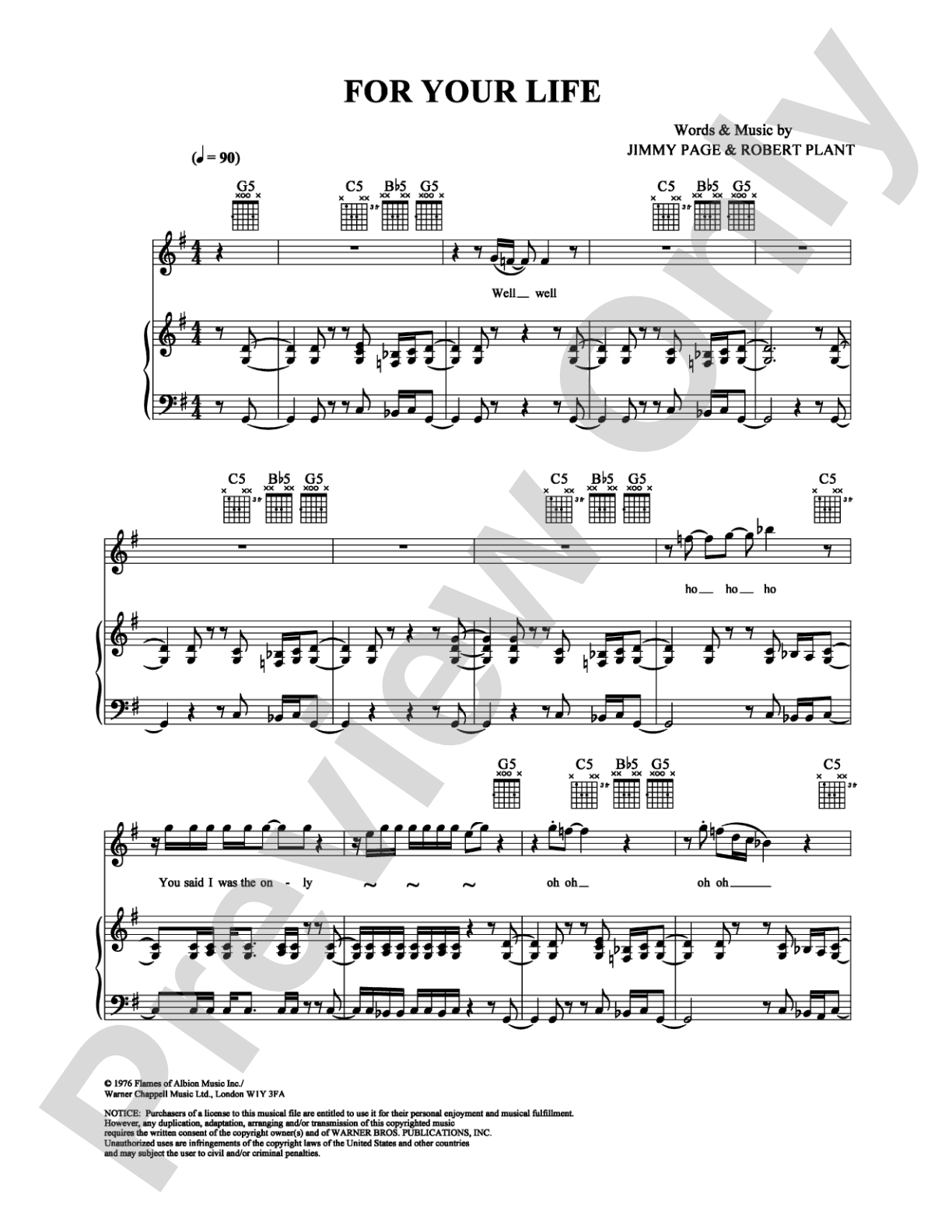
For Your Life: Piano/Vocal/Chords Digital Sheet Music

For Your Life: Piano/Vocal/Chords Digital Sheet Music

Led Zeppelin, Jimmy Page, Robert Plant

Item: 00-PS-0002860

Digital Download
$3.99
Description

For Your Life: Piano/Vocal/Chords Digital Sheet Music isn't in MakeMusic Cloud just yet...but it could be. Let us know you'd like to see it, and you'll help shape what comes next. In the meantime, start a free trial and dive into thousands of interactive titles your students can play along with today.

Sample Audio
No sample audio found.
Sample Video
Additional Details
SKU: 00-PS-0002860

More about this title

About the Artist: Led Zeppelin

Led Zeppelin redefined rock music across the 1970s through their fusion of blues, folk, and Eastern influences with heavy amplification and mythic songwriting. The band's impact on popular music extends far beyond their era; their harmonic sophistication, dynamic control, and willingness to blend acoustic and electric textures shaped generations of musicians across genres.

Why we love this

This song bridges the gap between rock history and serious musicianship. The piano/vocal/chords arrangement strips away the original's orchestration to reveal the song's harmonic foundation, making it accessible for singers and pianists who want to understand how Led Zeppelin constructed their material. It's an honest way to teach students about songwriting craft without oversimplifying the music.

What to expect

This arrangement preserves the emotional weight and introspection of the original while stripping it down to essentials. The piano/vocal format invites intimacy without losing the song's power.

Who it's for

Pianists and singers who know rock music and want to explore how major artists structure songs harmonically. Advanced high school vocalists or college-level singers preparing audition material or exploring genre outside classical and musical theatre repertoire will find real value here.

How to get the most out of it

  • Pay attention to the dynamic shape of each verse and chorus; the original recording builds intensity through arrangement, so your interpretation needs to account for that trajectory even in a reduced setting.
  • Treat the piano part as a foundation rather than a full orchestral reduction. Space and silence matter as much as the notes themselves.
  • The vocal line sits in a specific register in the original; experiment with transposition early if the key doesn't serve your voice, but be aware that changing keys shifts the song's character significantly.

How to use it

This works well in a contemporary music or rock history unit where students analyze how professional songwriters approach harmony and form. It can also serve as a bridge piece in a recital that mixes classical and popular repertoire.

Skills your students will build

  • Reading lead sheets and chord symbols
  • Harmonic analysis of popular song structures
  • Balancing vocal line independence with harmonic support
  • Interpretation of dynamics and phrasing in unfamiliar genres

You May Also Like