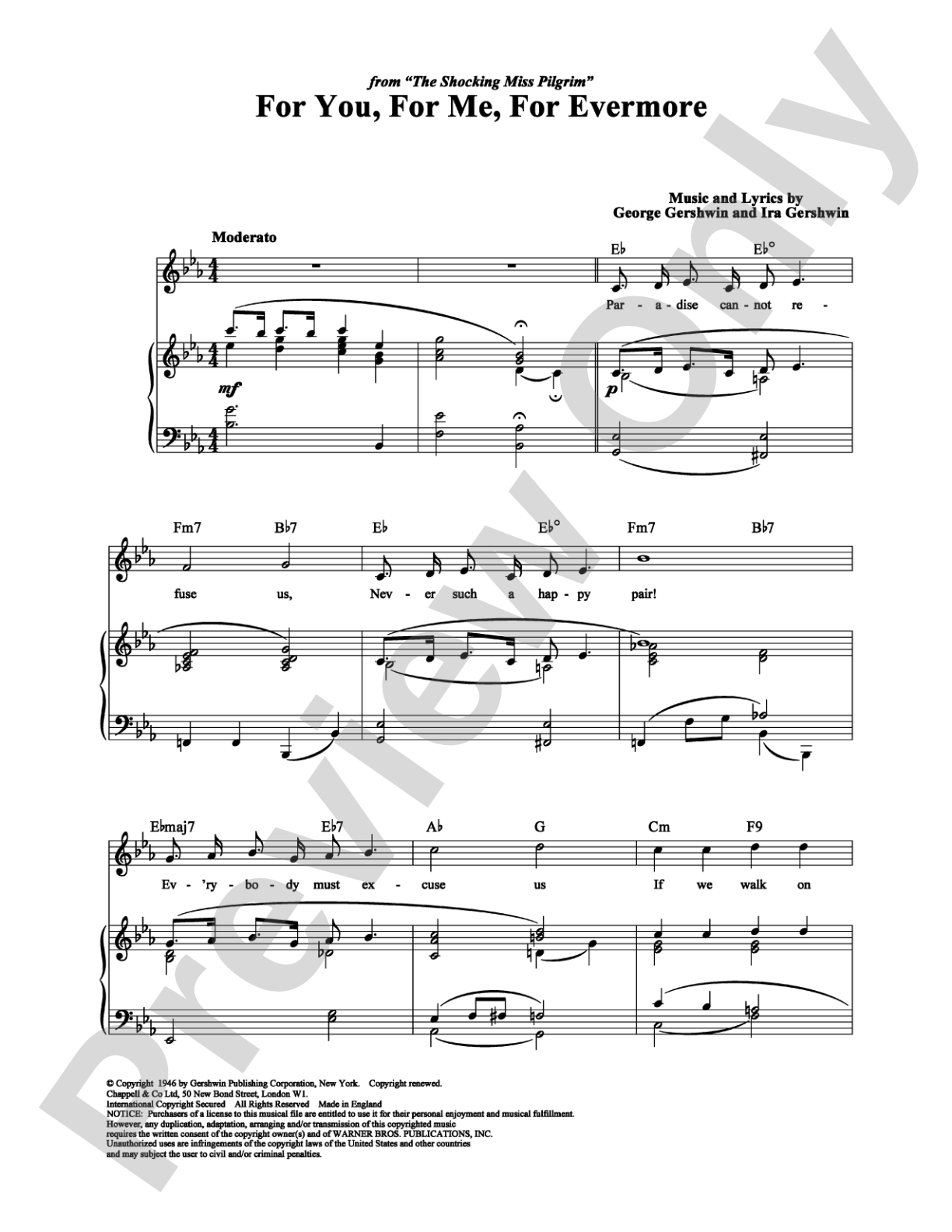
For You, For Me, For Evermore: Piano/Vocal/Chords Digital Sheet Music

For You, For Me, For Evermore: Piano/Vocal/Chords Digital Sheet Music

George Gershwin, Dick Haymes

Item: 00-PS-0004503

Digital Download
$3.99
Description

For You, For Me, For Evermore: Piano/Vocal/Chords Digital Sheet Music isn't in MakeMusic Cloud just yet...but it could be. Let us know you'd like to see it, and you'll help shape what comes next. In the meantime, start a free trial and dive into thousands of interactive titles your students can play along with today.

Sample Audio
No sample audio found.
Sample Video
Additional Details
SKU: 00-PS-0004503

More about this title

About the Artist: Dick Haymes

Dick Haymes (1918-1980) was an American baritone and actor who became one of the most sought-after vocalists of the 1940s and 1950s. Known for his smooth tone, impeccable phrasing, and emotional depth, Haymes recorded extensively for major labels including Decca and Capitol, establishing himself as a leading interpreter of the American songbook.

Why we love this

This standard gives singers a chance to work with a melody that rewards clear diction and legit phrasing in the classic vocal tradition. The piano/vocal/chords format makes it accessible for teaching purposes while preserving the harmonic sophistication that makes these standards work.

What to expect

There's an inherent warmth to this standard, a song built on gentle affection and commitment. The harmonic language feels conversational and intimate, inviting the singer to connect directly with the lyric rather than show off.

Who it's for

Singers studying jazz standards, American songbook repertoire, or mid-20th-century vocal literature will find this a valuable addition to their performance library. Teachers working with students who need quality lead sheets for lessons or recitals benefit from the chords-included format.

How to get the most out of it

  • Shape each phrase with attention to text declination; let the lyric rhythm guide your breath placement rather than fighting it.
  • Explore the chord changes at the piano during preparation to understand the harmonic movement and where the song naturally wants to breathe.
  • Balance the vocal melody against the piano part; these songs are written for partnership, not accompaniment.
  • Work slowly through the bridge to internalize the harmonic turns before bringing the piece to performance tempo.

How to use it

Position this alongside other standards from the golden age of American songwriting when you're building a recital focused on vocal tradition and craftsmanship. It works equally well in a jazz vocal program or as a teaching piece that demonstrates how to interpret a well-written melody with harmonic intelligence.

Skills your students will build

  • Phrase shaping and breath management across longer melodic lines
  • Reading and interpreting chord symbols in a jazz/standards context
  • Connecting lyrics to melodic contour and harmonic movement
  • Understanding call-and-response relationships between voice and piano accompaniment

You May Also Like