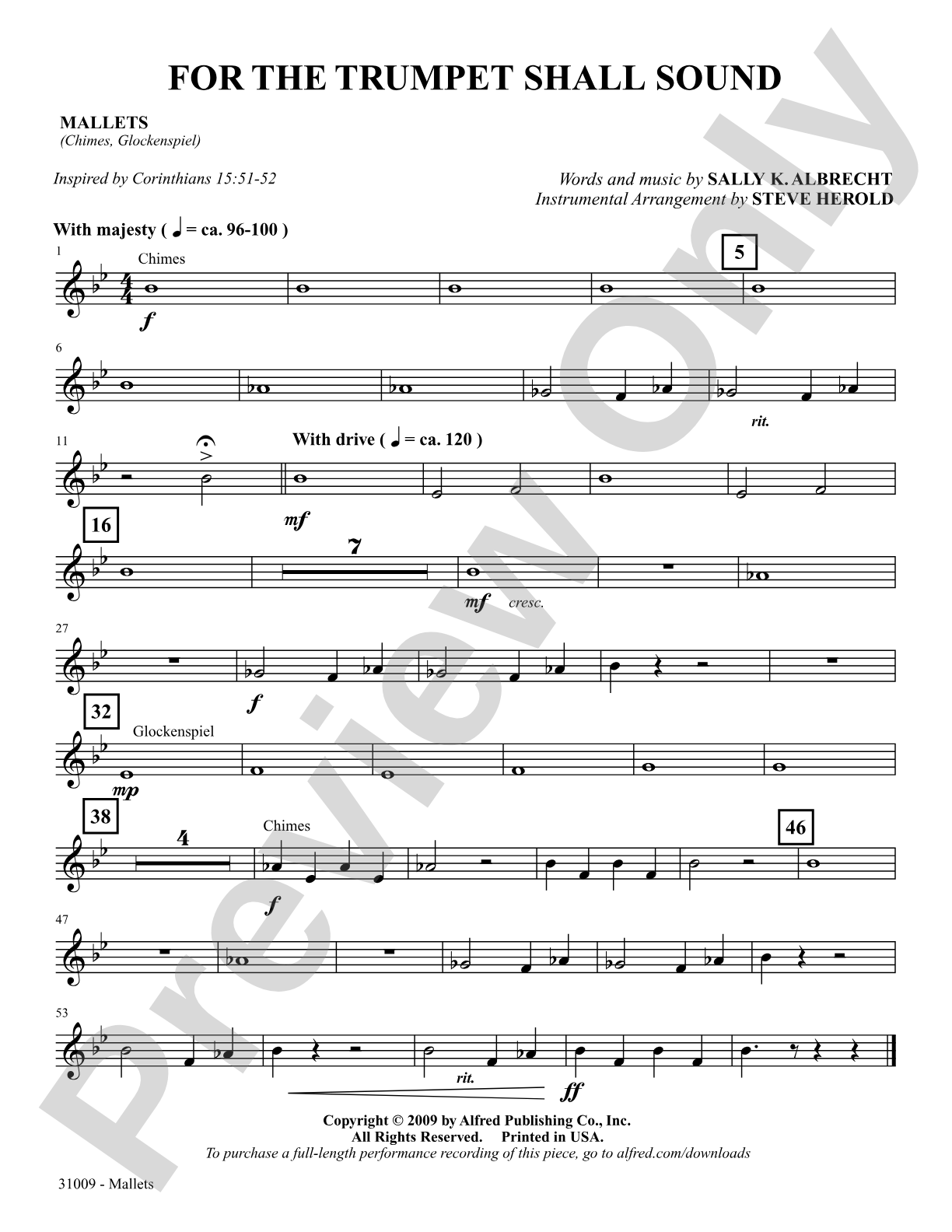
For the Trumpet Shall Sound: Mallets Sheet Music Preview

For the Trumpet Shall Sound: Mallets: Choral SoundPax

Words and music by Sally K. Albrecht

Item: 00-PC-0014311_M1

Digital Download
$3.00
Description
From the majestic opening fanfare, you'll know that this piece is something special. Wonderful echo format makes for easy learning. This powerful new work is appropriate for general and holiday concerts, festivals, contests, and adjudication. Also appropriate for church choirs. SoundPax includes 3 tpt., 2 tbn., tbn./tuba, timp., mallets, perc., sn. drum.

Don't just read it, hear it, play along with it, and watch your students grow with it. In MakeMusic Cloud, For the Trumpet Shall Sound: Mallets: Choral SoundPax comes alive with professional accompaniment, adjustable tempo, and built-in practice tools that turn solo practice into real progress.

Sample Audio
No sample audio found.
Sample Video
Additional Details
Series: Alfred Choral Designs
Publisher: Alfred Music
Page Count: 34
SKU: 00-PC-0014311_M1
Instrumentation: SoundPax

More about this title

About the Composer: Sally K. Albrecht

Sally K. Albrecht

Sally K. Albrecht has shaped choral music education for more than three decades, first as Director of School Choral, Vocal, and Elementary Publications at major educational publishers including Alfred Music, and throughout her career as a conductor, clinician, and prolific composer. She has received the ASCAP Special Music Award annually since 1987 and maintains over 600 choral publications in print, alongside 75 larger works for stage and concert. Her conducting has taken her to honor choirs and festivals nationwide, including prestigious venues at Lincoln Center, Carnegie Hall, and The Kennedy Center.

Albrecht earned her B.A. in Music and Theater from Rollins College (1976) and continued her studies at the University of Miami, where she completed an M.A. in Drama (1977) and an M.M. in Accompanying (1979). She has taught at Oakland University in Michigan, Jersey City State College in New Jersey, and Meredith College in North Carolina. In recognition of her leadership and artistic contributions, she received the Distinguished Alumna Award from both the University of Miami Frost School of Music and Rollins College in 2021, and previously served as Chair of the Board of Trustees for the Omicron Delta Kappa National Leadership Honor Society.

Why we love this

The echo format built into this work makes learning straightforward without sacrificing musical impact. A brass fanfare greeting your choir at the beginning immediately signals that this is festival-worthy repertoire, yet the piece remains accessible enough for general concert programming. You'll find it equally at home in a holiday concert, a church service, or on an adjudication schedule.

What to expect

Majestic and bright, with the ceremonial weight of a fanfare-driven opening that gives way to fuller choral textures. The echo format creates spatial depth and harmonic interest without demanding elaborate staging or movement.

Who it's for

Choirs of intermediate ability and above looking for a substantial yet learnable piece with built-in orchestral color. The work suits both school and church settings, making it valuable for directors juggling academic and worship programming calendars.

How to get the most out of it

  • Balance the opening trumpet fanfare so it cuts through clearly; these interjections anchor the echo sections, so precision matters more than volume.
  • Let the recorded accompaniment lock your ensemble into the harmonic framework during learning phases, then gradually reduce reliance on it as confidence builds.
  • Shape the echo phrases with slight dynamic shaping and legit vowel consistency; repetition can flatten if treated rhythmically instead of musically.
  • Coordinate with your brass section during rehearsals to ensure their rhythmic entries feel integrated rather than bolted on, especially where parts overlap with choir.

How to use it

Program this as a centerpiece for a sacred or holiday concert where you want something that sounds larger than your typical octavo. It also serves well as a festival or contest selection, since the combination of choral writing and brass integration demonstrates both ensemble control and musical interpretation.

Skills your students will build

  • Balancing sustained choral lines against articulated brass entrances
  • Executing echo textures with rhythmic precision and consistent tone color
  • Reading and responding to brass cues while maintaining ensemble cohesion
  • Shaping repeated phrases musically to avoid rhythmic flatness

You May Also Like