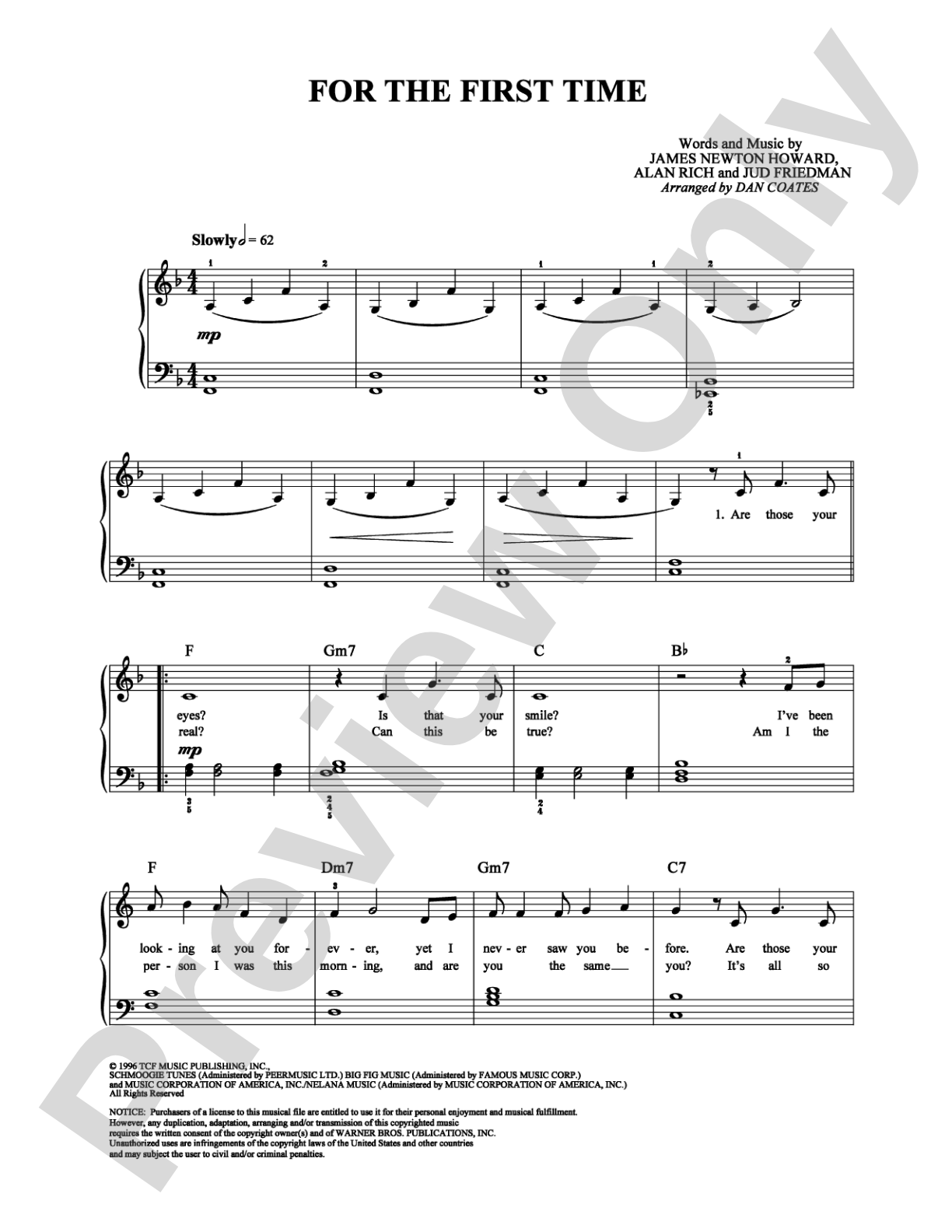
For The First Time: Easy Piano Digital Sheet Music

For The First Time: Easy Piano Digital Sheet Music

James Newton Howard, Kenny Loggins, Rod Stewart, Allan Rich, Jud Friedman

Item: 00-PS-0004617

Digital Download
$2.95
Description

For The First Time: Easy Piano Digital Sheet Music isn't in MakeMusic Cloud just yet...but it could be. Let us know you'd like to see it, and you'll help shape what comes next. In the meantime, start a free trial and dive into thousands of interactive titles your students can play along with today.

Sample Audio
No sample audio found.
Sample Video
Additional Details
SKU: 00-PS-0004617

More about this title

About the Artist: Kenny Loggins

Kenny Loggins rose to prominence in the 1970s and 1980s as a solo artist and member of Loggins and Messina, establishing himself as a master of accessible pop-rock songwriting. His catalog includes some of the era's most recognizable melodies, from "Footloose" to "Danger Zone," demonstrating an instinct for hooks that lodge themselves in the listener's memory. Loggins has spent decades crafting songs that balance emotional directness with sophisticated production, making his work ideal for musicians learning to navigate contemporary popular music.

Rod Stewart, a British rock icon with a career spanning five decades, brought his distinctive raspy voice and storytelling sensibility to the pop-rock mainstream. Known for his ability to infuse both swagger and vulnerability into his performances, Stewart's songwriting and interpretations have influenced generations of musicians. His contributions to the American songbook and his knack for crafting singable melodies make his work valuable in educational settings where students encounter rock history and popular music arrangement.

Why we love this

This arrangement captures the accessibility that makes these artists' music so enduring in popular culture while keeping the technical demands reasonable for developing pianists. The melodies are strong enough that students feel immediate satisfaction when they can play them cleanly, which builds confidence and motivation. It's a smart choice for students who learn better when repertoire connects to songs they already know and love.

What to expect

Warm, straightforward, and immediately gratifying. These melodies invite you to sing along as you play, and the harmonic language feels natural and inevitable even as you're learning it. There's an ease to the writing that doesn't sacrifice musicality; you're never battling unnecessary complexity just to feel challenged.

Who it's for

Students in their first or second year of piano study who are ready to move beyond simplified folk melodies and exercise pieces toward recognizable pop-rock material. Pianists who respond better to contemporary songwriting and want to understand how chord progressions and melody work together in modern hits. Classroom music teachers seeking repertoire that motivates students by connecting to music they hear on radio and streaming services.

How to get the most out of it

  • Focus on keeping the right-hand melody singing clearly above the left-hand accompaniment; resist the urge to play everything at equal volume.
  • Practice hands separately until you can execute each part confidently, then bring them together slowly before tempo.
  • Listen to the original recordings to internalize the phrasing and rhythmic feel that define these songs; let that familiarity guide your interpretation.
  • Watch for any syncopation in the melody or rhythm section that differs from a strict beat; lock those patterns in before increasing speed.

How to use it

Feature this as a recital piece where students showcase their growing ability to bring contemporary music to the concert stage with polish and confidence. Use it as a bridge between classical pedagogy and popular music study, demonstrating that serious piano technique applies equally to any genre. Consider pairing it with a unit on songwriting and arrangement where students analyze why these melodies endure.

Skills your students will build

  • Balancing melody and accompaniment texture
  • Reading and executing pop-rock rhythmic patterns
  • Sustaining phrase shape across chord changes
  • Connecting to familiar music as a learning tool
  • Sight-reading contemporary pop arrangement conventions

You May Also Like