For Me And My Gal Sheet Music Preview

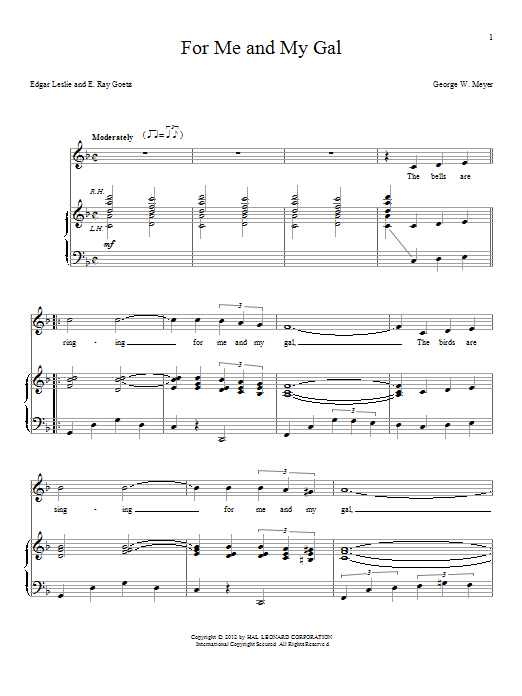
For Me And My Gal: Piano Vocal

As performed by George W. Meyer

Item: 35-DS00233575

Digital Download
$5.99
Description

For Me And My Gal: Piano Vocal isn't in MakeMusic Cloud just yet...but it could be. Let us know you'd like to see it, and you'll help shape what comes next. In the meantime, start a free trial and dive into thousands of interactive titles your students can play along with today.

Sample Audio
No sample audio found.
Sample Video
Additional Details
Publisher: Hal Leonard
Page Count: 3
SKU: 35-DS00233575

More about this title

About the Artist: George W. Meyer

George W. Meyer was a prolific American composer and songwriter who shaped popular music in the early 20th century. His gift for writing memorable melodies and accessible harmonies made him a staple of Broadway, vaudeville, and Tin Pan Alley during the 1910s and 1920s. Meyer's ability to craft songs that worked equally well in theaters, dance halls, and home parlors cemented his place in American musical culture.

Why we love this

This standard has the kind of straightforward charm that makes it perfect for vocalists building confidence with jazz-era material. The song sits naturally for most voices, and the piano part balances accompaniment with enough character to keep the instrumental part engaging rather than purely supportive.

What to expect

Wistful and warmly sentimental, with the kind of gentle, unhurried pacing that defined 1910s popular song. There's a nostalgic sweetness to the melody that feels both intimate and timeless.

Who it's for

Vocalists exploring the Great American Songbook, whether in a classical or jazz-oriented curriculum. Pianists looking to expand their standards repertoire with accessible, historically grounded material will also find plenty of value here.

How to get the most out of it

  • Treat the piano introduction as a conversation starter; let it breathe before the vocal enters so the listener has a moment to settle into the style.
  • Shape the melody with subtle dynamic swells rather than hard accents. These early standards reward legit, conversational phrasing.
  • Balance vocal projection so the piano part remains audible. At 3 pages, this arrangement likely features moments where both voices matter equally.

How to use it

Include this in a concert exploring American popular song history, or pair it with other Tin Pan Alley standards to create a cohesive set. It works well as a student recital selection when you want something that sits comfortably on the voice but still requires careful musical choices.

Skills your students will build

  • Interpretation of early 20th century popular song idioms
  • Legit vocal phrasing and dynamic control
  • Piano arrangement reading and accompaniment balance
  • Stylistic consistency across rubato and straight rhythmic sections

You May Also Like