
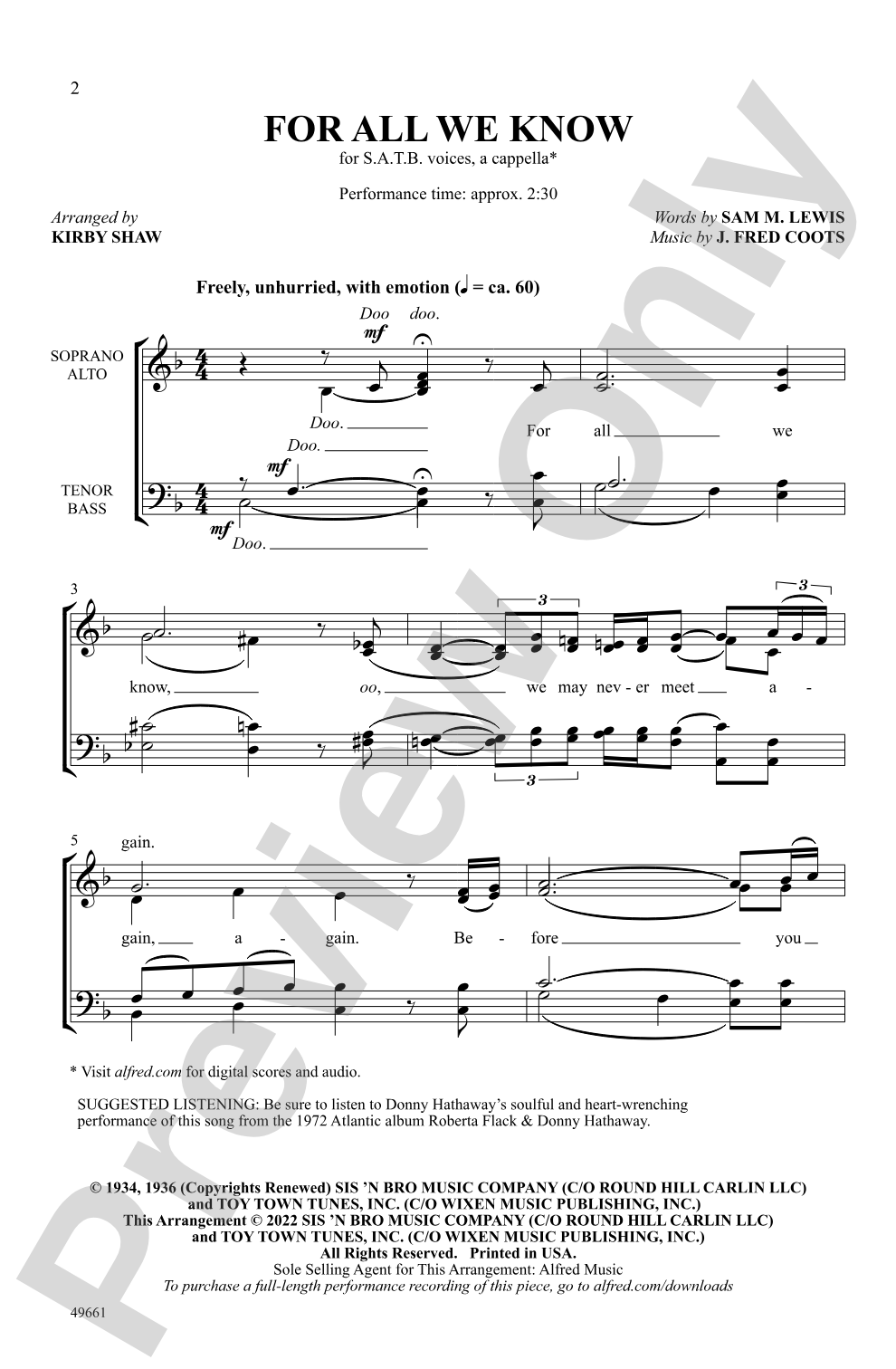

For All We Know: SATB, a cappella Choral Octavo
Words by Sam M. Lewis, music by J. Fred Coots / arr. Kirby Shaw
Item: 00-PO-0006992
$2.10
Minimum order quantity: 20 copies
One moment…
Related Items
For All We Know: SATB, a cappella Choral Octavo |
$2.10
|
View |
Description
Real deal a cappella jazz writing with great attention paid to phrasing, dynamics, expressive rhythms that sound unmetered, and bringing the emotional words to life. Be prepared to put in the time and feel the satisfaction of singing a lush and lovely ballad. The song has been recorded by a host of artists including Billie Holiday, Doris Day, Aretha Franklin, and Bette Midler, but Kirby's arrangement is inspired by soul artist Donny Hathaway's heart-wrenching performance.


For All We Know: SATB, a cappella Choral Octavo isn't in MakeMusic Cloud just yet...but it could be. Let us know you'd like to see it, and you'll help shape what comes next. In the meantime, start a free trial and dive into thousands of interactive titles your students can play along with today.
Request This Title
Tell us you want it.
Start Your Free Trial
Explore everything that's ready to play right now.
Sample Audio
1
Audio File
--:--
0:00
0:00
Sample Video
Additional Details
Series:
Alfred Pop Choral Series
Publisher:
Alfred Music
Page Count:
8
SKU:
00-PO-0006992
More about this title
About the Composer: J. Fred Coots
J. Fred Coots (1897-1971) was a prolific composer of the Great American Songbook era, creating standards that have endured across genres and generations. His gift for crafting memorable melodies with emotional depth made his work irresistible to vocalists from jazz singers to pop artists, and his songs remain central to choral and vocal repertoire today.
Coots understood how a simple, singable line could carry profound feeling. "For All We Know" exemplifies his ability to write a song that sounds effortless but rewards careful musical attention, which is precisely why it has attracted interpretations from Billie Holiday to Aretha Franklin to Donny Hathaway. For choral directors, his melodies offer natural phrasing and emotional clarity that singers can connect to immediately.
Why we love this
Kirby Shaw has taken Coots's elegant standard and written genuine jazz harmony that sits comfortably in your singers' voices while demanding musicianship. The arrangement's approach to phrasing, dynamics, and rhythmic freedom creates the feeling of unmetered singing, which challenges singers to listen deeply to one another and commit to the emotional arc of the text. This is a ballad that asks something real of your choir and delivers a performance that moves audiences.
What to expect
Singing this ballad feels like inhabiting a quiet, intimate moment. The a cappella texture wraps around the melody like a close conversation, and the jazz harmonies add warmth and subtle sophistication without overwhelming the tenderness of Coots's line. There's a luxurious quality to the lush voicings, but always grounded in the longing and vulnerability of the text.
Who it's for
Advanced choral ensembles with solid blend and harmonic literacy can take on this arrangement confidently. Your singers should be comfortable with jazz sonorities and responsive to expressive direction, as the piece demands both technical accuracy and emotional commitment. This works beautifully for chamber choirs, select ensembles, and honors groups ready to spend rehearsal time building nuance.
How to get the most out of it
- Study Donny Hathaway's recording to understand the soul-inflected phrasing Shaw was drawing from; let that sensibility inform your choir's approach to rubato and breath placement, even though you're singing without accompaniment.
- Treat the dynamics as precise instructions rather than suggestions. The contrast between soft passages and fuller moments is essential to the ballad's emotional shape, and a cappella singing requires even greater control to maintain that architecture.
- Work the harmonic shifts slowly in sectional rehearsals. The jazz voicings will sound unfamiliar at first, and singers need time to hear how their voice relates to the surrounding parts before adding expression.
- Lock in the rhythmic freedom together. Unmetered-sounding passages require ensemble agreement about pulse and forward motion. Have singers mark subtle breath points and visual cues so that liberty feels intentional, not tentative.
How to use it
This octavo shines in concert settings where it can anchor a set of vocal standards or serve as a centerpiece between more energetic pieces. It pairs well with other Great American Songbook repertoire, and its emotional intensity makes it an excellent choice for graduation, gala, or commemorative concerts where you want to leave the audience with something reflective and beautifully sung.
Skills your students will build
- Jazz harmony and voice leading in a cappella setting
- Expressive phrasing and rubato without instrumental pulse
- Attention to dynamic control and contrast in unaccompanied singing
- Emotional text interpretation through vocal production and blend
- Ensemble listening and intonation adjustment in complex harmonies