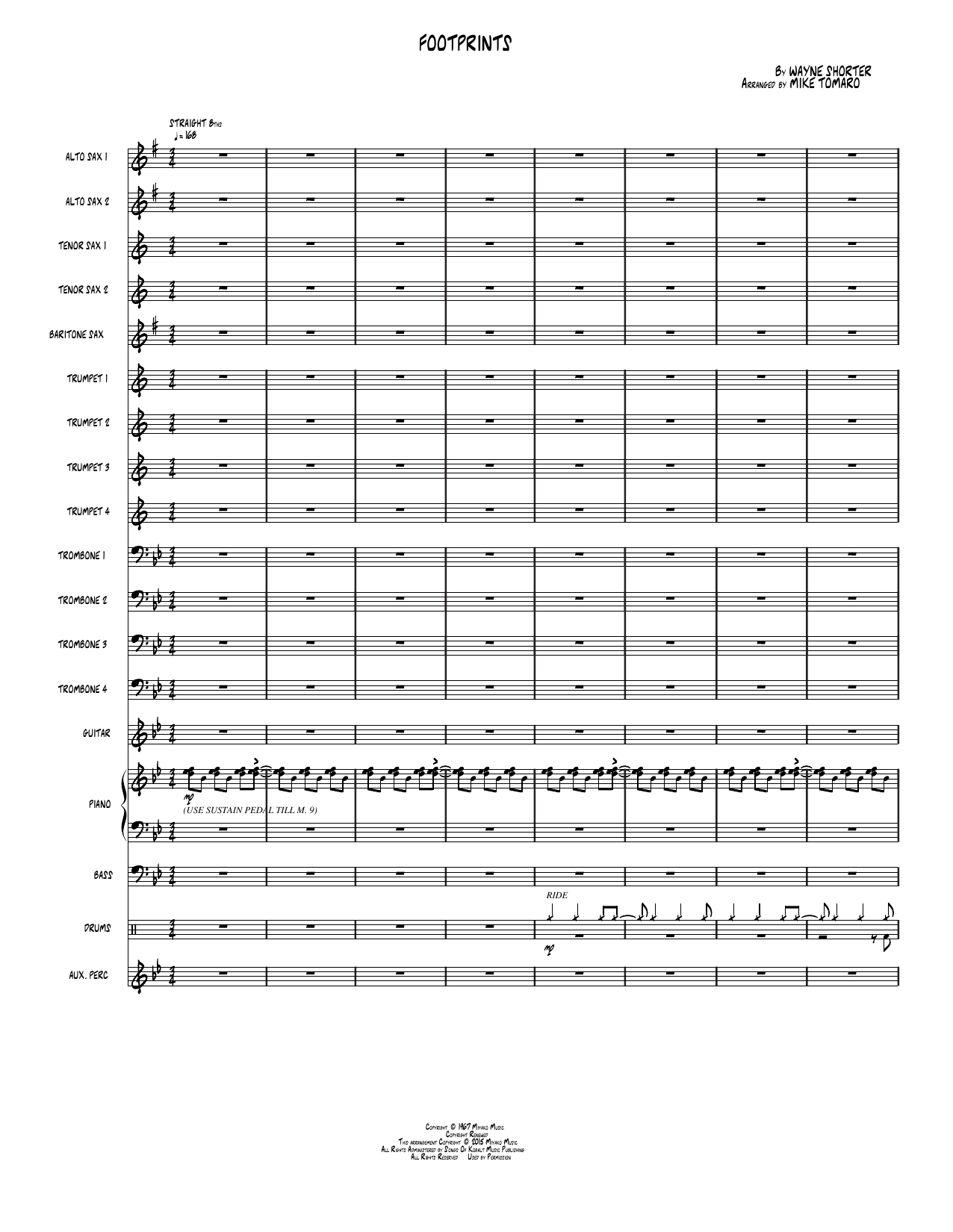
Footprints Sheet Music Preview

Footprints: Jazz Ensemble Conductor Score & Parts

By Wayne Shorter / Arranged by Mike Tomaro

Grade: 4

Item: 35-PK00427116

Digital Download
$50.00

Buy Extra Parts (Digital PDF Download)

Product Price Quantity
Footprints - Full Score $50.00

Parts Added to Cart!

Description
Footprints

Footprints: Jazz Ensemble Conductor Score & Parts isn't in MakeMusic Cloud just yet...but it could be. Let us know you'd like to see it, and you'll help shape what comes next. In the meantime, start a free trial and dive into thousands of interactive titles your students can play along with today.

Sample Audio
No sample audio found.
Sample Video
Additional Details
Publisher: Hal Leonard
SKU: 35-PK00427116

More about this title

About the Composer: Wayne Shorter

Wayne Shorter stands as one of jazz's most innovative composers and saxophonists, bringing harmonic complexity and lyrical depth to modern jazz since the 1950s. His work with Art Blakey's Jazz Messengers, the Miles Davis Second Great Quintet, and Weather Report established him as a visionary who expanded what jazz composition could express, moving beyond conventional chord changes into more abstract and exploratory harmonic territory.

Why we love this

Tomaro's arrangement strips Shorter's composition down to its essential melodic and harmonic beauty, making it accessible for Grade 4 ensembles without sacrificing the tune's sophisticated character. The piece teaches ensemble listening and blend while keeping parts playable for developing musicians, and it introduces students to a standard that professionals still grapple with decades later.

What to expect

Introspective yet propulsive, Footprints carries a walking contemplation beneath its rhythmic drive. The melody lingers in the mind with the quiet insistence of a half-remembered dream, leaving space for individual voices to emerge without losing the composition's cohesive emotional center.

Who it's for

Jazz ensembles at the intermediate level who are ready to move beyond basic swing repertoire into more compositionally sophisticated material. This arrangement works equally well for groups preparing for jazz festivals or those simply looking to expand their understanding of modern jazz vocabulary.

How to get the most out of it

  • Establish the opening melody's sense of forward motion early in rehearsals; the tune breathes differently than a traditional swing head, so mark the phrasing with your baton and have sections echo the shape back to you.
  • Balance the rhythm section carefully once soloists enter; younger players often push the tempo when trading with drums, so lock that foundation before running full form.
  • Bring out the chromatic voice leading in the harmony parts, particularly in the second chorus; these lines support the soloist and shouldn't disappear into the background.

How to use it

Include this as the centerpiece of a jazz set focused on standards that challenge harmonic thinking, or pair it with other Shorter compositions to explore his compositional language. It also serves as an excellent introduction to modal and chromatic concepts for students transitioning from bebop fundamentals into post-bop territory.

Skills your students will build

  • Reading and performing modal jazz changes
  • Ensemble balance and blend while accompanying soloists
  • Phrasing and articulation appropriate to modern jazz language
  • Listening for and responding to rhythmic displacement in the rhythm section
  • Understanding chromatic voice leading within jazz harmony

You May Also Like