
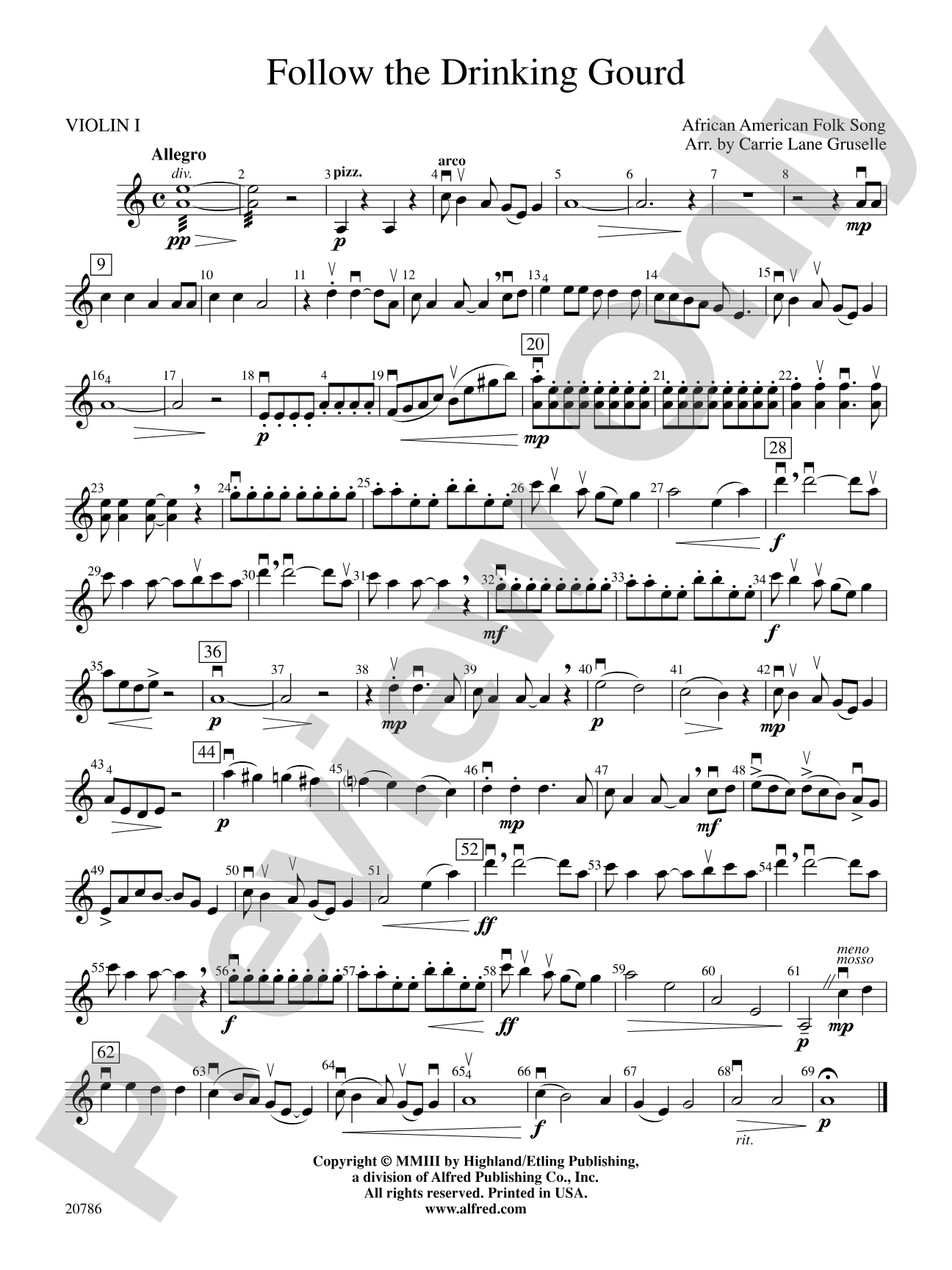

Follow the Drinking Gourd: 1st Violin
African-American Folk Song / arr. Carrie Lane Gruselle
Grade: 3
Item: 00-PC-0000455_VN1
$5.99
Pickup currently not available
Description
During the Civil War era, the song "Follow the Drinking Gourd" was shared among slaves as a means to facilitate their escape to the North. The text of the song contained hidden messages about how the slaves could find their freedom. The Drinking Gourd represented the Big Dipper, which pointed them to the next step of their journey- ultimately leading to the Underground Railroad. This arrangement requires minimal shifting for the first violin, cello and bass, while the second violin and viola remain in first position throughout. Varying rhythms, bowings and articulations are featured components in this energetic adaptation of an African-American folk song. This title is available in MakeMusic Cloud.


Don't just read it, hear it, play along with it, and watch your students grow with it. In MakeMusic Cloud, Follow the Drinking Gourd: 1st Violin comes alive with professional accompaniment, adjustable tempo, and built-in practice tools that turn solo practice into real progress.
Open in the Player
Jump straight in and assign it today.
Start Your Free Trial
Open this title and explore the full library in minutes.
Sample Audio
1
Audio File
--:--
0:00
0:00
Sample Video
No sample videos found.
Additional Details
Series:
Highland/Etling String Orchestra
Publisher:
Alfred Music
Page Count:
62
SKU:
00-PC-0000455_VN1
More about this title
About the Arranger: Carrie Lane Gruselle
Carrie Lane Gruselle earned her Bachelor of Music Education from the University of Wisconsin–Eau Claire and continued her studies at the University of Wisconsin–Stevens Point, where she completed a Masters of Music Education with a Suzuki emphasis. She has taught elementary and middle level strings for the Appleton Area School District while also maintaining a cello studio at the Lawrence University Arts Academy in Appleton, Wisconsin.
Gruselle's work in string education spans both classroom instruction and private instruction, giving her deep insight into what young string players can accomplish at different developmental stages. Her arrangements for student orchestras reflect practical knowledge of shifting patterns, position work, and the technical capacities of developing musicians.
Why we love this
Gruselle respects the technical realities of Grade 3 orchestras without compromising the power of this historically significant piece. The constraint she builds around for first violin and cello (minimal shifting) and the secure first-position foundation for second violin and viola means your students can focus entirely on musical storytelling rather than wrestling with technique. The varying rhythms, bowings, and articulations keep the arrangement engaging for every voice without becoming a reading nightmare.
What to expect
The piece unfolds with quiet determination, building from whispered solidarity into something more urgent and alive. You hear the geography of the journey in its pacing; there are moments of searching, moments of hope, moments of collective resolve. The varying articulations and bowings create texture and shadow, turning what could be a straightforward folk tune into a layered human story.
Who it's for
Grade 3 string orchestras ready to engage with music that carries real historical and cultural significance. This arrangement works for orchestras with uneven shifting readiness across sections; the limited technical demands in certain parts mean advanced and developing players can share the performance load fairly. It's ideal for ensembles preparing for festival or contest programming where meaning matters as much as musical execution.
How to get the most out of it
- Establish the pulse clearly in early rehearsals through the varying rhythmic figures. The energy comes from precision, not from rushing; lock the bow rhythms section by section before focusing on intonation.
- Balance the melody line between first and second violins during their dialogues. Neither part dominates; they're conversation partners telling the story together.
- Shape the bowing gestures to match the journey itself. Long, sustained bowings on certain phrases can evoke movement through darkness, while shorter articulations bring urgency and momentum.
- Record a sectional rehearsal of just the cello and bass lines early on. Their steady harmonic foundation allows upper voices to sit securely and respond to the text's historical weight.
How to use it
Program this as part of a concert exploring American roots music or social justice themes in art. It pairs naturally with other folk arrangements at similar difficulty levels and can anchor a thematic program about resilience and resistance. Consider pairing it with a spoken introduction that contextualizes the song's role in the Underground Railroad, turning the performance into something more than entertainment.
Skills your students will build
- Reading and executing varied articulations and bowings within a single phrase
- Ensemble balance between melody lines that trade leadership
- Intonation security in first position across all four string parts
- Historical and cultural context awareness through repertoire
- Rhythmic precision across contrasting rhythmic figures within the same section