

Follow the Drinking Gourd: SATB Choral Octavo
Traditional Spiritual / arr. Victor C. Johnson
Item: 00-PO-0006451

$2.05
Minimum order quantity: 20 copies
Pickup currently not available
Related Items
Follow the Drinking Gourd: PianoTrax Digital Audio Download |
$9.99
|
View | |
Follow the Drinking Gourd: SAB Choral Octavo |
$2.05
|
View | |
Follow the Drinking Gourd: TTB Choral Octavo |
$2.05
|
View | |
Follow the Drinking Gourd: SATB Choral Octavo |
$2.05
|
View | |
Follow the Drinking Gourd: SAB Choral Octavo |
$2.05
|
View | |
Follow the Drinking Gourd: TTB Choral Octavo |
$2.05
|
View |
Description
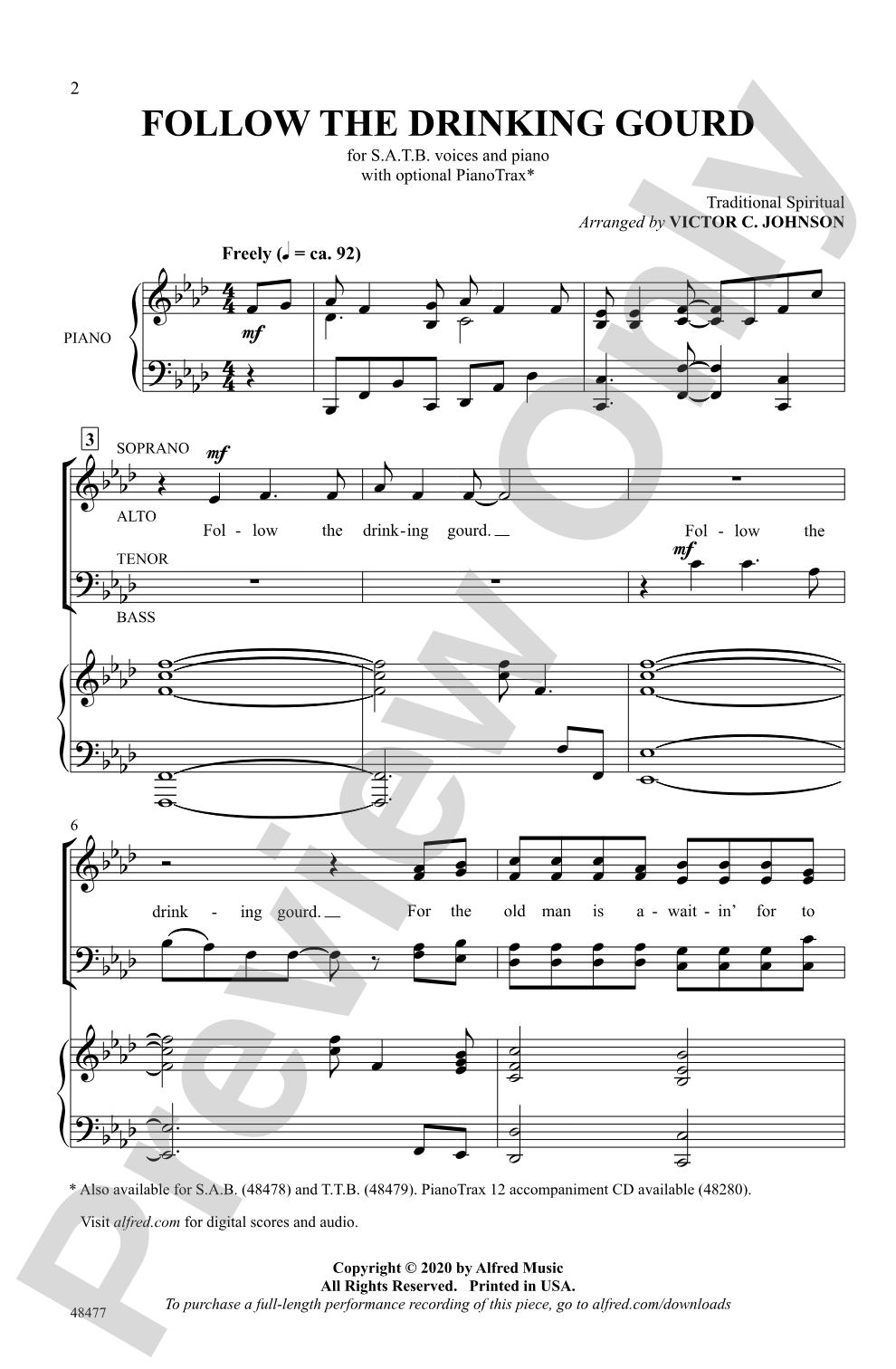
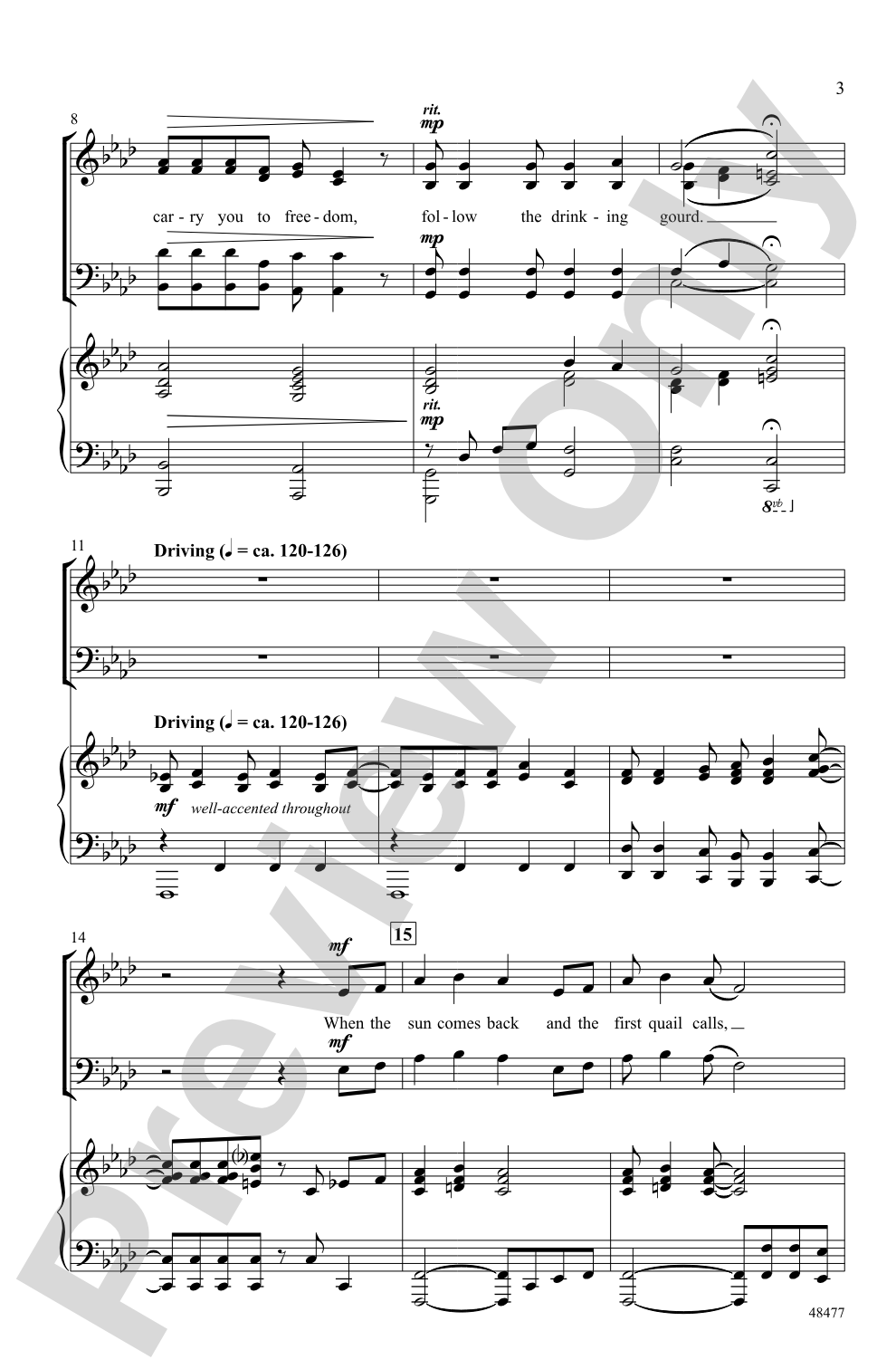
Victor Johnson's driving setting of the traditional African-American spiritual conveys a sense of urgency that builds from beginning to end, including a dramatic optional descant in the final chorus. A hardy piano accompaniment propels the arrangement and supports the syncopated singers, who are fully harmonized in all voicings.


Don't just read it, hear it, play along with it, and watch your students grow with it. In MakeMusic Cloud, Follow the Drinking Gourd: SATB Choral Octavo comes alive with professional accompaniment, adjustable tempo, and built-in practice tools that turn solo practice into real progress.
Open in the Player
Jump straight in and assign it today.
Start Your Free Trial
Open this title and explore the full library in minutes.
Sample Audio
1
Audio File
--:--
0:00
0:00
Sample Video
Additional Details
Series:
Alfred Choral Designs
Publisher:
Alfred Music
Page Count:
12
SKU:
00-PO-0006451
More about this title
About the Arranger: Victor C Johnson

Victor C Johnson brings decades of choral direction and arranging experience to his work as School Choral Editor for Sing!, the educational publishing division of Choristers Guild. Based in Dallas, Texas, Johnson has shaped the musical lives of countless students through his tenure as choral director at Ft. Worth Academy of Fine Arts, where he led the Academy Singers and Academy Men's Choir while also serving as Artistic Director of the Singing Girls of Texas and Children's Choir of Texas.
With over 500 published choral works, vocal collections, and keyboard arrangements in print, Johnson continues to be a significant voice in choral education. Since 2022, he has conducted the Dallas Symphony Children's Chorus Mixed Ensemble, the resident youth ensemble for the Dallas Symphony Orchestra. His professional involvement spans the American Choral Directors Association, Texas Music Educators Association, National Association for Music Education, and ASCAP.
Why we love this
Johnson's arrangement captures the spiritual's historical urgency without resorting to bombast. The syncopated harmonization keeps all four voices engaged throughout, the piano part propels rather than merely supports, and the optional descant in the final chorus gives you a built-in moment of textural climax that feels earned rather than tacked on. This is the kind of setting that sounds substantial in a concert program while remaining fully accessible to developing choirs.
What to expect
Johnson's setting radiates purposeful motion from the opening measure. The syncopated harmonies create rhythmic tension that pulls the piece forward, building steadily toward the final chorus where the optional descant breaks through the texture like a beacon. There's urgency here, but not panic; instead, a determined, resolute character that honors the spiritual's historical meaning while engaging modern singers with a driving, present-tense energy.
Who it's for
This arrangement works for intermediate to advanced high school choirs and collegiate ensembles seeking repertoire with both historical substance and contemporary energy. Concert choirs and festival-focused groups will find this piece particularly rewarding, as the dramatic arc and technical polish speak to both audiences and adjudicators.
How to get the most out of it
- Shape the rhythmic momentum by treating the syncopation as part of the text's forward motion, not as an obstacle. Singers should feel propelled through the syncopated figures rather than fighting against them.
- Use the piano accompaniment as a rhythmic anchor; it's deliberately robust and should be heard as a full partner with the choir, especially in supporting the off-beat figures.
- Build the descant strategically by assigning it only to your most secure sopranos and introducing it in rehearsal only after the full chorus feels solid. This keeps the dramatic impact intact for performance.
- Balance the fully harmonized voicings carefully across all parts; no single voice line should dominate, even when the text seems to suggest a leading melody.
How to use it
Program this as a centerpiece in a concert that traces African-American choral traditions, where it can sit alongside either spirituals by other arrangers or contemporary works by Black composers. The piece also works effectively as a contest selection, where the combination of technical skill required and emotional directness creates strong audience and adjudicator response. Its 12-page length makes it substantial enough to anchor a set without overshadowing other repertoire.
Skills your students will build
- Reading and performing syncopated rhythmic figures in four-part harmony
- Balancing fully voiced SATB texture while maintaining individual line clarity
- Executing optional divisi and descant lines with secure ensemble blend
- Responding to text-driven momentum and building dramatic shape across longer forms
- Collaborating with a rhythmically active piano part that functions as an equal voice