
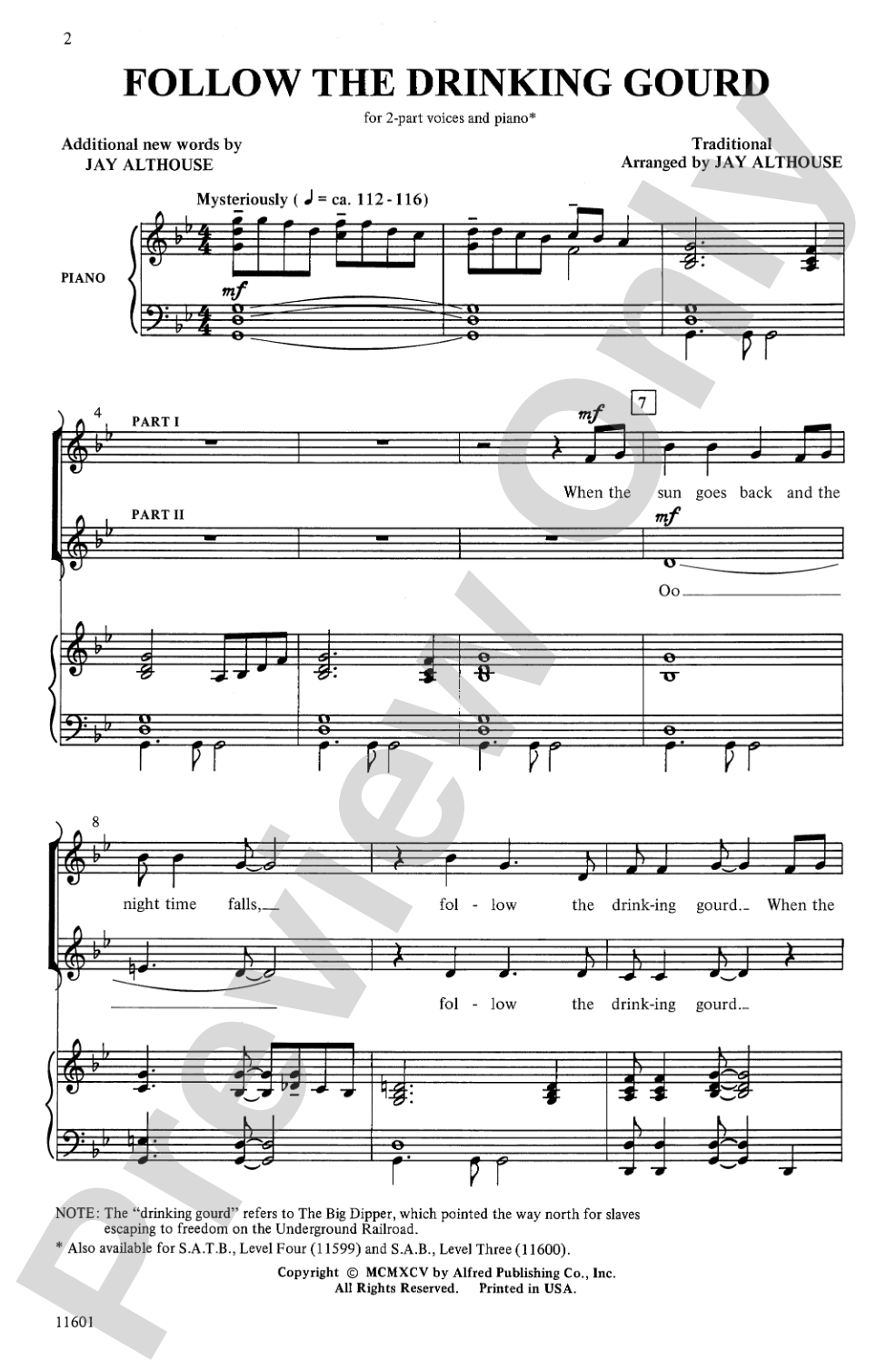
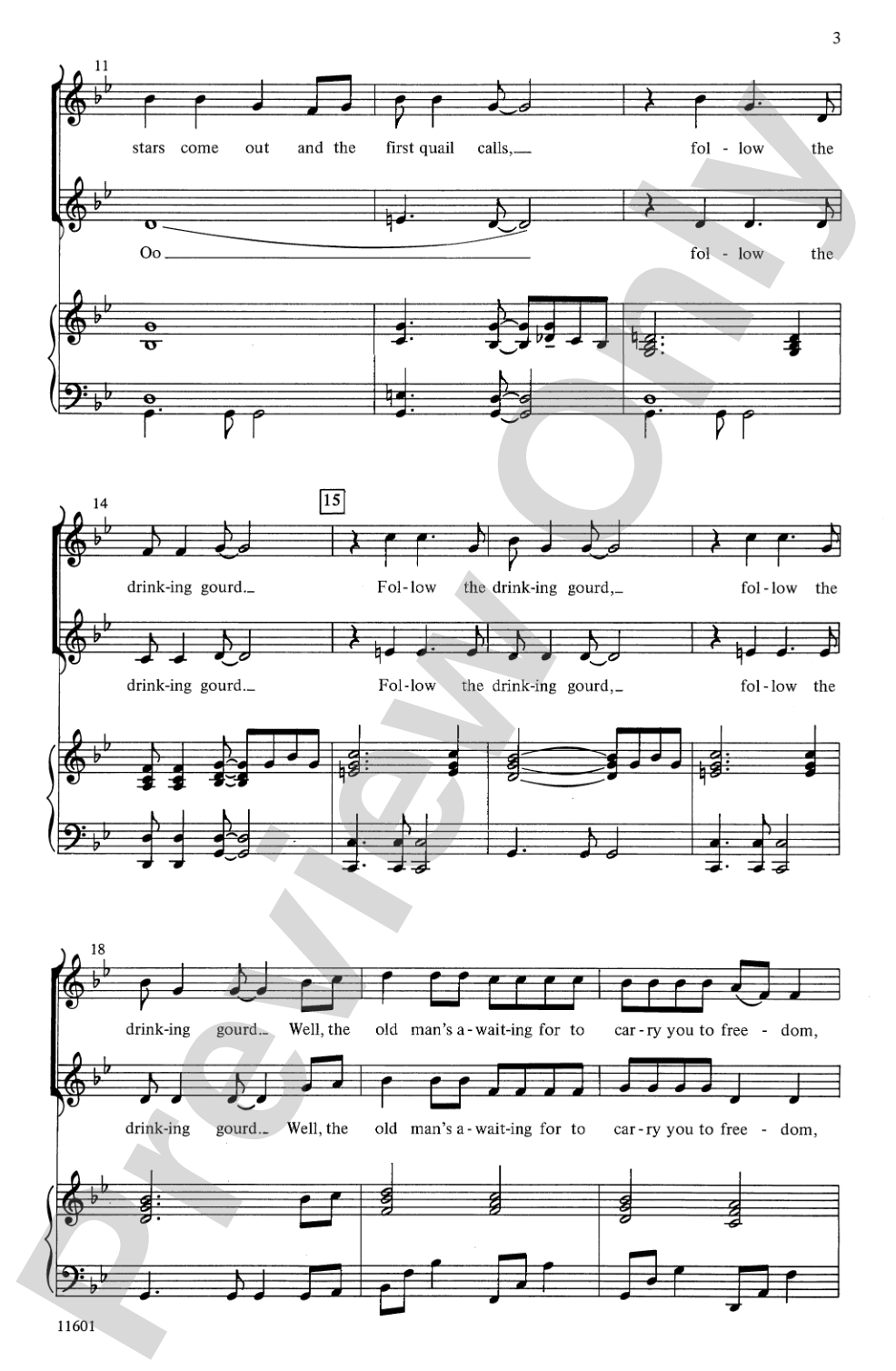

Follow the Drinking Gourd: 2-Part Choral Octavo
Arr. Jay Althouse
Item: 00-PO-0003875
$2.25
Minimum order quantity: 20 copies
Pickup currently not available
Description
An exceptional arrangement of the traditional African-American folk song pertaining to the Big Dipper (the "Drinking Gourd") and how it points north t freedom. Features solid choral writing with a haunting piano accompaniment. Comfortable ranges, no solos, no divisi. Good for multi-cultural programs.


Follow the Drinking Gourd: 2-Part Choral Octavo isn't in MakeMusic Cloud just yet...but it could be. Let us know you'd like to see it, and you'll help shape what comes next. In the meantime, start a free trial and dive into thousands of interactive titles your students can play along with today.
Request This Title
Tell us you want it.
Start Your Free Trial
Explore everything that's ready to play right now.
Sample Audio
1
Audio File
--:--
0:00
0:00
Sample Video
No sample videos found.
Additional Details
Series:
Alfred Archive Edition: Alfred Choral Designs
Publisher:
Alfred Music
Page Count:
8
SKU:
00-PO-0003875
More about this title
About the Arranger: Jay Althouse

Jay Althouse studied Music Education and Music at Indiana University of Pennsylvania, where he later received the Distinguished Alumni award. His career spans both publishing and composition; he spent eight years managing rights and licenses for a major educational music publisher and served on the Executive Board of the Music Publishers Association of America. He is a prolific choral composer with over 800 published works performed throughout the English-speaking world.
Althouse has extended his influence beyond composition into music education publishing. He co-wrote several children's musicals with his wife, Sally K. Albrecht, compiled respected vocal solo collections including Folk Songs for Solo Singers, and authored instructional resources like Ready to Read Music and One-Page Composer Bios. His collaborative work I Hear America Singing was performed by the San Francisco Girls and Boys Choirs at President Barack Obama's 2009 inauguration. Althouse currently serves on the National Advisory Board of the Folk Art Society of America and contributes regularly to the society's publications.
Why we love this
Althouse's treatment respects the historical weight of this spiritual while making it genuinely singable for developing choirs. The haunting piano writing complements rather than competes with the voices, and the accessible ranges mean singers can focus on expressing the song's profound meaning rather than navigating technical demands.
What to expect
Haunting and purposeful. The arrangement honors the song's historical roots as a coded guide to freedom while creating a meditative, almost reverent quality. Singers and listeners alike feel the weight of both the melody and its meaning.
Who it's for
Directors building multicultural programming or exploring spirituals with choirs that lack advanced sightreading skills. The 2-part voicing and comfortable ranges work equally well in middle school, high school, and community settings where singing freedom songs matters as much as vocal polish.
How to get the most out of it
- Balance the melody between parts so the narrative voice remains clear; this arrangement trusts the song's power rather than layering complexity.
- Let the piano establish the harmonic landscape before voices enter; the accompaniment carries the emotional arc as much as the singing does.
- Shape phrases with deliberate, unhurried pacing; the song's metaphorical journey deserves time to breathe.
How to use it
Pair this with other spirituals or freedom songs in a concert themed around resilience and cultural heritage. It also works as a powerful standalone opener or closer, giving audiences time to reflect before moving to lighter repertoire. Festival adjudicators respond well to thoughtful spiritual arrangements that demonstrate arrangement craft and historical awareness.
Skills your students will build
- Singing with historical and cultural awareness
- Blending in 2-part texture with consistent tone
- Interpreting text-driven phrasing in folk arrangements
- Listening to piano accompaniment and responding to harmonic support