
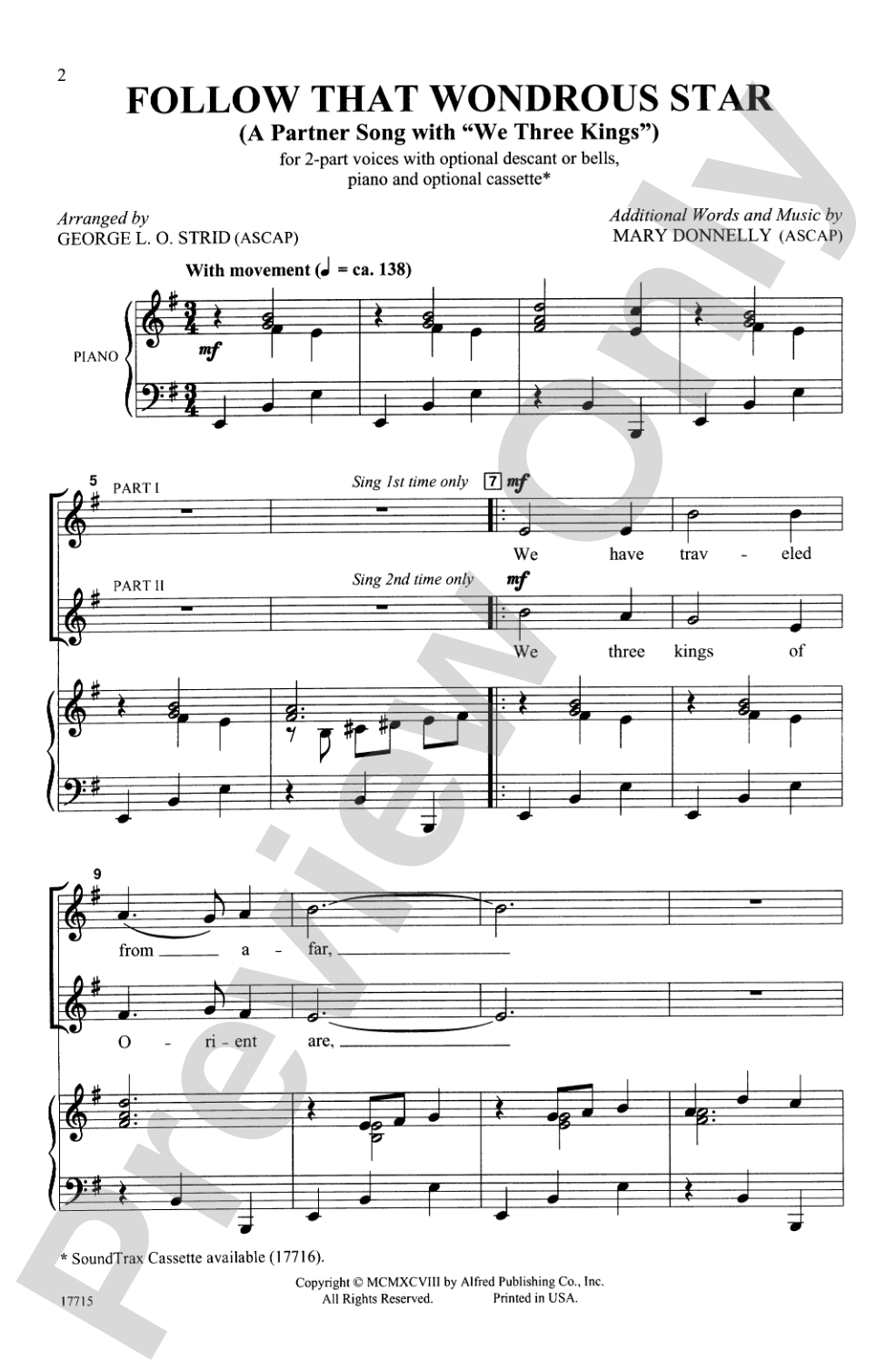
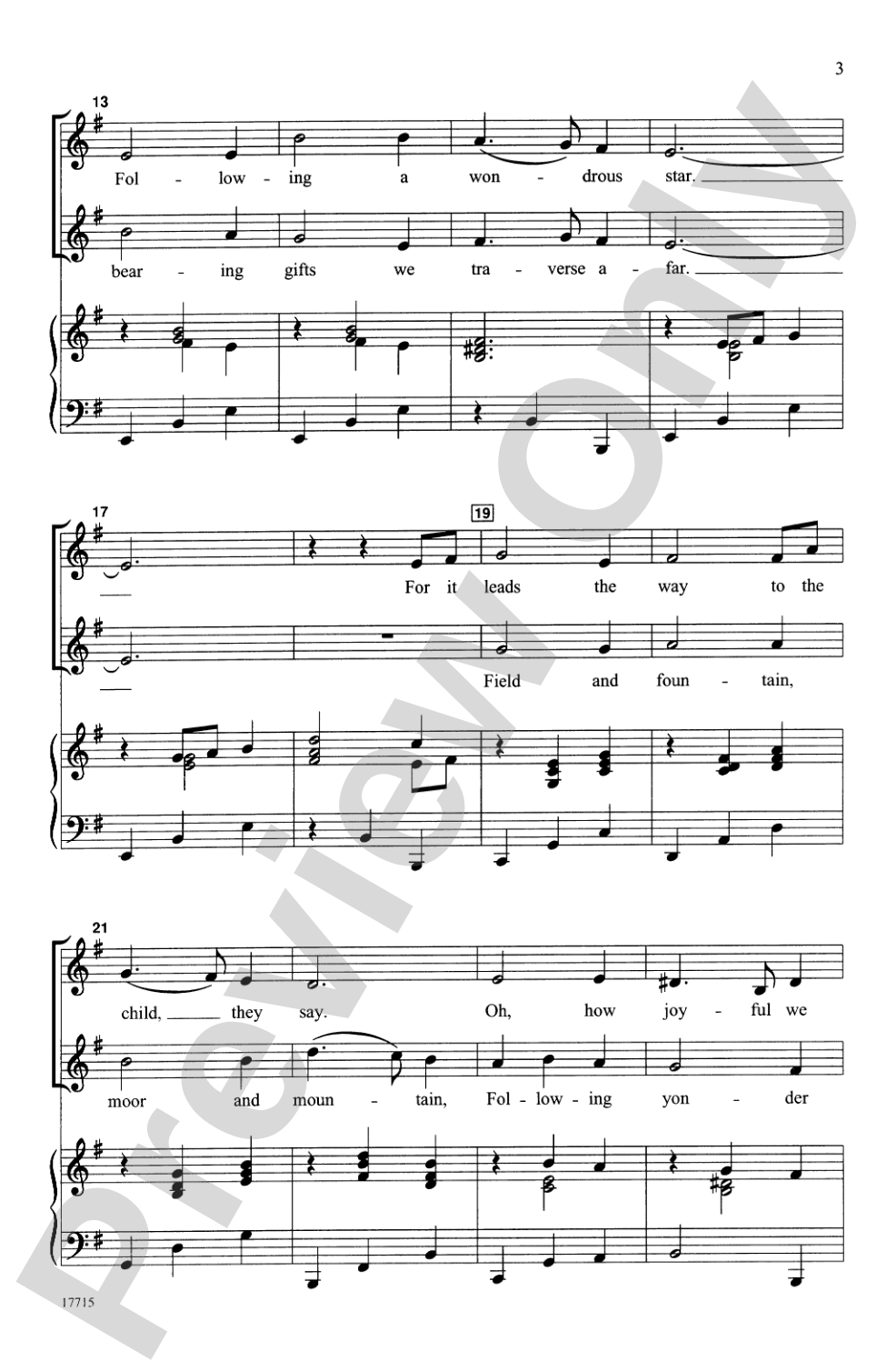

Follow That Wondrous Star: 2-Part Choral Octavo
A Partner Song with "We Three Kings"
Music by Mary Donnelly and George L. O. Strid
Item: 00-PO-0004010
$2.25
Minimum order quantity: 20 copies
Pickup currently not available
Description
Singable and accessible partner song combining "We Three Kings" with a new melody. Practical and creative choral perfection for young school choirs.


Follow That Wondrous Star: 2-Part Choral Octavo isn't in MakeMusic Cloud just yet...but it could be. Let us know you'd like to see it, and you'll help shape what comes next. In the meantime, start a free trial and dive into thousands of interactive titles your students can play along with today.
Request This Title
Tell us you want it.
Start Your Free Trial
Explore everything that's ready to play right now.
Sample Audio
1
Audio File
--:--
0:00
0:00
Sample Video
No sample videos found.
Additional Details
Series:
Alfred Archive Edition: Alfred Choral Designs
Publisher:
Alfred Music
Page Count:
12
SKU:
00-PO-0004010
Instrumentation:
Opt. Bells
More about this title
About the Composer: Mary Donnelly

Mary Donnelly grew up in Reno, Nevada, and studied English and French at the University of Nevada, Reno before discovering her passion for music education during her undergraduate years. She went on to earn a Master's Degree in Education from Lesley College, where she focused on integrating the arts across disciplines. Over thirty years, she taught general music and choir in elementary and middle schools throughout the Washoe County School District.
In 1985, Donnelly began collaborating with George L. O. Strid when they co-taught a sixth grade music class. What started as a request to write a musical for Reading Week became a prolific partnership spanning more than two hundred songs and twenty-five staged works. Both are active members of ACDA, and Donnelly holds memberships in the NEA and ASCAP.
Why we love this
Partner songs offer a natural path for young choirs to experience harmony without the demands of traditional two-part voicing, and pairing a beloved carol with fresh melodic material keeps both singers and audiences engaged. Donnelly and Strid have designed this arrangement to sit comfortably in developing voices while preserving the emotional weight of "We Three Kings." The optional bell parts add a festive shimmer without requiring extra rehearsal time or specialized instrumental skill.
What to expect
Warm and celebratory, with the security of a familiar melody running alongside a complementary line that adds depth without complexity. The piece carries the reverent quality of the original carol while the partner song framework creates a fuller, more contemporary sound that young singers find rewarding to perform.
Who it's for
This octavo works well for elementary and middle school choirs with limited harmonic experience, as well as community and church youth choirs seeking accessible holiday repertoire with genuine musicality. The 2-part voicing suits changing voices and allows directors to assign parts flexibly based on range rather than traditional voice classifications.
How to get the most out of it
- Balance the two independent melodic lines by rehearsing each group separately first, then gradually bringing them together with the upper line pulling slightly back so the familiar tune remains recognizable.
- If adding the optional bells, let them play the primary melody ("We Three Kings") to anchor the texture and help singers lock onto the harmonic framework.
- Record a rehearsal with both parts at performance tempo and have singers listen independently between rehearsals; hearing the completed arrangement builds confidence and trains the ear for blend.
- Shape phrases through slight dynamic swells rather than constant volume; this keeps young singers engaged and prevents the arrangement from feeling static across all twelve pages.
How to use it
Pair this with a cappella carols or instrumental-backed hymn arrangements to create a balanced holiday concert that showcases both traditional and creative approaches to seasonal music. The moderate length and accessibility make it an ideal closing piece for a young choir's December concert, or a strong anchor for a multi-ensemble holiday assembly.
Skills your students will build
- Singing independent melodic lines while listening to a different melody (harmonic independence)
- Maintaining steady pitch in two-part texture with minimal support
- Blending treble voices while preserving clear diction in partner song format
- Following a conductor through longer choral works (12 pages)
- Interpreting phrasing and dynamics in sacred choral literature