
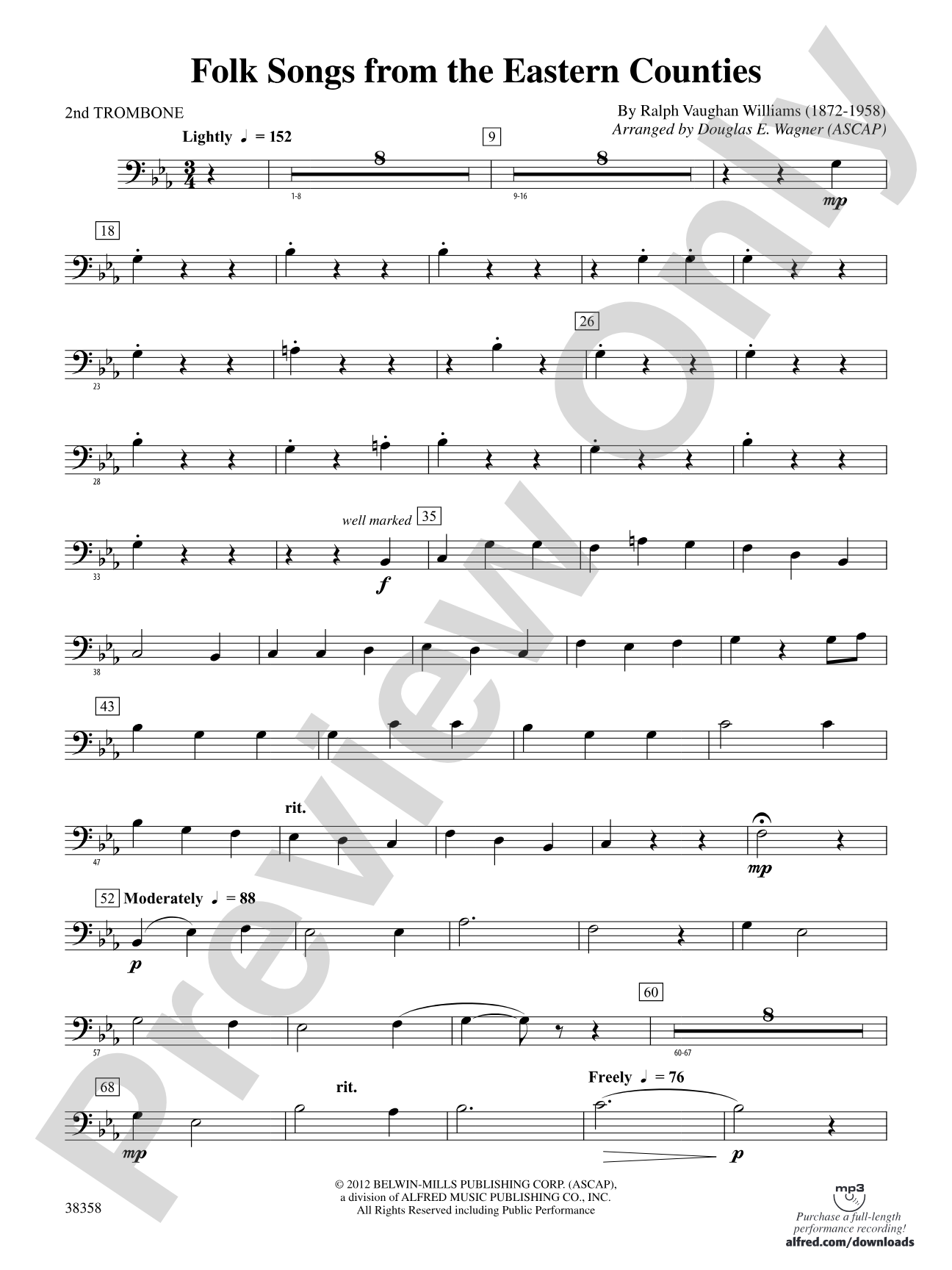

Folksongs from the Eastern Counties: 2nd Trombone
By Ralph Vaughan Williams / arr. Douglas E. Wagner
Grade: 3 (Medium Easy)
Item: 00-PC-0015444_TN2
$5.99
Pickup currently not available
Description
Vaughan Williams traveled during 1903 to 1906, collecting folk songs first-hand from residents. Four of the fifteen titles he published for voice and piano in the original volume comprise Folk Songs from the Eastern Counties, including "The Lost Lady Found," "The Lark in the Morning," "Bushes and Briars," and "Ward, the Pirate." Scored for concert band exactly as they were first published, with much of the accompanying material also being drawn from RVW's harmonizations and stylistic interpretations. Experience these cherished authentic folk songs creatively complied for your concert band. (3:30) This title is available in MakeMusic Cloud.


Don't just read it, hear it, play along with it, and watch your students grow with it. In MakeMusic Cloud, Folksongs from the Eastern Counties: 2nd Trombone comes alive with professional accompaniment, adjustable tempo, and built-in practice tools that turn solo practice into real progress.
Open in the Player
Jump straight in and assign it today.
Start Your Free Trial
Open this title and explore the full library in minutes.
Sample Audio
1
Audio File
--:--
0:00
0:00
Sample Video
No sample videos found.
Additional Details
Series:
Belwin Concert Band
Publisher:
Alfred Music
Page Count:
226
SKU:
00-PC-0015444_TN2
More about this title
About the Composer: Ralph Vaughan Williams
Ralph Vaughan Williams (1872–1958) was a central figure in the English musical renaissance, deeply committed to preserving the nation's folk heritage. Between 1903 and 1906, he undertook extensive field research across the English countryside, recording folk melodies directly from rural singers and documenting the musical traditions of generations past.
Vaughan Williams understood that folk song was not merely a historical curiosity but living material worthy of artistic development. His arrangements honor the simplicity and authenticity of these melodies while enriching them through sophisticated harmonic language and orchestration. This balance between respect for tradition and creative vision shaped not only his folk song publications but his entire compositional philosophy.
Why we love this
Douglas E. Wagner's band arrangement captures the modal character and open harmonic quality of Vaughan Williams's original settings without sentimentality. The grade 3 scoring sits comfortably for developing ensembles while preserving the distinctive voice of each folk melody; directors appreciate how the writing distributes material across sections in ways that build sectional strength rather than relying on a single line.
What to expect
Rural England emerges through these four melodies: the wistfulness of "The Lost Lady Found," the vivid imagery of "The Lark in the Morning," the dark beauty of "Bushes and Briars," and the narrative energy of "Ward, the Pirate." Wagner's orchestration lets each melody breathe in its own way, sometimes spare and sometimes lush, always grounded in the authenticity Vaughan Williams captured from his sources.
Who it's for
Intermediate concert bands seeking substantive American repertoire with English roots. This arrangement works for groups with solid fundamentals in intonation and balance but does not require virtuosic technique.
How to get the most out of it
- Honor the modal inflections in these melodies by allowing singers or lead players subtle flexibility with articulation and phrasing. The music sounds best when players feel the long line rather than count it mechanically.
- Balance the harmonic texture carefully; Wagner's voicings can cloud if the middle voices override the melody. Work your clarinets and saxes to sit lightly beneath the primary line.
- Treat dynamic contrasts between verses as opportunities for color shift, not volume alone. A movement from open score to closed voicing can suggest intimacy without requiring a change in overall level.
How to use it
These pieces anchor a concert focused on folk traditions or English composers, or stand alone as a three-and-a-half-minute set that showcases your ensemble's interpretive maturity. The folk roots and manageable difficulty also make this a natural fit for spring concert programming when directors often balance new challenges with audience-friendly content.
Skills your students will build
- Balancing melody and harmony across sections
- Responding to modal and chromatic inflections in phrasing
- Playing sustained passages with consistent tone and intonation
- Interpreting dynamic subtlety without exaggeration