Folk Fest: Oboe Sheet Music Preview

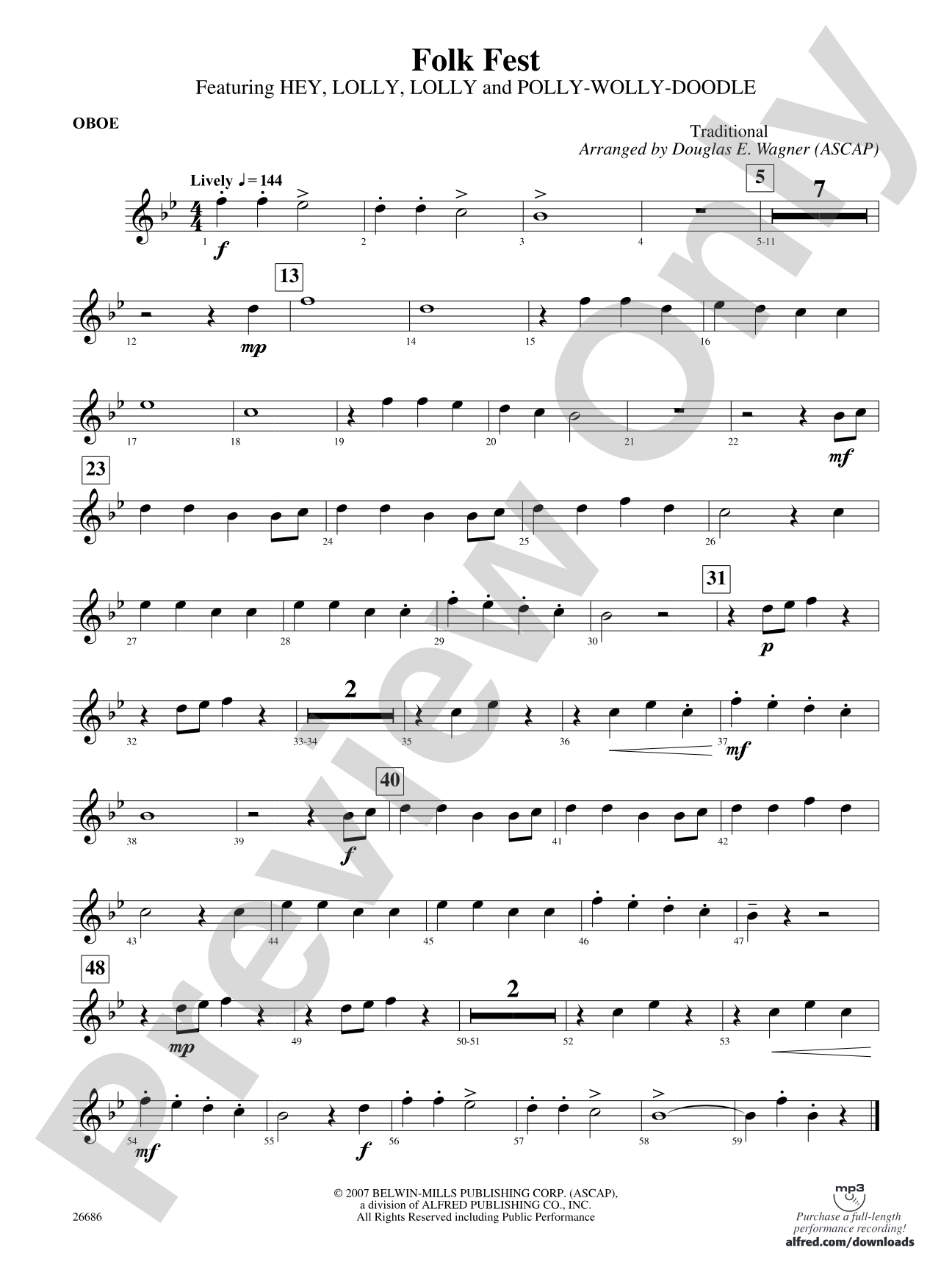
Folk Fest: Oboe

Traditional / arr. Douglas E. Wagner

Grade: 0.5 (Very Easy)

Item: 00-PC-0001169_O1

Digital Download
$3.00
Description
Combining two classics, Douglas E. Wagner has crafted this charming duo for performers with less than a year of instruction. This setting will make your band sound big and polished while using primarily five and occasionally six notes to perform Hey, Lolly, Lolly and Polly-Wolly-Doodle. Rich and full with a brief counterpunctual statement, this one is a winner. This title is available in MakeMusic Cloud.

Don't just read it, hear it, play along with it, and watch your students grow with it. In MakeMusic Cloud, Folk Fest: Oboe comes alive with professional accompaniment, adjustable tempo, and built-in practice tools that turn solo practice into real progress.

Sample Audio
0:00
0:00
Sample Video
Additional Details
Series: Belwin Very Beginning Band
Publisher: Alfred Music
Page Count: 68
SKU: 00-PC-0001169_O1

More about this title

About the Arranger: Douglas E. Wagner

Douglas E. Wagner

Douglas E. Wagner studied music at Butler University, earning both undergraduate and graduate degrees before spending three decades as a high school music director and administrator. Since 1973, he has published more than 3,500 compositions and arrangements across virtually every ensemble type: concert band, choir, orchestra, handbell ensemble, organ, piano, and voice.

His output has reached global audiences through concert performances, broadcast performances on radio and television, and recordings distributed across North America and internationally. More than seventeen million copies of his music have been purchased by music educators and performers. Wagner now lives in Indianapolis, Indiana, where he concentrates fully on composition and arranging.

Why we love this

Wagner strips these folk melodies down to their essence without ever letting them sound thin or undernourished. The brief counterpoint and full voicing techniques make beginning bands sound genuinely polished during their first year, which builds both student confidence and audience respect. This is exactly what a very early-level concert band needs: music that teaches without sounding didactic.

What to expect

Bright, unpretentious, and genuinely charming. These folk melodies carry a folk-song warmth that feels immediate and accessible to audiences, yet the arrangement's careful voicing and brief counterpoint add sophistication that keeps the piece engaging for the performers themselves. There's real music-making happening here, not just note-reading.

Who it's for

This arrangement is designed for concert bands in their first year or performing at the Grade 0.5 level. Conductors building very new ensembles will find two instantly recognizable melodies that audiences enjoy while students stay within comfortable technical range. Ensure your ensemble has secure command of basic technique and rhythmic stability before beginning.

How to get the most out of it

  • Establish the swing feel early in rehearsal with careful attention to rhythmic clarity; even with five-note ranges, articulation separates competent performances from forgettable ones.
  • Balance the melody line between sections so that the folk tune remains the clear focal point while accompaniment parts support without overwhelming.
  • Use the brief counterpoint section as a teaching moment for independence; assign players to sustain their parts while others carry the tune above them.
  • Shape the dynamics across both melodies so the arc of the arrangement builds naturally rather than staying flat throughout.

How to use it

Program this early in your season or at family/community concerts where repertoire designed for very beginning ensembles is expected and valued. It works beautifully as a confidence-builder at the start of your year or as a lighter moment on a concert that includes more substantial works. Consider pairing it with another folk-inspired piece to create a thematic segment.

Skills your students will build

  • Reading and performing with limited note ranges (five to six pitches)
  • Playing independent harmonic lines with basic accompaniment figures
  • Sustaining long tones to support moving melodic lines
  • Responding to conductor cues for dynamic shaping and phrasing
  • Maintaining rhythmic precision in simple meters

You May Also Like