
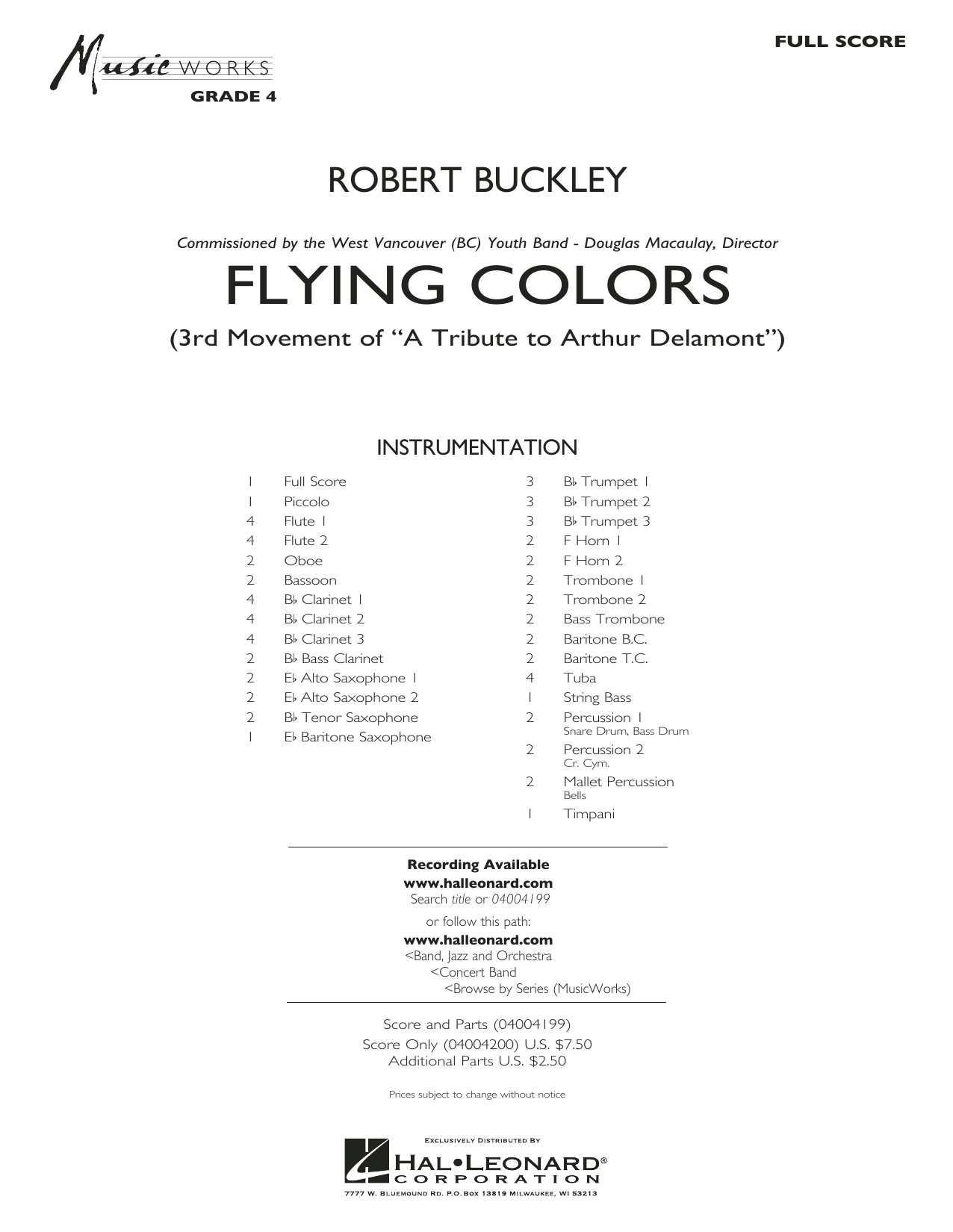

Flying Colors: Concert Band Conductor Score & Parts
By Robert Buckley
Grade: 4
Item: 35-PK00306706
$75.00
Pickup currently not available
Buy Extra Parts (Digital PDF Download)
Parts Added to Cart!
Description
Imagine a band far off in the distance marching toward you soft at first, the music becomes louder and louder; the red capes of the band sway in the wind, getting closer and closer. It was this image that inspired "Flying Colors". Famed bandmaster Arthur Delamont always programmed a march in his concerts, and the hallmark of his band was their red capes. The work begins very softly with a distant snare drum beat. The trumpets enter quietly with the melody, and with each new melodic entry the music grows and intensifies to a roaring finish. This is a fresh new take on a march, and is sure to please players and audiences alike! "Flying Colors" is the third movement of "A Tribute to Arthur Delamont" and was commissioned by the West Vancouver Youth Band. Dur: 3:10


Flying Colors: Concert Band Conductor Score & Parts isn't in MakeMusic Cloud just yet...but it could be. Let us know you'd like to see it, and you'll help shape what comes next. In the meantime, start a free trial and dive into thousands of interactive titles your students can play along with today.
Request This Title
Tell us you want it.
Start Your Free Trial
Explore everything that's ready to play right now.
Sample Audio
No sample audio found.
Sample Video
No sample videos found.
Additional Details
Publisher:
Hal Leonard
SKU:
35-PK00306706
More about this title
Why we love this
Robert Buckley captures something genuinely theatrical here: the march form stripped of predictability and rebuilt as a study in dynamic control and ensemble cohesion. The compositional restraint in the opening pays real dividends when that roaring finish arrives, and your students will feel the difference between playing loud and building earned intensity.
What to expect
Anticipation builds with each passing moment. What begins as a whisper in the distance becomes a vivid, colorful procession moving steadily toward you, each new voice adding brilliance until the final arrival feels inevitable and satisfying. There's pageantry here, but earned through restraint rather than bombast.
Who it's for
Concert bands working at the Grade 4 level who want repertoire with genuine musical substance and a clear dramatic arc. This works equally well for students discovering how compositional craft creates impact and for directors seeking a crowd pleasing closer that doesn't sacrifice musicianship.
How to get the most out of it
- Start the opening snare drum passage with clarity and absolute stillness in the ensemble; the silence around that distant beat is as important as the beat itself.
- Resist the temptation to accelerate as the music grows. The intensification comes from layered entries and dynamic rise, not from rushing the pulse.
- Balance the trumpet melody carefully in the quiet sections so it projects without forcing; this melody carries the entire narrative arc.
- Treat the final section like a physical approach rather than a sudden eruption. Let the accumulated momentum of each new entrance build the energy naturally.
How to use it
This lands beautifully as a concert finale, particularly when preceded by quieter or more introspective work; the contrast makes the approach and arrival even more striking. It also pairs well on a program with other contemporary takes on traditional forms, showcasing how modern composers refresh familiar genres.
Skills your students will build
- Dynamic control across an extended crescendo without rushing
- Entrance coordination as a compositional device
- Balance between independent melodic lines and ensemble blend
- Sustaining ensemble focus during moments of minimal activity
- Interpreting program music and visual imagery through sound