
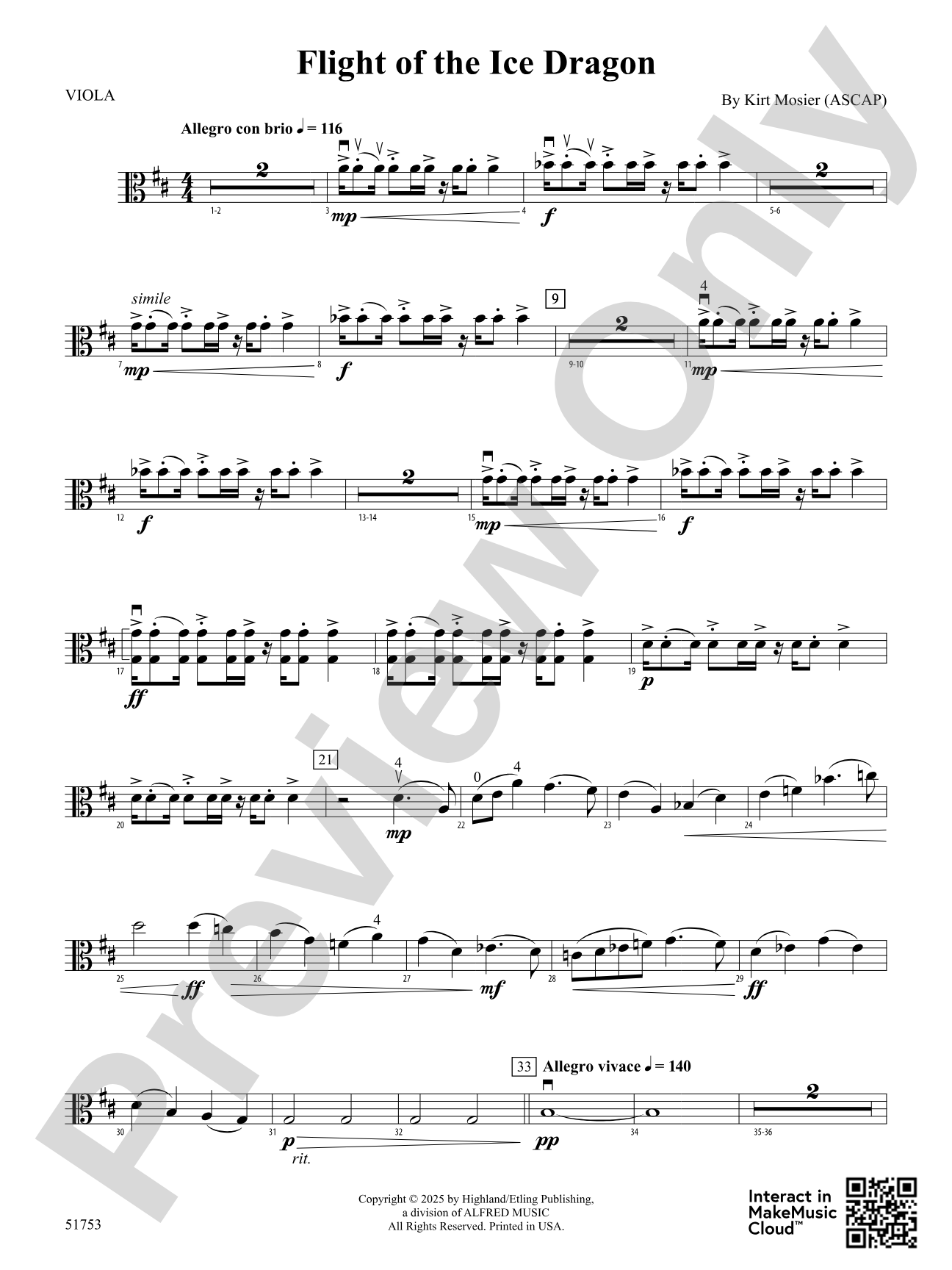

Flight of the Ice Dragon: Viola
By Kirt Mosier
Grade: 4
Item: 00-PC-0019575_VA1
$3.00
Pickup currently not available
Description
The Flight of the Ice Dragon, by Kirt Mosier, is an exciting piece that follows the odyssey of the mythical ice dragon's flight over frozen tundra; soaring over mountain peaks and resting in snow covered valleys. The beauty of the ice dragon's flight is captured in this musical landscape. Challenging, but well worth the effort! (3:55)


Don't just read it, hear it, play along with it, and watch your students grow with it. In MakeMusic Cloud, Flight of the Ice Dragon: Viola comes alive with professional accompaniment, adjustable tempo, and built-in practice tools that turn solo practice into real progress.
Open in the Player
Jump straight in and assign it today.
Start Your Free Trial
Open this title and explore the full library in minutes.
Sample Audio
1
Audio File
--:--
0:00
0:00
Sample Video
Additional Details
Series:
Highland String Orchestra
Publisher:
Alfred Music
SKU:
00-PC-0019575_VA1
More about this title
About the Composer: Kirt Mosier

Kirt Mosier stands out as both conductor and composer, bringing distinctive artistry to orchestras across the globe. His performances have taken him to Carnegie Hall, Vienna's MuTH, the Sydney Opera House, and dozens of international venues. He has earned national recognition twice over, winning composition awards for "Baltic Dance" (1993) and "American Reel" (2004), and was commissioned by Portland Ballet Company to compose an original score for "The Legend of Sleepy Hollow" in 2010. His works appear regularly at the Midwest International Clinic in Chicago, where he also conducts.
Beyond the concert hall, Mosier has shaped music education across multiple roles and contexts. He served as Director of Orchestras in the Raytown and Lee's Summit School Districts in Missouri and taught orchestration at the University of Missouri Kansas City Conservatory. He founded and directed the Digital Media Technology program at Summit Technology Academy, where his students have achieved national recognition and gone on to professional careers in recording and media production. Currently, Mosier serves as artistic director for the Youth Symphony of Kansas City and associate conductor of the Lee's Summit Symphony. He is also an accomplished keynote speaker and motivational presenter for educational institutions and organizations nationwide.
Why we love this
Mosier crafts a programmatic narrative that young orchestras can actually execute at Grade 4 level without sacrificing musical substance. The piece balances technical challenge with accessible ranges and clear orchestral roles, so students feel the drama of a mythical journey without getting lost in overly complex passage work. Contest festivals consistently program this because it engages audiences immediately and gives adjudicators something genuinely musical to hear and reward.
What to expect
A sweeping, cinematic journey across a frozen world. The music soars with the exhilaration of flight, dips into quiet moments of rest in snow-covered valleys, and builds with the majesty of mountain peaks. There's energy and adventure here, but also moments of stillness and beauty that let the ensemble settle into sustained, singing lines.
Who it's for
String orchestras at Grade 4 level (typically middle school through early high school) looking for a concert or contest piece that carries real narrative weight without requiring advanced technique. Directors want something that sounds impressive to audiences and judges while remaining achievable in a school rehearsal setting.
How to get the most out of it
- Shape the dynamic arc across the entire 3:55 duration to mirror the ice dragon's journey. Treat each section (flight, peaks, valleys) as a distinct phrase with its own arrival point rather than playing in isolated climbs and falls.
- Balance the first violins' soaring material against the lower strings' foundation; young players often double the melody too forcefully and obscure the harmonic support underneath.
- Establish clear visual cues for the ensemble's transitions between the landscape sections. This piece's programmatic journey requires secure ensemble awareness, so precise conducting gestures help players track where they are in the narrative.
- Allow some breath room in the slower valley passages. Younger orchestras tend to rush when the energy drops, and these moments are essential for the frozen landscape imagery to register with listeners.
How to use it
Program this as a concert opener or centerpiece to establish an adventurous tone for the evening. Its programmatic character and moderate difficulty make it an excellent choice for a festival or competition where you want to showcase the ensemble's musicality and range. It also pairs well alongside other contemporary string pieces in a thematic program exploring nature or mythology.
Skills your students will build
- Shaping dynamic arcs across longer phrases and full sections
- Balancing multiple melodic lines while maintaining ensemble cohesion
- Executing sustained tones with consistent intonation
- Responding to programmatic intent through musical choices
- Managing tempo and phrasing in contrasting textures (soaring vs. sustained vs. rhythmic)